









Brought to you by BULLS N’ BEARS
Murray Ward
Locksley Resources has confirmed high-grade neodymium and praseodymium-enriched rare earths mineralisation at its El Campo prospect in America.
The company also successfully extended the rich antimony trends at the nearby Desert Antimony Mine (DAM), which lies within its broader Mojave project in California.
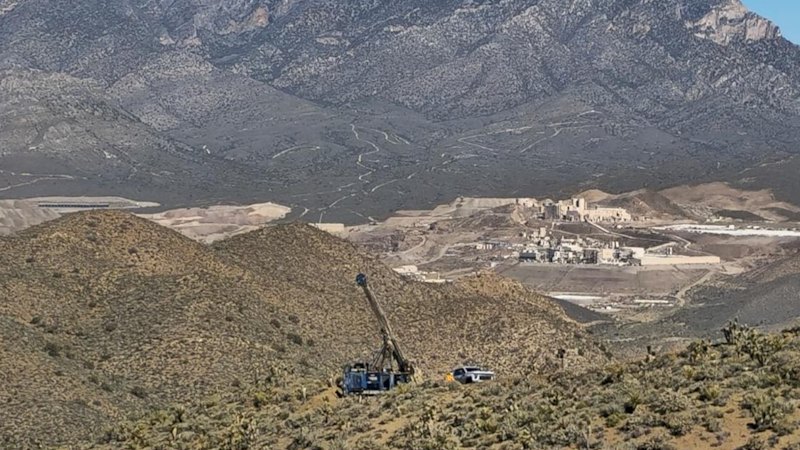
The recent maiden diamond drilling program at El Campo successfully verified that this light rare earth system appears to mirror the style of the prominent Mountain Pass carbonatite system. These types of geological structures host much of the world’s rare earths.
The premier drilling intersection from the program jagged a broad 7.20 metres grading 2.93 per cent total rare earth oxides (TREO) from 35.40m.
‘We are evaluating the REE opportunity in the context of our evolving understanding of the Mountain Pass-style magmatic system at El Campo.’
Locksley Resources non executive technical director Ian Stockton
This hit featured a higher-grade 3.75-metre slice grading 4.45 per cent TREO from 37m, with a peak internal of 0.70m grading 6.03 per cent TREO from 40.05m.
A second hole also hit the system, returning 0.90m at 1.09 per TREO from 107.30m. According to management, the drilling has confirmed rare earths mineralisation extends well below surface and remains open along strike and at depth within the corridor.
Notably, the assays also show neodymium and praseodymium make up roughly 25 per cent of the TREO in the key drill intercepts. That matters because neodymium and praseodymium magnet rare earth oxides are highly critical for permanent magnets, defence technologies, robotics and advanced manufacturing.
Locksley says the results support the interpretation of a potentially larger primary carbonatite system sitting at depth across the permits.
El Campo strategically sits just 5.5 kilometres southeast of MP Materials’ massive Mountain Pass mine – the only operating and producing rare earths mine in the United States.
Additionally, the company received the last assays from the final two holes of an eight-hole maiden diamond drilling program at DAM, successfully confirming the continuity of high-grade stibnite – the host rock for antimony – along strike to the south and below historical underground workings.
One hole successfully pierced subvertical quartz-stibnite veins within the granite gneiss to return a top hit of 0.30m, showcasing an impressive 6.44 per cent antimony from 65.3m, including a section of 0.30m grading 2.90 per cent antimony from 50.70m.
Locksley Resources non- executive technical director Ian Stockton said:“Diamond drilling at the El Campo prospect represents the first test of the depth extensions of known REE mineralisation exposed at surface. Diamond drilling at DAM represents the first test of antimony mineralisation beneath the historical workings.”
Management says both sets of drill results support the company’s broader United States critical minerals exploration strategy.
Beyond the immediate drilling zones at El Campo and DAM, Locksley’s wider Mojave project area spans a highly prospective 40 square kilometres.
Ongoing regional target generation is underway, using an enhanced thorium radiometric process to seek out priority targets of interest across the tenements.
Locksley’s immediate next steps will focus on updating its 3D geological models for both prospects to help with future step-out drill targeting.
Additionally, the company plans to combine its detailed magnetic and gravity datasets with a high-resolution ground scintillometer survey across El Campo, aiming to improve its understanding of the project’s structural controls and pinpoint the most promising drill targets for the next round of exploration. Metallurgical and mineralogical assessments on representative mineralised core samples are also scheduled.
Elsewhere, Locksley’s other assets include Tottenham and the newly optioned Iron Duke copper-gold projects in New South Wales. The flagship Tottenham asset hosts an inferred mineral resource of 9.86 million tonnes grading 0.72 per cent copper.
The company says it will shortly launch a maiden 2000-metre drilling campaign at Iron Duke to test extensive historical mineralisation across the freshly secured 188.3 square kilometres of prospective tenure.
With the United States heavily prioritising secure domestic supply chains for both rare earths and antimony to achieve critical minerals independence, Locksley appears to be in the right place at the right time.
The market should expect a steady stream of regional-targeting news as the company continues to peel back the layers of these multi-commodity systems at Mojave.
Is your ASX-listed company doing something interesting? Contact: mattbirney@bullsnbears.com.au


