









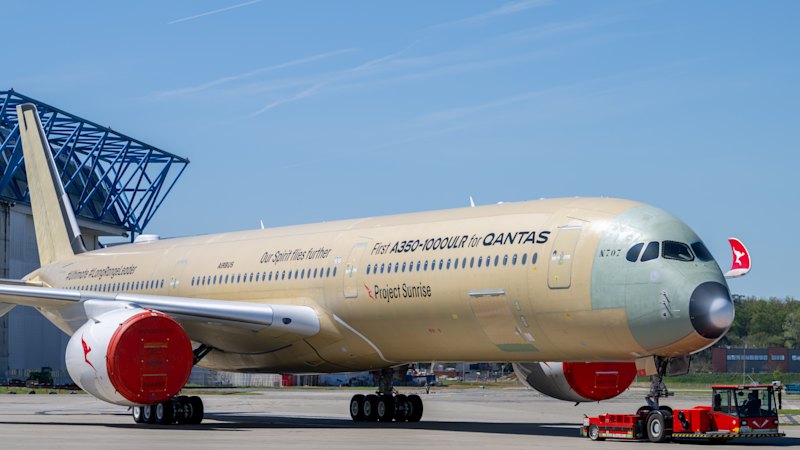


Qantas’ much-anticipated Airbus plane, made for ultra-long flights and known as Project Sunrise, has exited the factory in France and will begin test flights, the company said.
The specially configured Airbus A350-1000ULR, designed to be able to reach almost any point on the globe in a non-stop flight, will allow Qantas to plan routes to Europe without transiting the Middle East.
The plane now has all components attached, including fuselage, wings, tail, landing gear and Rolls-Royce Trent XWB engines. It will begin a two-month flight-testing programme in Toulouse, France, in the weeks ahead.
Qantas’ Project Sunrise is an ambitious plan to fly ultra-long-haul routes to and from Australia. Airbus has made this special version of its A350 to fly for 22 hours at a stretch, helped by an extra 20,000-litre rear centre fuel tank.
The range of the plane will unlock new flight possibilities for the airline, in a development keenly watched by the industry.
Qantas CEO Vanessa Hudson last year told reporters that, depending on wind patterns, sometimes, “the fastest way to get from Sydney to London will be over Japan and over the North Pole and down the other side”.
The first aircraft is emblazoned with the words “Our Spirit flies further”. Under the plan laid out by the airline, the planes will be configured with 238 seats, giving passengers more space, instead of the 350-plus seats an A350 could accommodate.
Fewer passengers in more spacious settings will allow Qantas to charge a premium for tickets and save on weight, so the plane can then accommodate a heavier fuel load.
Qantas also said it plans to name 12 Airbus fleet of planes after stars, in honour of Qantas’ World War II-era Catalina flying boats, which operated the legendary Double Sunrise flights. Those planes, which traversed the Indian Ocean during the global conflict in the early 1940s, were each named after a star used for navigation.
The star theme was suggested by Qantas pilots and then voted on by Qantas employees, and the first name will be revealed mid-year.
Project Sunrise, if successful, will create a new type of flight for the industry, allowing Qantas to bypass hubs in favour of direct paths to destinations.
The cabins will include Wellbeing Zones, premium self-serve refreshments, and areas made for passengers to stretch.
The cabins are designed by David Caon, the mind behind Qantas’ understated A380 and 787 interiors, as well as Qantas lounges in Singapore, Hong Kong and Auckland.
From the start, critics have asked which segment of the market would be willing to pay more for longer, uninterrupted flights.
With airspace closures and conflicts in Ukraine, the Middle East and around the Persian Gulf forcing airlines – including Qantas – to reroute trips, the business case for ultra-long-haul flights has strengthened.
University of Sydney business professor Rico Merkert said that for Australians travelling to and from Europe, “not having to stop over in the Mideast is a massive bonus now”.
“Yes, the higher fuel costs are a problem, but the market would be happy to pay that premium.”
The market segment most interested Project Sunrise will be corporate or business travellers and first-class passengers, Merkert said.
“They have a high willingness to pay and value time more than the average leisure traveller.”
The first Project Sunrise flights are expected to fly from Sydney to London and Sydney to New York in the first half of 2027.
While the flights will simplify the travel experience for passengers, more contested airspace near war zones adds to the appeal of ultra-long-distance point-to-point flying.
Dr Oleksandra Molloy, a lecturer in aviation at the University of NSW in Canberra, said the planned service will reduce “exposure to geopolitical disruption in an increasingly fragmented and unpredictable global airspace environment”.
The non-stop operations “remove exposure to on-ground threats, including airport closures or security incidents”.
“It enables [Qantas] to proactively avoid emerging risks,” she said, while relying less on hubs, and allowing aircraft to “optimise routing in real time” and to “bypass contested or constrained airspace activity”.
Project Sunrise will build on Qantas’ existing long-haul experience, which includes flights such as Melbourne to Dallas Fort Worth or Perth to Paris.
The flight testing will check the aircraft’s systems, performance and certification for the A-350 ULR-specific modifications, including the additional 20,000-litre rear centre fuel tank that will make 22-hour Project Sunrise non-stop flights possible.
Start the day with a summary of the day’s most important and interesting stories, analysis and insights. Sign up for our Morning Edition newsletter.


