


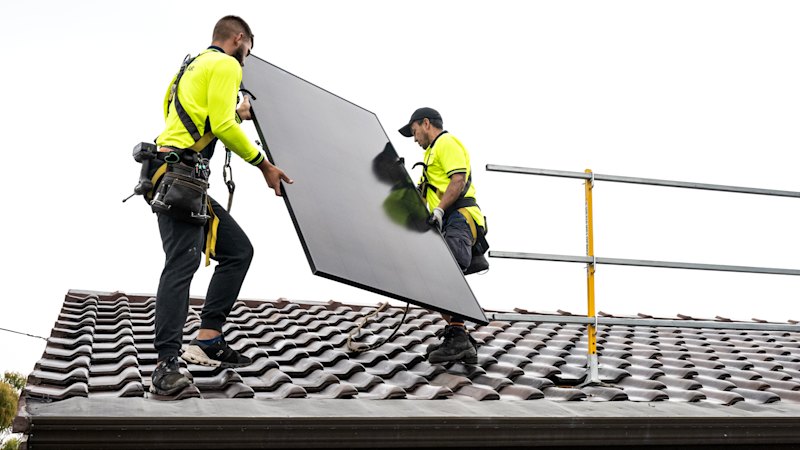

Australia’s ambitious household battery rollout is being threatened by a proposal to raise the cost of connecting to the electricity network, say energy experts who warn recommendations of the energy regulator could leave household solar and battery owners several thousand dollars worse off.
The Australian Energy Market Commission is pressing ahead with a proposal to change the way electricity companies recoup costs of maintaining the poles and wires network, which comprise about 50 per cent of average household power bills.
It is scrambling to find ways to pay for the grid upkeep as the surging uptake in solar power – 4.3 million solar-powered homes and 500,000 residential batteries – dramatically cuts household electricity use.
Payments for network upkeep are expected to shrink under the current system of variable charges, which are levied on the amount of electricity used from the grid.
Electricity costs paid by households are largely made up of two parts: the cost per hour of electricity used and a network charge for maintaining the grid that provides power to homes.
The commission has recommended that the centrepiece of its changes would be a shift to a higher, fixed network charge, which would create “more equitable sharing” of grid upkeep costs.
Experts say adopting fixed charges could lower costs for wealthy, large families who are among the biggest energy users, who may benefit by as much as $1400 a year. But it could also leave low-income households $200 a year worse off, and those with solar panels and batteries $700 out of pocket.
Energy Minister Chris Bowen has said rapid uptake of batteries is essential to creating a grid powered by clean energy. His Cheaper Home Batteries program cuts about 30 per cent off the cost of installing a battery.
He appeared sceptical of the commission’s recommendations.
“We’ve been clear to the industry and regulators: Reforms must deliver cheaper bills, better reliability and the modern grid and services we all deserve,” Bowen said.
“This is a contentious and complex area, requiring careful and considered reform to balance the interests of those who’ve invested in solar and batteries, and those who haven’t.”
Green Energy Markets advisory director Tristan Edis said higher, fixed network charges would increase the electricity costs for a household with rooftop solar and a 20-kilowatt-hour battery, over its 15-year lifetime, by about $6000 in Melbourne and about $8500 in Sydney.
“This completely erodes the value of the government’s battery rebate of $4500 and so could cripple what has been a very successful program,” Edis said, adding that the popularity of Bowen’s home battery program had delivered globally significant results.
Australian household installations for March were equivalent to 9 per cent of the global battery capacity installed by power companies and almost half of what Europe delivered.
The commission’s proposal included an example that said an average battery owner would receive $3312 less in energy savings over 10 years under higher, fixed network charges, compared with the current rules.
Commission chair Anna Collyer said the proposed change would also seek to reduce network upkeep costs by allowing electricity networks to impose “dynamic” network charges that incorporate grid location and peak usage time into the cost. It claimed this change could cut $6 billion in costs over five years.
It would also implement consumer protections, which were not yet finalised, to ensure low-income households and battery investors were not worse off, Collyer said.
“By putting in place these important protections, we can ensure that these cost structures don’t simply flow through to customers. That’s why we’re considering both at the same time.”
Collyer said the commission had received significant criticism from an earlier round of consultation, including from battery owners who argued they should not be disadvantaged for participating in state and federal government schemes that encouraged them to cut their reliance on the grid.
“We don’t want people to feel that they were encouraged to invest their hard-earned money and then find that their investment is not of the same value that they were anticipating,” Collyer said.
The commission’s recommendations included modelling that said an average two-person household with solar panels and batteries could save up to $600 a year by 2040, if the dynamic charges and consumer protections were put in place.
Without commenting on the details of the commission’s recommendations, Grattan Institute senior fellow Tony Wood said it was a sound principle to ensure all those connected to the network paid a fair share of its upkeep, regardless of how much electricity they used.
“If you rely on your own water supply, and just use your own tanks, you still pay for the fact that there is a connection to your property whether you use it or not,” Wood said.
“If you’ve got an electric car, you should pay a road-user charge because you are using the road.
“The same thing applies here. If you’re still using the network, you still should be paying.”
 Mike Foley is the climate and energy correspondent for The Age and The Sydney Morning Herald.Connect via email.