



Updated ,first published
The Solomon Islands’ new prime minister says he will review a controversial security agreement struck with China, risking a backlash from Beijing, as Australia and the Pacific nation look to sign a sweeping new treaty by the end of the year.
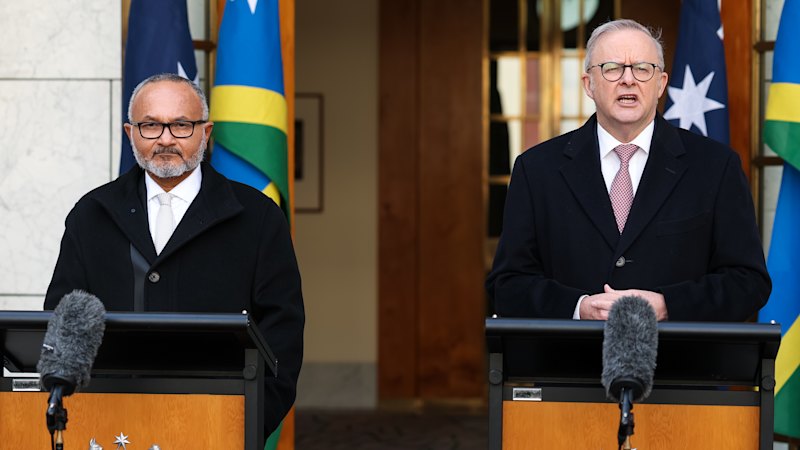
Solomons Prime Minister Matthew Wale said he was seeking a “reset” in the relationship with Australia after a difficult period dominated by the Solomons’ deepening ties with China, including the secretive security deal struck in 2022.
“We acknowledge that there’s been problems over the last few years,” Wale told reporters in Canberra during his first overseas visit since being elected two weeks ago.
Underlining the sensitivity of the deal with Beijing, Wale said he had needed to “remove certain people from key positions” to gain access to the document and had only been able to read it just before leaving for Australia.
“I’ve been praying and fasting about it, but of course you know we have to have a look at these things,” Wale said.
“There is a non-disclosure clause in it, so I couldn’t show it to you right away, but we are going to be reviewing [it] as we are reviewing other security agreements that we have with many other countries.”
Wale promised before the 2024 Solomon Islands election to release the full text of the agreement. During the same campaign, he accused his political opponents of “sleazing up to Beijing, trying to kiss their feet”.
Prime Minister Anthony Albanese and Wale confirmed reporting in this masthead that they would seek to strike a comprehensive new treaty agreement to upgrade the bilateral relationship.
Australia has previously sought to use such agreements to limit Pacific nations’ ability to partner with China on critical infrastructure projects such as ports and airports in exchange for financial support and expanded access to visas in Australia.
“We have said very clearly: we want Australia to be the security partner of choice in our region, and we want the Pacific family to look after our security in this region,” Albanese said.
Senior Solomons sources, speaking on condition of anonymity, said they were hoping to strike a treaty agreement by the end of the year.
In a statement issued after the meeting, Albanese said he “acknowledged Prime Minister Wale’s wish to bring about transformational change in the relationship, cemented in a treaty, and significant enhancement of the bilateral development assistance partnership between the two countries”.
“Both leaders agreed to commence negotiations towards a comprehensive treaty to capture the two countries’ joint ambition for the relationship,” the leaders’ statement said, and they wanted it to be “concluded as expeditiously as possible”.
In the joint statement, Wale backed the view that “Pacific peace and security is best led and handled by the Pacific” in a rhetorical win for Australia in its battle for influence with China.
Opposition defence spokesman James Paterson welcomed the visit as “a real opportunity for Australia to reset our relationship with the Solomon Islands”.
“They are a critical partner, they are part of our Pacific family and we wish the government all the best on this,” he said.
Lowy Institute research fellow Connor Graham said the launch of negotiations on a new treaty was a “great sign for Canberra that the relationship reset is under way”.
“However, a step towards Canberra isn’t necessarily a step away from Beijing,” he said, adding he doubted Wale would tear up the security pact with Beijing.
The leaders announced they would double the number of Pacific Engagement visas to be offered to the Solomon Islands to 300 for the next year of the program, to allow more Solomon Islanders to live and work in Australia.
Cut through the noise of federal politics with news, views and expert analysis. Subscribers can sign up to our weekly Inside Politics newsletter.
 Matthew Knott is the foreign affairs and national security correspondent for The Sydney Morning Herald and The Age.Connect via X, Facebook or email.