


Opinion

The fire at Geelong’s oil refinery flared like a distress beacon for Australia’s ability to function in the new reality of an open-ended global disarray.
In a country that imports 80 to 90 per cent of its refined liquid fuels, the 72-year-old Geelong plant supplies half of the rest. It’s been kept going only by a government subsidy.
If the head of the refinery’s owner, Viva Energy’s Scott Wyatt, is right, the fire will not be consequential for either price or supply of fuel. It’ll be a momentary scare, if so.
But the event reminds us that Australia is structured for a smoothly functioning clockwork system in a world that is now haywire. The prime minister himself had to go shopping in Asian capitals to buy fuel and fertiliser like an overpaid buying agent.
He can’t do this every time there is a global disruption. Because it’s a permanent condition.
Former World Trade Organisation chief Pascal Lamy said the global system of “just in time” supply lines had been replaced by “just in case”. In other words, as he said: “It’s all about resilience now.” That was six years ago. We’ve been slow to absorb the lesson.
The global pandemic of 2020-22 won’t be the last one we confront; the economic punishment imposed on Australia by Beijing won’t be its last effort to coerce us; Donald Trump’s war on Iran won’t be the last lethal thunderbolt he throws; Hormuz won’t be the last vital commercial artery to be closed. And the climate will keep changing regardless of how many other crises we must manage.
No country can be entirely self-sufficient. The closest is North Korea with its ruinous “Juche” policy of autarky. Mind you, even Kim Jong-un has to import a couple of absolutely essential national needs – cognac for himself and nuclear weapon technology for his regime.
But every responsible country needs to provide its people with continuity of essentials. Albanese on Friday touched on how his government will address resilience in the budget due in four weeks.
“We have very much a Future Made In Australia agenda that’s about making sure that our economy is more resilient,” he said. “And one of the themes of the budget on May 12 will be resilience; resilience in two forms. One, making more things here in Australia, leaving us less vulnerable to international events. But secondly as well, how do we give Australians a stake in our economy? And that is an important component of that as well.” He gave no detail.
Australia is on the cusp of an outbreak of political populism. If the main parties can’t address the root causes of this in the next two years, Australia is likely to suffer a convulsive self-sabotage by electing One Nation to a decisive position in the federal parliament.
“Populism”, in my preferred definition, is a style of politics that proposes unworkably simplistic solutions to complex problems. It scorns expertise.
More specifically, right-wing populism adds an extra element – scapegoating an “out group”. In Pauline Hanson’s case, the out group changes with the seasons. First Asian, then Indigenous, now Muslim people.
Who knows, maybe one day it’ll be all three? Or more. But she must always have at least one minority of Australians to be blamed, hated, and punished by the majority of Australians. As Trump shows, this approach solves few problems and creates many more.
If Australia is to avert this possible future, the major parties need to restore hope. And that requires offering workable solutions to real problems. Albanese’s two budget themes are prerequisites for achieving this.
Economic resilience: at the very least, a country in a fuel supply crisis needs to be shown a pathway to more reliable energy, beyond daily crisis management. Social resilience: at the very least, younger generations need to be shown a pathway to home ownership.
But many more problems need to be addressed as well. This week, the government and the opposition attempted to address some fundamentals of sovereignty. Labor had a crack at defence and the Coalition at immigration.
Labor’s announcements reveal a government that is getting more serious about national defence. Defence Minister Richard Marles promised increased funding, better capability and more self-reliance. It’s plain that Trump’s America can’t be expected to defend any of its traditional allies while Xi Jinping’s China continues to work towards dominance.
It’s hard to fathom that, just a year ago, Australia had no capacity to make missiles. Now there’s a factory in South Australia that is, at least, assembling some. An actual manufacturing plant is set to start producing missiles in Newcastle next year. The government is planning a third facility to make sophisticated hypersonic missiles in a few years.
It’s hard to fathom that, just a year ago, Australia made no military drones of its own. Now the first Ghost Bat drones, designed and made in Australia, are being operated by the air force and the first Ghost Shark drones, designed and made in Australia, are being operated by the navy. Marles describes these large drones as world-leading and tailored to Australian needs.
It’s also hard to fathom that Australia still has no land-based missiles capable of defending against hostile missiles or aircraft. A program to deploy some is to begin this year.
The doyen of Australian military strategy, Paul Dibb of the Australian National University, tells me that, in his opinion, “this government is taking defence more seriously than any government since Kim Beazley’s time” as defence minister in the Hawke government. And that was long ago, 1984 to 1990. It was the Hawke government that commissioned the Collins-class submarines, the last ones Australia actually received.
Heartening as this may be, it’s not enough to benchmark Australian defence today against Australian defence yesterday. We need to benchmark it against the country that Australia is worried about.
The Albanese government generally is reluctant to name it out loud, but Marles spelt out the basics. That Beijing has the world’s biggest nuclear weapons proliferation under way. That the Chinese Communist Party is conducting the biggest conventional military build-up since World War II, and without explaining why.
That China’s military is “enforcing contested territorial and maritime claims in the South and East China seas and has not accepted the binding legal decision of the relevant international tribunal. China has now resumed large-scale land reclamation for new military facilities at Antelope Reef,” an atoll also claimed by Vietnam and Taiwan.
Marles also said the People’s Liberation Army Navy was pushing ever further in deployments and that “PLA deployments close to Australia have grown in frequency and capability over the last two years, a trend that will continue”.
And while Australia’s chattering classes still debate whether we should buy and build nuclear-powered submarines, they never pay heed to what Beijing is doing. The International Institute for Strategic Studies reports that in the past five years, China’s shipyards have been producing two nuclear-powered submarines every year. Beijing made 10 subs while the US made seven. Although, the institute notes, China’s were “almost certainly” of lesser quality. The AUKUS program is proceeding.
For the record, Australia’s defence planners don’t anticipate a Chinese invasion of the mainland, and they never have. They do worry about potential interruptions of Australia’s shipping lifelines to the world. So an honest assessment of the overall Australian defence effort is that it’s more serious than it was, yet not as serious as it needs to be.
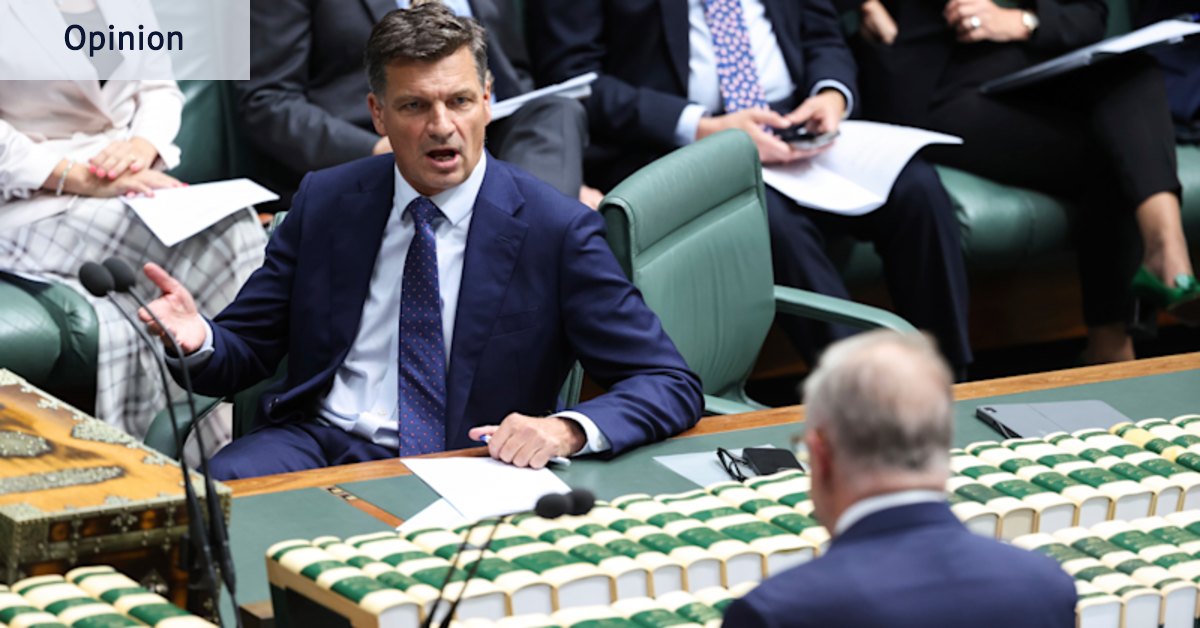
And that leaves the Coalition’s effort at an immigration policy. Opposition Leader Angus Taylor called it part one of his “Australian values migration plan”. It comes amid a cut to the intake of about 40 per cent since numbers peaked in 2022-23.
Taylor offered a few positive ideas. But he wasn’t so much announcing a plan as striking a pose. The positive ideas first. He told Sky News that the immigration intake should be in line with housing supply.
This is common sense and should be adopted. To now, one of the federation’s great disconnects is that Canberra decides the annual immigration intake, but it falls to the states to supply hospitals, schools, transport and housing to match. Better co-ordination would help everyone. He also proposed higher levels of English requirement and more emphasis on Australian values. Again, sensible stuff if Australia wants to restore confidence in immigration.
Paul Keating attacked Taylor’s speech as “racist”. That’s a misnomer. It was actually sectarian. Judge for yourself. Taylor talked about “migrants of subversive intent” then said: “Consider what we’ve seen in recent years: the Bondi Beach terrorist attack. Radical Islamic preachers espousing hate with impunity. Genocidal marches in major cities. Antisemitism across Australian communities.” This is unsubtle Muslim-baiting. Gratuitous and grubby.
Australia needs its main parties to develop nation-building plans to solve real problems in an age of global disorder. While the government was trying to build the nation, the Coalition was posing as One Nation. While Albanese was trying to be a bit more serious, Taylor’s performance was sad.
Peter Hartcher is political and international editor. He writes a world column on Tuesday.
Get a weekly wrap of views that will challenge, champion and inform your own. Sign up for our Opinion newsletter.
 Peter Hartcher is political editor and international editor of The Sydney Morning Herald and The Age.Connect via email.