


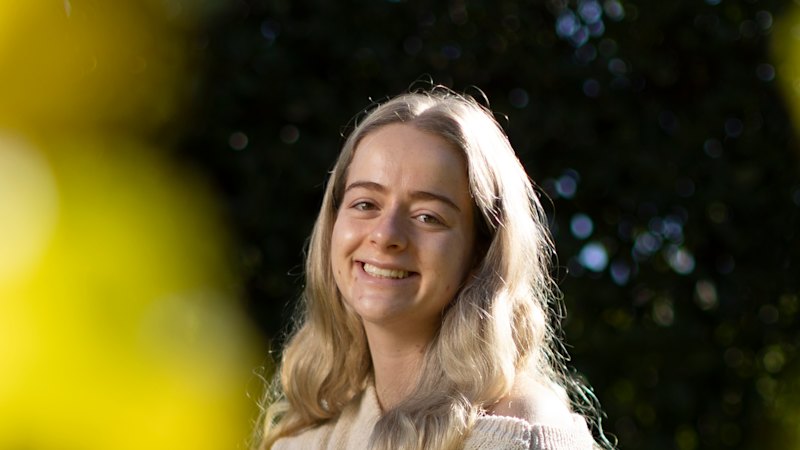

Missing days of school and work for period pain that rendered her bedridden was a monthly occurrence for Zoe Kapolos, who was diagnosed with endometriosis at 19 years of age.
She was plagued by anxiety when she had to take days off work every month to manage her pain.
“My first few jobs, I had to call in sick once or twice a month just because I couldn’t stand up because of the pain and the sickness and the dizziness, unfortunately, that comes with [my] endometriosis,” she said.
Now a newly graduated nurse at a women’s hospital in Victoria, Kapolos sees patients facing the same pressure to repeatedly prove their chronic pain to their employers.
Now 21, she is petitioning the federal government for specific “menstrual leave” for people with endometriosis and adenomyosis to be enshrined in Australian law.
“It breaks my heart … so many people [are] anxious about medical certificates, about their employers thinking that they’re always taking sick leave.”
The Australian Institute of Health and Welfare estimates one in seven Australian women has endometriosis, and one in five has adenomyosis.
The diseases, neither of which has a cure, are caused by rogue endometrial tissue: endometriosis occurs when tissue grows outside the uterus, while adenomyosis occurs when tissue grows into the uterine muscular wall.
Sufferers can experience debilitating pain and fatigue, preventing them from attending work or hindering their productivity if they try to work through the symptoms.
Kapolos’ petition amassed close to 30,000 signatures in four weeks before it closed last Wednesday. Health Minister Mark Butler has 90 days to respond to the proposal.
Variations of menstrual leave exist now in Spain, Japan, Taiwan and South Korea.
In 2024, Queensland passed legislation granting public sector workers entitlement to 10 days of paid, non-cumulative reproductive health leave annually for conditions including menstruation, menopause, endometriosis and IVF.
Kapolos’ petition is not the only pitch for a national entitlement to some sort of menstrual leave. In March, the Australian Council of Trade Unions submitted a proposal to the federal parliamentary inquiry into the National Employment Standards (NES) calling for 10 days’ reproductive leave for all Australian workers.
The NES guarantees personal and carer’s leave, but does not cover reproductive health. Under the ACTU proposal, all workers, regardless of gender, would gain access to 10 days of paid leave to manage health issues linked to reproduction, including prostate cancer screening, vasectomy recovery, IVF and fertility treatment, miscarriage, menstrual pain, menopause and conditions such as endometriosis.
Critics of menstrual leave say it could increase the likelihood of hiring discrimination, giving employers reason to justify overlooking women for jobs or promotions.
Business lobby groups are also reluctant to back the leave, saying it would come at a hefty cost to employers. But economic models have suggested the opposite.
According to the Australian Institute of Health and Welfare, absenteeism caused by endometriosis alone costs the Australian economy up to $9.7 billion a year, while modelling from the Bankwest Curtin Economics Centre shows employee absences and the impact of working through pain costs the Australian economy $21.3 billion a year.
The economics centre modelling also estimates that, by comparison, employers would absorb only $1.7 billion a year to provide paid reproductive leave.
Sylvia Freedman was 11 when she began to experience excruciating pain. It would take another 10 years for her to receive a formal endometriosis diagnosis.
She founded endometriosis advocacy group EndoActive in 2014 alongside her mother, Lesley, to combat the lack of information they met while trying to find an answer to her pain.
Freedman said no one should have to choose between managing severe pain and protecting their income or career progression.
“What matters most is that workplaces recognise these conditions as legitimate chronic health issues,” she said.
For 37-year-old Sydney woman Tamara Meyer, endometriosis leave would be life-changing. She was diagnosed in February after years of debilitating pain and several practitioners failing to identify the condition.
“I’d be stuck on the toilet, in excruciating pain … It forced me to take a lot of painkillers, too much, to the point that it was becoming a problem, just to be able to function at work,” she said.
Meyer estimates she and her partner have spent more than $20,000 on appointments, scans, surgeries and pain management associated with her endometriosis.
“I’m definitely for a proposal where we can have, honestly, this chronic illness be supported more from a financial standpoint. For women, especially who do go to work, who have kids, this is something that would mean so much for that community of women.”
Start the day with a summary of the day’s most important and interesting stories, analysis and insights. Sign up for our Morning Edition newsletter.
 Emily Kaine is a national news blogger at The Sydney Morning Herald.Connect via email.