


Laid bare
However, new players argue this is a healthy disruption of an industry in need of a shake-up. Award-winning challenger funeral brand Bare started out six years ago, offering cheaper cremations and providing clarity in a sector that it says has long been shrouded in secrecy when it comes to pricing.

Bare co-founders Sam McConkey and Cale Donovan.
It started with no equipment, but as the business grew, it invested in 25 transfer vehicles, hearses and mortuary facilities, with more under construction. It doesn’t own any crematoriums, utilising government-owned facilities in each state.
Founder Sam McConkey says it’s a small cohort of traditional funeral directors who are resistant to the idea of change. But he’s the first to agree that the industry requires better regulation, though he believes the issue of ownership is less important.
“What is important from the customer perspective is transparency, choice and informed decision-making,” he says.
“While regulation of specific infrastructure assets is important, we believe ownership of those assets is less important as it is generally self-serving, allowing traditional players to create a barrier for entry to new competitors who can’t afford to buy infrastructure from day one.”
Anyone can be a funeral director right now and can handle the deceased, and we’re not comfortable with that.
Funerals Australia chief Dale Gilson
Families choosing Bare know upfront that it doesn’t own bricks-and-mortar funeral parlours, with families preferring to arrange a funeral over the phone or on video call, rather than being forced into a traditional funeral parlour to make decisions.
“While we all agree that better – and more nationally standardised – regulation in the funeral industry would benefit families, we’d love to see those regulations extend across more than simply the ownership of physical infrastructure.”
Loading
Bare is far from the only new operator to emerge over the past decade, with other players such as Green Heaven Funerals in Sydney and The Last Hurrah in Melbourne.
A complex web
Death is big business. There were 187,268 registered deaths in 2024, an increase of 4137 on 2023.
However, funerals and cremations are legislated differently in each state and territory and responsibilities are often split between different departments. In Victoria, the Funerals Act 2006 has not been meaningfully updated in nearly two decades.
State health departments handle public health regulations and the processes that govern the handling of deceased bodies, including the handling and transportation of human remains and the practice of preparing the deceased for burial or cremation. NSW outlines clear rules about body transport, but in many other states and territories, there are minimal laws covering the transportation of bodies.
State-managed cemeteries and crematoria organisations govern how crematoriums are established and operated. Victorian cemeteries are operated by trusts, which have to adhere to standards set out by the state government.

There are concerns held across the industry that funeral directors are allowed to operate largely unregulated.Credit: iStock
However, when it comes to funeral directors themselves, there are no licences required, though directors can opt to receive a diploma from various training organisations. In Victoria, providers must register their business with Consumer Affairs.
The National Funeral Directors Association of Australia (NFDA) has more than 230 members, who own a licensed mortuary, a funeral home, a crematorium and a hearse. Some estimate it would cost more than $1 million to set up a funeral parlour in most suburban areas in today’s market – a hearse alone costs $300,000 to purchase new.
Loading
The NFDA says standards and ethics have dropped over the years as operators look for ways to offer cut-price services amid the ongoing cost-of-living crisis. The most cost-effective way of exiting this world is a cremation-only package, which can be found online for as little as $1190, while a burial can cost up to $15,000.
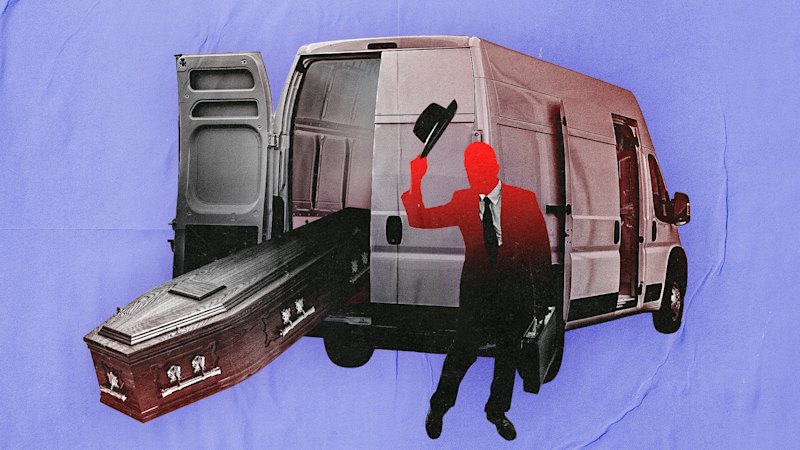
President Michael Mackay acknowledged that the industry is not immune to disruption but raised concerns about claims of bodies being transported across cities in nondescript white vans to access shared crematoriums, all organised entirely remotely.
“We don’t mind new people coming into the industry, but if you do, we should all play under the same set of rules,” he says. “If people realised what was going on, they would be horrified. Their loved one is being transferred all over the city. It’s not the way things should be. If you come to us, everything is done under one roof and the body is here until we do the funeral.”
The NFDA has spent years working with regulators and various government departments to lift standards, and has since raised the alarm out of frustration, warning that regulations don’t go far enough and that a number of complaints have fallen on deaf ears over the years.

Dale Gilson, chief executive of Funerals Australia.
Instead, the organisation is working with Standards Australia to implement a new voluntary industry standard that would require operators own their own mortuary and vehicles. Mackay hopes this will force the government to introduce tighter legislation.
In lieu of regulation keeping pace with technology and the subsequent new ways to deliver funeral services, this is an example of the industry finding ways to self-regulate, says Funerals Australia chief Dale Gilson.
“Anyone can be a funeral director right now and can handle the deceased, and we’re not comfortable with that. We’d like the government to play a bigger part in legislating our industry,” Gilson says.
“This is a largely unregulated industry, and the public would think that there would be licensing, but there isn’t. We believe in standards and regulation.”
Loading
In 2020, the Australian Competition and Consumer Commission said it had begun a crackdown on the funeral industry over unconscionable conduct, with then-chair Rod Sims saying that many customers were being “charged for things they shouldn’t have been”.
In 2021, the watchdog fined WT Howard Funeral Services in Taree and Coventry Funeral Homes in Townsville for proclaiming they were locally owned and operated, when they were both owned by Sydney-based publicly listed company Propel Funeral Partners. Penalties were $12,600 each.
The Business Briefing newsletter delivers major stories, exclusive coverage and expert opinion. Sign up to get it every weekday morning.
