










Switching browsers isn’t like trying a new coffee blend. It’s more like switching banks.
If Altman can even partially realise his vision, there are huge rewards on offer in gaining market share and winning over billions of daily internet users.
Australian software giant Atlassian is making a similar bet, recently buying the start-up behind Silicon Valley’s buzziest AI-powered browser in a deal worth nearly $1 billion.

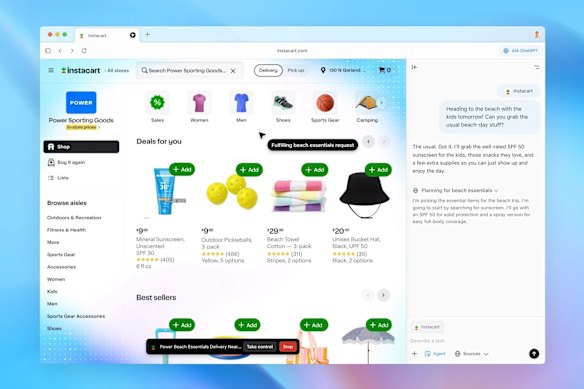
OpenAI’s new AI browser Atlas.
“Browsers were built for the wrong era,” Cannon-Brookes told me at the time. “They were built for people reading news articles or recipes, not for people living eight hours a day in applications like Jira, Salesforce, Gmail or Slack. AI changes that equation – it means the browser can become your memory of everything you’ve done at work.”
OpenAI’s new AI browser Atlas.
I think Altman and Cannon-Brookes are onto something. But there’s also a sobering reality check: getting Australians to change their browser is about as easy as getting them to change dentist or barber. Most simply won’t bother.
Loading
Google’s Chrome commands 54 per cent of Australian browser usage, with Apple’s Safari in second place at 27 per cent. And people are creatures of habit: switching browsers isn’t like trying a new coffee blend. It’s more like switching banks: straightforward on paper, sure, but psychologically exhausting with bookmarks, passwords, history, credit card data to worry about.
OpenAI isn’t naïve about this challenge. The company is dangling increased ChatGPT data limits for seven days to anyone who sets Atlas as their default browser – a digital carrot to sweeten the deal. But incentives only work if people feel the pain point you’re solving. Browsers, overall, work just fine.
And that’s where things get interesting. Early testing suggests AI browsing agents struggle with complex tasks, working well for simple jobs but faltering on more cumbersome problems. If Atlas’s killer feature – autonomous web agents – can’t reliably deliver, it’s just another browser with a chatbot bolted on.
There’s also the trust question. Atlas includes optional “browser memories” that learn preferences over time, though OpenAI promises not to train models on browsing data unless users opt in. For a company that’s been cagey about data practices, asking Australians to hand over their entire browsing history requires a leap of faith many won’t take.
Loading
The real test won’t be the tech journalists like me or early adopters fawning over buzzy AI features. It’ll be whether my cousin on the Gold Coast switches from Chrome, or my colleague in Sydney actually uses agent mode to book their Bali holiday. Browser loyalty isn’t rational. It’s habitual, stubborn and deeply embedded.
If anyone has the resources and brand recognition to pull off such a market shift, it’s OpenAI, now valued at $US500 billion and fresh off multibillion-dollar deals with Nvidia, Broadcom and AMD.
Altman’s heady vision of AI-native browsing might very well be the future. But first, he’s got to convince millions of Australians that the future is worth the hassle of leaving the past behind.
Get the day’s breaking news, entertainment ideas and a long read to enjoy. Sign up to receive our Evening Edition newsletter.


