








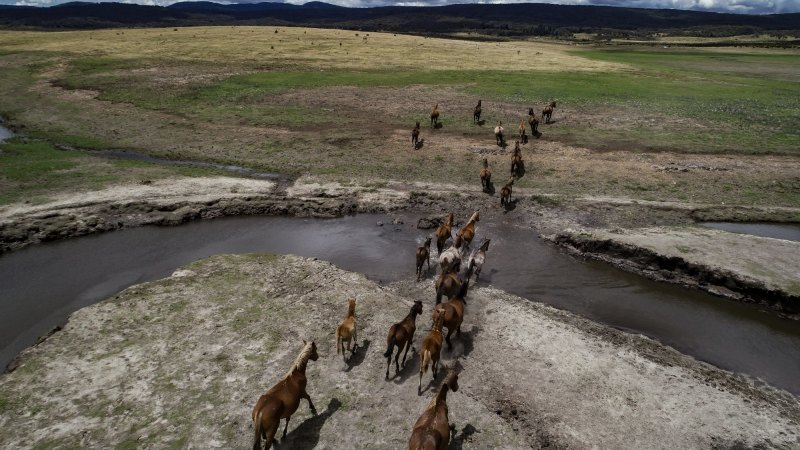


The NSW government has committed to a trial of fertility control for wild horses in the Snowy Mountains, even as it prepares to resume aerial shooting this winter to deal with a surge in numbers.
The population of feral horses, also known as brumbies, within Kosciuzsko National Park was estimated to be at least 6476 and up to 16,411 in late 2025, about triple the previous year’s count. Damage from horses trampling vegetation and waterways was still evident across many parts of the park, the government said.
NSW Environment Minister Penny Sharpe said the government would take a “cautious, evidence-based approach” to reach the required population target of 3000 horses to protect the fragile alpine and sub-alpine environment.
“No one wants to have to kill horses. But there are still too many in Kosciuszko National Park,” she said.
In late 2024, after a winter of intensive aerial shooting, the population was between a lower estimate of 2131 and an upper estimate of 5639.
The aerial shooting was paused last winter because of the legal requirement under a law pushed through by former Nationals leader John Barilaro requiring the retention of 3000 horses in certain areas of the park for heritage reasons.
This law was repealed last year, with the passage of a private member’s bill introduced by independent MP Joe McGirr, but the 3000 target remains in the park’s plan of management.
Sharpe has ruled out changing the current plan of management, but future decisions on horse control will revert to the National Parks and Wildlife Service.
Invasive Species Council chief executive Jack Gough said it was not unexpected that numbers had surged, since there was no effective control in 2025, and it would be most cost-effective and humane to manage the population as quickly as possible towards zero.
”The minister could make a decision tomorrow to scrap those retention zones,” he said. “It seems that they are pushing that decision off beyond the election. I think that’s a mistake because I think we have broad community and cross-party support for getting that action done now.”
The NSW government said NPWS would resume aerial shooting and other feral animal control measures in June, and rehoming in retention areas will recommence immediately.
NPWS will also engage an independent expert to design an initial reproductive control trial for wild horses in the park, a measure that has been heavily pushed by the Animal Justice Party.
A108-page report on wild horse fertility control options for Kosciuszko National Park to be released on Friday morning alongside the 2025 population survey report outlines several options. They include trying fertility control across multiple sites with a retention population of 3000 horses, and an alternative scenario where about 200 horses are retained.
The authors conclude that a multi-year management program that incorporates a research component and is focused on the Snowy Plain site “seems to offer the best balance of feasibility and knowledge that is likely to be gained”.
The most promising treatment option was identified as the GnRH (gonadotropin releasing hormone) vaccine, GonaCon EQ, which is used for wild horse management in the United States and New Zealand. This would be administered either by mustering the animals and injecting by hand or remote darting from the ground or helicopters.
The report quotes the RSPCA in saying that while GonaCon and similar vaccines show promise in small, contained populations, annual retreatment was a significant hurdle for large, inaccessible wild herds.
The report recommends that the government needs to provide explicit ethical justification for the trial to the wider community, ensure adequate resourcing, and allow a research timeframe of up to 10 years to allow robust conclusions about the long-term effectiveness.
The report also acknowledges the managers of the park need to be “prepared for attempts by unsupportive community members to sabotage the program through vandalism of infrastructure or targeting of treated and identified animals”.
Get to the heart of what’s happening with climate change and the environment. Sign up for our fortnightly Environment newsletter.


