









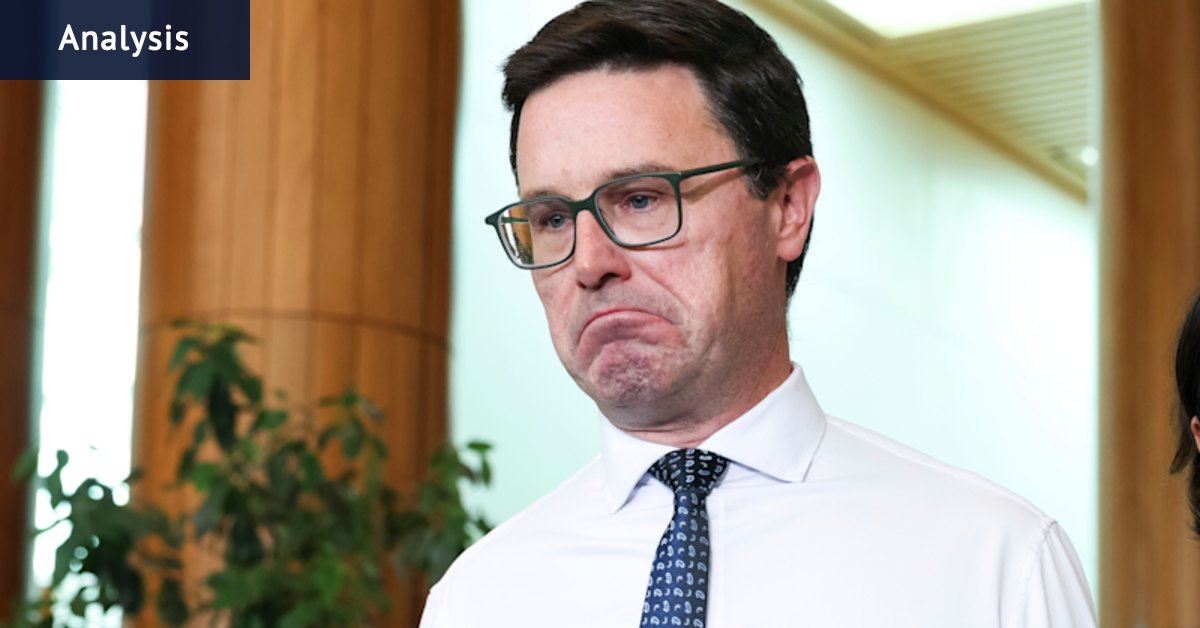


David Littleproud was on borrowed time as Nationals leader, but his decision to call time was still a shock.
He survived splitting and reforming the Coalition with Sussan Ley, twice, before waving the former Liberal leader – with whom he shared a frosty relationship – out the door. Littleproud then easily saw off a leadership challenge from disgruntled MP Colin Boyce just months after his greatest enemy in the party room, Barnaby Joyce, had defected to One Nation.
There was no sign that another spill was imminent, and Littleproud was, seemingly, secure in the job.
So why go now?
“You’ve got to get yourself up when you’re the leader, and you’ve got to want to go and drive and get to that next place and go, and I had the greatest and the most fun I’ve ever had before the last election … and it’s just, I’m just buggered,” Littleproud said on Tuesday.
Which is an explanation, but one that doesn’t quite stack up, especially since he is remaining in parliament and is willing to serve in the next shadow cabinet.
In announcing his resignation as leader on Tuesday, Littleproud repeatedly compared his leadership of the Nationals to the party’s greatest-ever custodian, John “Black Jack” McEwen. Littleproud said that under him, the Nationals had influenced the national conversation on issues such as the Indigenous Voice to parliament, while also shaping and driving Coalition policy in areas such as adopting support for nuclear power.
Pull the other one, David.
McEwen served decades in parliament, was the only Nationals MP ever sworn in as prime minister (for about a month), the first-ever deputy prime minister, and most consequentially, he drove high tariff trade and industry policies that insulated the Australian manufacturing and farming sectors for decades, before being dismantled by the Hawke government.
Littleproud is a popinjay who has been in federal politics for less than a decade and who achieved little in various portfolios, including agriculture, water resources and emergency management.
It is true that he moved the Coalition further to the right to adopt more hardline policies on issues such as climate change. But how has that worked out?
Instead of stopping One Nation in its tracks, Pauline Hanson has poached charismatic former leader Barnaby Joyce and seen her party’s standing in the opinion polls surge dramatically.
Littleproud boasted that while the Liberals lost a swag of seats at the last election, the Nationals had not lost a single seat in the lower house.
While true, it’s a very narrow reading of the scorecard over the four years of his leadership.
Littleproud wasn’t as keen to mention other events during his time as leader. Joyce’s defection, which can be directly linked to the surge in One Nation support, former Nationals MP Andrew Gee quitting to the crossbench as an independent, Jacinta Nampijinpa Price joining the Liberals, and former NSW senator Perin Davey losing her spot at the last election.
Two more experienced MPs, Keith Pitt and David Gillespie, quit politics entirely (their seats were retained, at least).
That’s why Littleproud was on borrowed time.
Patience with his outlandish claims and his sometimes erratic decision-making was wearing thin in the party room. Politicians can count, and the writing was on the wall.
Because here’s the truth: under David Littleproud’s leadership, the Nationals’ party room shrank, the party turned inward, and One Nation became an existential threat. The Coalition was also split twice – causing huge damage to both parties – for flimsy reasons.
Littleproud won’t be leader when the Farrer byelection is held in May.
But if the Nationals struggle and finish well behind One Nation, the Liberals and the independent candidate, as many Nationals MPs expect, that too will be part of Littleproud’s legacy.
Cut through the noise of federal politics with news, views and expert analysis. Subscribers can sign up to our weekly Inside Politics newsletter.


