









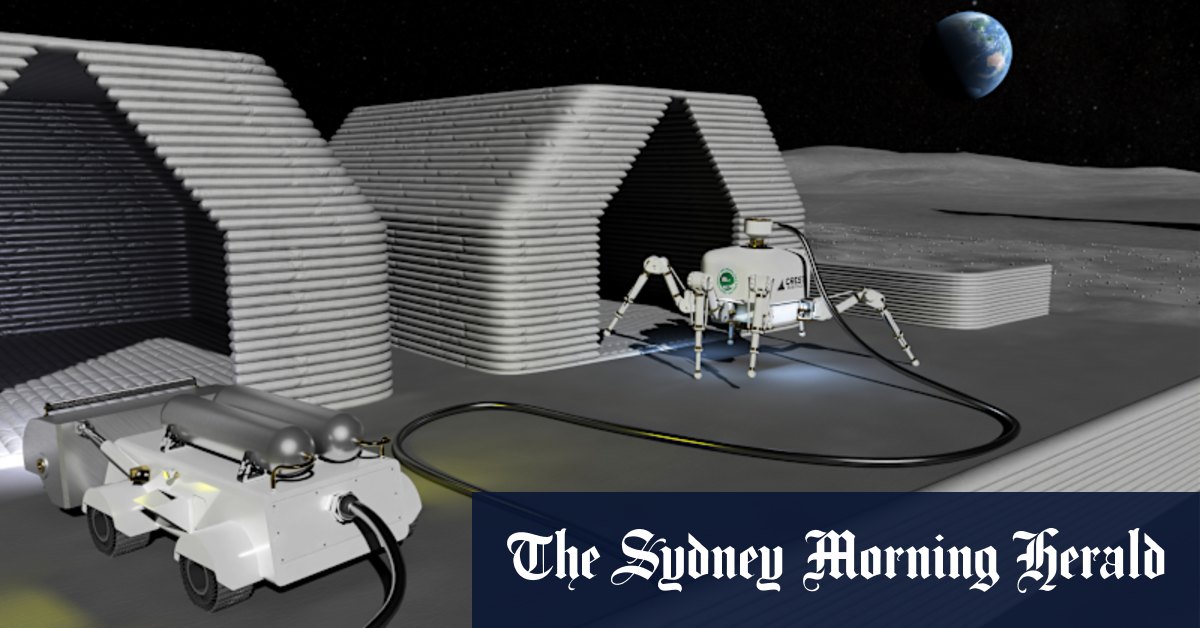
Xavier De Kestelier, head of design for Australian architecture firm Hassell, has already thought of that – and selected a site near the Shackleton Crater for a proposed shelter for 155 astronauts.
In collaboration with the European Space Agency, Kestelier designed a series of inflatable pods which are light and compact during space travel but can blow up into large, modular living space containing bedrooms, gyms, kitchens and greenhouses on the moon.

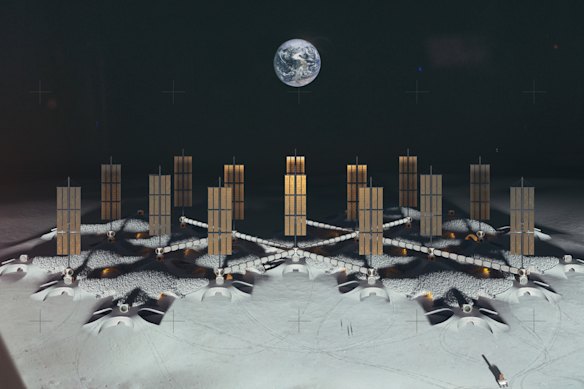
Xavier De Kestelier’s vision for a community of 155 astronauts on the lunar surface, made from inflatable pods.Credit: Hassell/European Space Agency
“It’s all good to have your astronauts living in these inflatables, but what you really need to do is protect them from radiation,” he said. The moon’s surface is lashed with cosmic radiation 200 times stronger than we experience on Earth due to its lack of protective magnetic sphere.
To solve that problem, Kestelier turned to “hexapods”, interlocking structures similar to the concrete blocks sometimes used to create artificial seawalls.
The hexapods could be 3D-printed from moon dust and crushed rock and tossed on top of the inflatable living pods, where they would naturally connect and create a metres-thick shield against radiation.
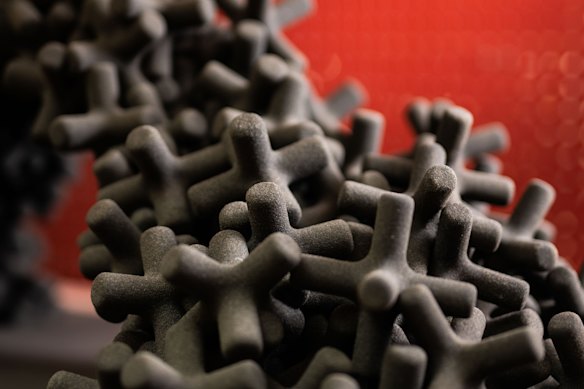
These protective “hexapods” could be made from moon dust.Credit: Hassell/European Space Agency
Inside, the focus would be on a homey vibe rather than the “tacky” lab-style look often associated with structures in space.
“Space has moved on. It’s not just about survival any more. It’s about thriving in space as well,” Kestelier said.
“Astronauts are not test pilots any more. There are going to be tourists. There are going to be researchers. You need to accommodate for all sorts of people living in these spaces.
“What we’re trying to demonstrate here is that master planning on the moon is really a thing.”
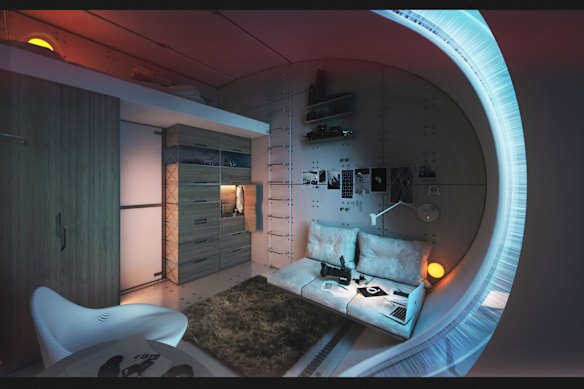
The interior of Hassell’s proposed Lunar Master Plan residential pods.Credit: Hassell/European Space Agency
Sticking the landing
Sydney-based company Advanced Navigation has delved into the bowels of the Earth and undertaken rigorous testing above the moonlike landscape of central Western Australia to help solve the most potentially catastrophic part of any lunar landing: the landing.
“The surface is uneven, it’s not friendly, it’s very hard to pick a landing spot,” said Matt Suntup, senior engineer at the robotics company partly backed by the Australian Space Agency.
The company is working with the US-based company Intuitive Machines (IM). Last year the IM achieved the first-ever private moon landing with their spacecraft Odysseus (partly guided by the CSIRO’s Murriyang radio telescope in Parkes), although it snapped a leg and toppled over on impact. In February, IM’s next lander, Athena, rolled and slid into a dark crater.
Advanced Navigation is hoping to address the costly challenge of sticking the landing with their LUNA (Laser measurement Unit for Navigation Aid) system, which uses lasers like a police radar gun to get an accurate real-time view of the lunar surface as a spacecraft comes in to land.
“We can actually get a very accurate 3D velocity measurement, which tells us how we’re moving in all three dimensions relative to that lunar surface,” Suntup said.
The LUNA system recently passed navigation tests over the Pinnacles Desert in WA, a landscape similar to the lunar surface.
Suntup and the Advanced Navigation team also tested the technology in Europe’s deepest mine in Finland, using the laser navigation to delve 1400 metres underground with no GPS. (Being Finland, there was a sauna at the bottom.)
LUNA is slated for its space debut in 2027 on IM’s fourth lunar landing mission.
The Examine newsletter explains and analyses science with a rigorous focus on the evidence. Sign up to get it each week.


