


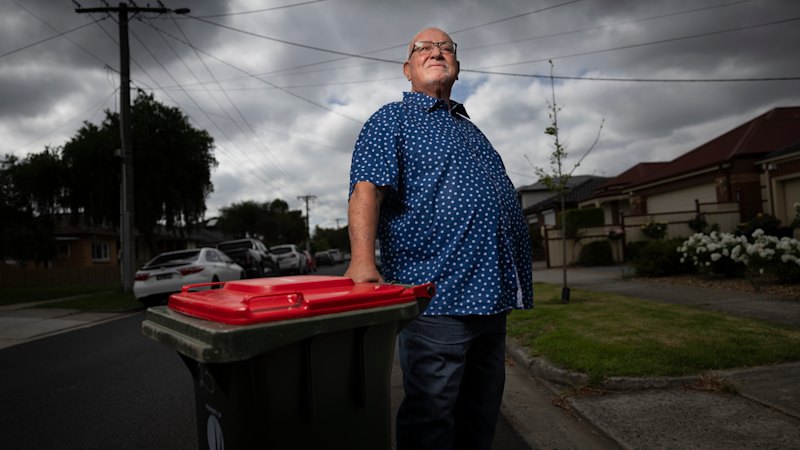

Fortnightly rubbish collection is “inevitable” across Melbourne, as more councils consider reducing pick-ups while grappling with rising waste costs, environmental concerns and a looming deadline to roll out glass recycling bins.
One in three councils have already reduced rubbish collection to every second week and even more are considering the shift, seven years after former premier Daniel Andrews declared it a “rubbish idea” and one that would never happen under a Labor government.
Twenty-six of Victoria’s 79 councils collect general rubbish fortnightly, while Whitehorse and Brimbank recently considered the change but decided to keep weekly collection.
Hobsons Bay in the city’s west was the first to switch collection to every second week but shifted back to weekly in 2021 after a backlash from residents.
Merri-bek in the city’s north is now planning to start fortnightly general rubbish collection across the municipality from the middle of next year, which is intended to slow increases to ratepayers’ waste charges, reduce landfill and increase composting.
The Municipal Association of Victoria expects even more councils will consider following suit, while waste management expert Trevor Thornton said the shift to fortnightly collections was inevitable to cut costs.
Under Merri-bek’s proposal, the standard red lid rubbish bin would increase from 80 litres to 120 litres, while certain households like those with multiple children in nappies could get bigger bins free.
There would be no change to other bin collections, including food and garden organics, which are picked up weekly.
Merri-bek resident Joe Perri worries his family of three will struggle with fortnightly rubbish collection as their landfill bin is crammed even after separating green and recyclable waste.
“The household rubbish bin is always full,” the Fawkner Residents Association founder said.
“The disconnect between residents and councils is just getting wider and wider – as far as I’m concerned, the decision has already been made.”
Coburg resident Danielle Polizzi said she had made more than 20 complaints about rubbish to the council in the past 18 months and was concerned more rubbish could pile up in the streets if collections were reduced.
“The accumulation of waste has increased because people just do not want to spend the money to go to the tip,” Polizzi said.
However, it’s not a concern for Fawkner woman Georgia Koulis, who lives in a household of three but rarely fills the rubbish bin.
“That one is not that much of an issue,” she said.
The overhaul has already been trialled in three suburbs, and households involved had reduced their landfill waste by 19 per cent, according to the council.
Merri-bek Mayor Nat Abboud said the council would finalise plans for fortnightly collection across the municipality in June, and public feedback, trial results and other councils’ experiences would be considered.
“This consultation is to make sure everyone is well informed in advance and to understand how we can build on learnings from the trial so we can help everyone adjust to the change, should council decide to proceed,” she said.
Merri-bek has already rolled out fourth bins for glass recycling but other councils have until July 2027, a mandate that sparked a backlash from 35 councils which instead want the state government to expand the container deposit scheme.
Modelling commissioned by some opposing councils last year, which was not publicly released, estimated glass bins would cost an additional $4 million a year, with a $27 increase to household waste charges.
Manningham Mayor Jim Grivas is advocating for an expanded container deposit scheme similar to that in NSW, Queensland and other states.
“More bins mean more costs, more trucks, more congestion and more contamination,” Manningham Mayor Jim Grivas said.
Whitehorse Mayor Kirsten Langford said an expanded scheme would achieve the same impact as a glass-only kerbside bin, but without substantial extra cost.
Municipal Association of Victoria president Jennifer Anderson expected other councils with weekly rubbish collection would now consider whether to shift to fortnightly because waste was one of their greatest expenses and decisions about bins were not made in isolation.
“They will be analysing absolutely everything and because waste is such a big expense, I can’t imagine any council does not look at their waste services,” she said.
“Councils are under a lot of financial strain at the moment because more and more the state government and the federal government are asking councils to do things, but providing less funding.”
Thornton, a Deakin University senior lecturer who specialises in hazardous waste management, said it was inevitable councils would move towards fortnightly collection mainly for financial reasons, but with environmental gains.
He pointed to the state waste levy, which jumped by more than 30 per cent in July 2025 to $169.79 per tonne for municipal waste, tip operators charging more as landfill space declined, and higher transport costs due to rising fuel and wage bills.
Thornton said councils would have to move to fortnightly collection to meet the financial challenges of collecting four separate bins, although recycling and green waste aren’t as expensive because the materials are sold so costs can be recouped.
“The more that can be diverted to those two streams is actually cheaper for the council and cheaper therefore for the ratepayers,” Thornton said.
A Victorian government spokesperson said the four-bin system made it easier for people to sort their recycling at home and the frequency of general waste collections was decided by local councils.
The state government has invested $129 million to support the shift to four bins.
Opposition local government spokeswoman Beverley McArthur said rubbish collection was a matter for local government so councils needed to be empowered to make decisions that suited their own communities.
“When you impose a fourth bin mandate on councils that are already struggling with state government cost shifting, something has to give, and it is core services that suffer,” she said.
Start the day with a summary of the day’s most important and interesting stories, analysis and insights. Sign up for our Morning Edition newsletter.
 Rachael Ward is a journalist in the City team at The Age. Contact her at rachael.ward@theage.com.auConnect via email.