



Transport Minister John Graham’s staff demanded NSW transport bureaucrats model the effect of a toll shake-up on Sydney’s motorways across state electorates, which a corruption-busting barrister describes as “completely inappropriate”.
The request for modelling, and senior transport officials’ efforts to respond, are contained in a trove of emails between Transport officials and consultants, which was happening amid long-running negotiations between the government and Transurban over changes to toll pricing.
The NSW Coalition accused the transport minister of putting the political interests of the Labor Party first, describing the request for modelling as a “blatant improper use of public resources”.
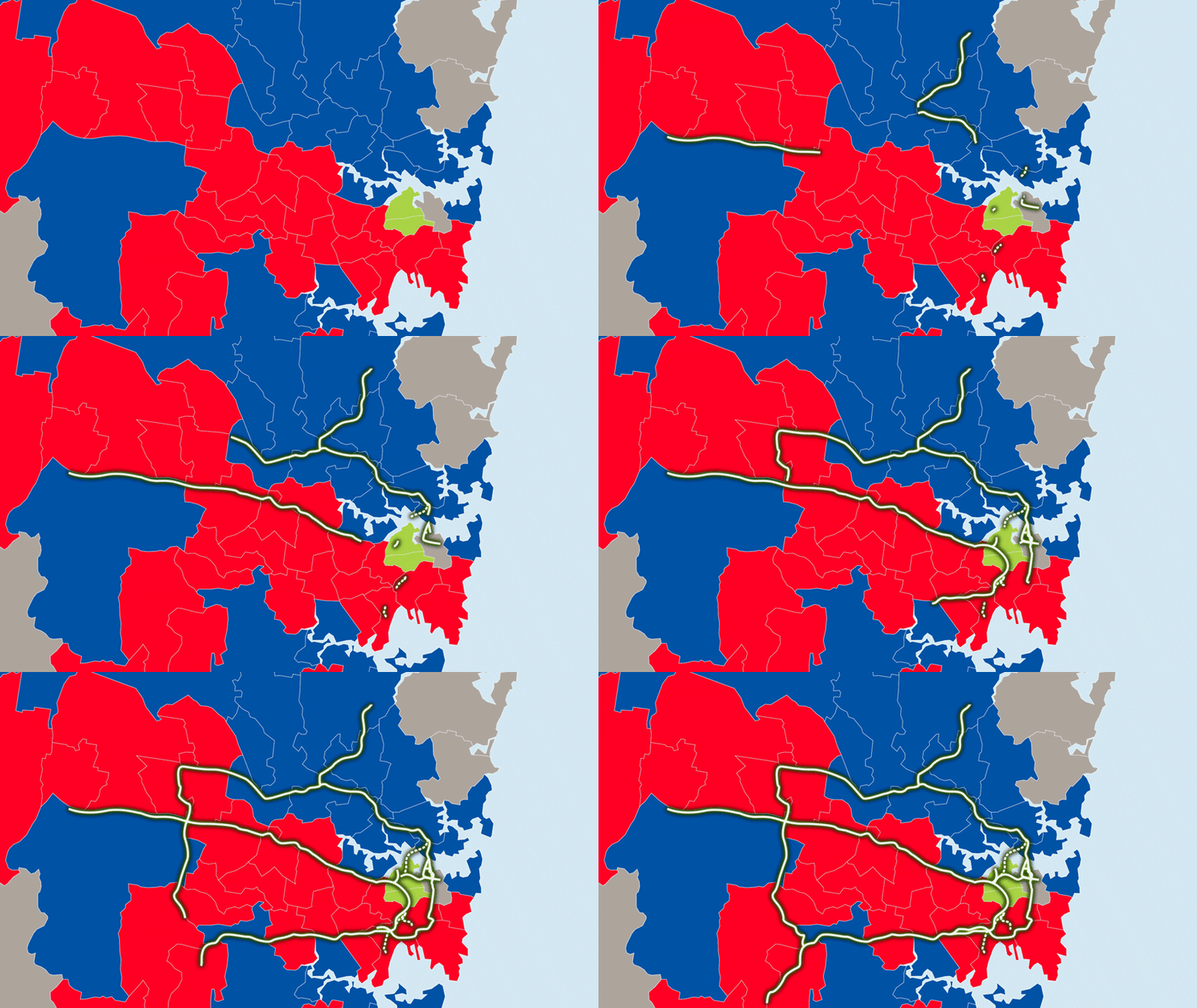
An email sent on January 10 last year shows that senior Transport for NSW officials had received a request from the transport minister’s office to “assess the 2026 toll burden across all options on an electorate zoning basis”.
A week later, emails marked “sensitive” between Transport officials and consultants pointed out that the request from the minister’s office “explicitly asked for this analysis” to be undertaken at a state electoral district level, and that a briefing was scheduled for several days later.
In one of the emails, a senior Transport official shared four tolling scenarios – summarised by “state electoral district” – with several colleagues and transport consultants. The email’s subject line noted the “MO request”, which refers to the minister’s office.
Then, in late July last year – six weeks before the Kiama byelection – the minister’s office emailed NSW Motorways, which was set up last year, to ask if it could “provide advice on how much of the $60 toll relief has been provided to motorists in the state seat of Kiama”.
Centre for Public Integrity director Geoffrey Watson, SC, said it was “completely inappropriate” for the minister’s office to ask the department to conduct modelling on an electorate basis.
“There’s only one guide for development of public policy as far as politicians and bureaucrats are concerned, and that is the public interest,” he said. “The public interest is not reflected in distorting outcomes for political interests. In fact, that’s the embodiment of an improper purpose.”
Watson, a former counsel assisting the Independent Commission Against Corruption, also said he was “stunned” that someone within government thought it was appropriate to make a request for information from an agency about the take-up of toll relief in the seat of Kiama six weeks before a byelection. “I think it’s quite improper,” he said.
Graham said he made no apologies for investigating who benefits from the $60 toll cap and toll reform. “Under the Coalition, no one would have received a dollar from the toll cap,” he said.
Opposition transport spokeswoman Natalie Ward said that ordering the use of taxpayer resources to model how different toll reform options impacted electorates was an improper use of public resources and a potential breach of public trust.
“The only reason a minister ordered this work is to put the political interests of the Labor Party first, and the public interest of taxpayers and drivers second,” she said.
“It is a blatant improper use of public resources at the direction of a minister to pursue political objectives. Electorates are only relevant to understand political objectives, and using taxpayer funds to do it isn’t in the public interest or good public policy.”
Ward said the demand for modelling on an electorate basis raised questions about what the government’s objective for toll reform was. “Is it for the public good or the good of marginal Labor seats? I doubt they prioritised the option that was bad for the Labor Party’s interests,” she said.
Transport for NSW said providing data analysis when developing and tracking new policy initiatives was a standard practice between departments and the NSW government and was in keeping with related protocols.
“This data is regularly broken up and provided in various different formats including on a postcode or electoral basis,” the agency said in a statement. “In relation to toll relief, Transport for NSW regularly provides reporting on data, broken down by suburb, postcode and [local government area].”
The government has been negotiating with Transurban and other large investors about a shake-up of tolling contracts since July 2024.
They have already reached a deal to scrap administration charges on toll notices, while the government has confirmed that motorists will be charged two-way tolls on the Sydney Harbour Bridge and Harbour Tunnel from as early as 2028 to help fund a $60-a-week cap on motorway charges across the city.
Start the day with a summary of the day’s most important and interesting stories, analysis and insights. Sign up for our Morning Edition newsletter.
 Matt O’Sullivan is transport and infrastructure editor at The Sydney Morning Herald.Connect via X or email.