









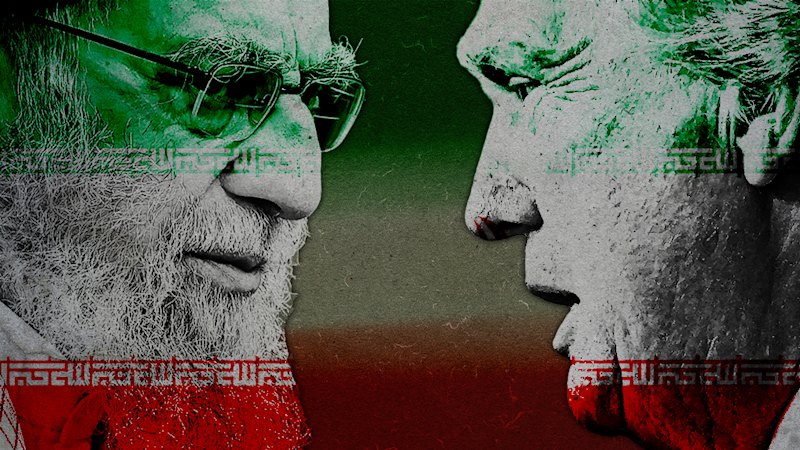
US President Donald Trump has told Iranian protesters that “help is on its way”, giving his strongest indication yet that the US will intervene in the country following the Islamic Republic’s brutal crackdown on anti-government protests.
He warned that the regime’s “killers and abusers” would “pay a big price” for their repression, which has reportedly seen security forces kill some 2000 people since demonstrations began late last month.
Whilst Trump offered no details on the type, or extent, of intervention Washington may be about to make, it is thought that the options being considered include military strikes, assassinating Supreme Leader Ayatollah Ali Khamenei, and cyberattacks against the regime.
But first, he must determine what his ultimate goal is.
“Does [Trump] want this to end in regime change, or does he want to weaken them to force them into a new nuclear deal? We don’t know, and this is raising major questions about what America might do,” says Danny Citrinowicz, an Israeli defence analyst who specialises in Iran.
The US must also weigh the prospect that intervention could backfire, encouraging Iranians to “rally to the flag” and strengthening the government’s grip on power. The country has a long history of coming together to resist foreign invasion, and the regime has a record of exploiting that sentiment to legitimise itself.
Symbolic strikes
One option for the US is a minimal strike – or series of strikes – designed only to send a message and redeem Trump’s promise to hit Iran in the event the regime started killing protesters.
Loading
There are no shortage of potential targets for such action, from Islamic Revolutionary Guard Corps (IRGC) bases around the country to missile facilities.
To maximise the symbolism, the US may choose to strike an official building in Tehran. During the 12-day war between Israel and Iran in June, the Israelis bombed the Ministry of Intelligence.
A similar strike in the capital, or on a remote but high-value nuclear facility, is feasible and could be achieved with assets the US already has in the region. That may be enough to persuade the regime to ease off its bloody crackdown on protesters.
But if it is too obviously symbolic, it may backfire – telling the regime and its opponents that the Americans are not really serious about getting involved.
A sustained bombing campaign
To force a real change in direction, stop the security forces killing protesters, or actually undermine the regime, a more sustained and more widespread bombardment would be required.
It would need to hit not only headquarters and ministry buildings, but also an array of bases and staging posts used by the IRGC and its Basij militia throughout the country. The Israeli airforce struck many such targets last year, and also savaged Iran’s air defence systems.

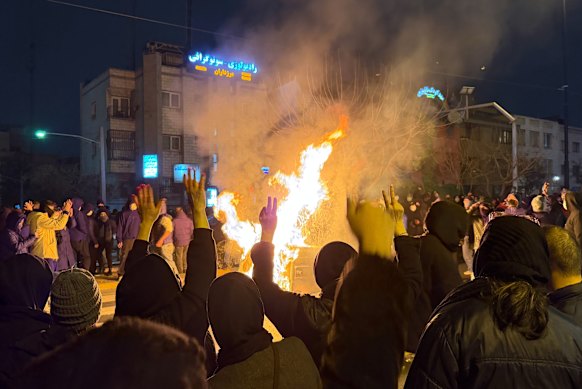
Anti-government protesters chant around a fire on the streets of Tehran.Credit: UGC via AP
“The preponderance of [America’s] focus would have to be on the domestic repressive apparatus,” argues Farzan Sabet, a managing researcher at the Global Governance Centre in Geneva.
“Key personnel, not only at the top level but one or two levels down; their communications nodes; the facilities they use. And then the main facilities of state media … and the judiciary and prosecution service.
“Military planners might also feel compelled to hit some military targets so that the retaliation is limited.”
But the Israeli campaign failed to bring down the regime with nearly two weeks of bombing, so the Americans would have to be prepared for an even larger and more sustained assault. That would require a build up of US forces that do not appear yet to be in place.

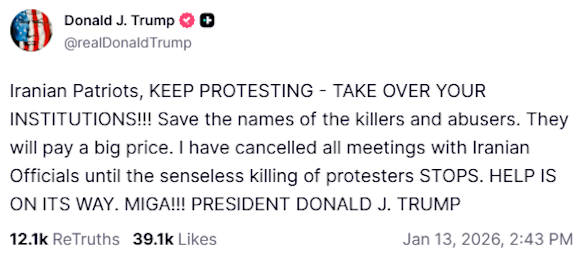
A post by US President Donald Trump on Truth Social about Iran.
As far as we know, there is no US carrier group in the immediate vicinity. Its nearest one, the USS Abraham Lincoln, is currently located thousands of miles from the Persian Gulf, in the South China Sea.
There has been no visible deployment of B2 bombers to Diego Garcia, the Indian Ocean base from which long-range bombers would take off for such a mission.
And while the US could, in theory, call on warplanes stationed at bases around the region, host countries may not allow those sites to be used for sorties in Iran owing to fears over retaliation and uncertainty over what would follow any toppling of the Iranian regime.
Those issues aside, the bigger the campaign, the bigger the risk of triggering a “rally around the flag” effect for the regime – and of handing it a victory if it survives.
Short of deploying drones over city centres to attack the Islamic Republic’s security forces, it is, in fact, difficult to see how any kind of bombing would stop the crackdown on the streets. To achieve that outcome, some analysts say, the US would need to be willing to send troops into Iran.
“You would need to put American boots on the ground, and he is not going to do that,” said Nicholas Hopton, a former British ambassador to Iran.
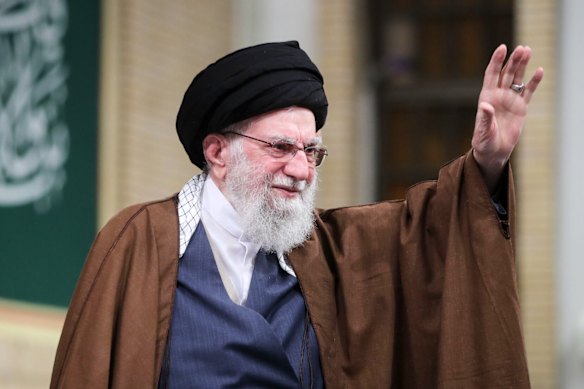
Iranian Supreme Leader Ayatollah Ali Khamenei in Tehran in November.Credit: AP
Assassinating Khamenei
The hope, then, must be that American intervention, or the threat of it, will persuade the regime to change course: to ease off the suppression of protesters, and to cut a new nuclear deal.
This is a message that has currency in Tehran. Many in the establishment know that the omnicrisis of economic chaos, collapsing legitimacy, and environmental degradation facing Iran cannot be fixed without the lifting of sanctions.
There are many in the regime, including Masoud Pezeshkian, the president, who are thought to favour doing anything to achieve that – including ditching Iran’s nuclear program.
“But I think the way that Khamenei is talking in public is not a good indicator that he’s actually got that message,” says Matthew Savill, director of military sciences at the Royal United Services Institute, pointing to his defiance in the face of Trump’s threatened intervention.
“And if Khamenei is seen as the blocker, would there be a pressure to remove the blocker?”
Loading
To call a spade a spade, this means kidnapping or assassinating the supreme leader.
For a White House team flush with success from the capture of Nicolás Maduro, that must be tempting. As in Venezuela, the US might hope that there are others in the regime ready to play by Washington’s rules – by jettisoning any nuclear ambitions and easing up on repression – provided they can stay in power.
That might suit American interests, but Iranians who have risked their lives taking to the streets in the hope of seeing the whole Islamic Republic collapse may judge such an outcome to be an outright betrayal.
And it would be fraught with risk, says Citrinowicz, who points to the very real risk of triggering a war involving Shia Muslims across the Middle East. That, in turn, could put US troops in the region in harm’s way.
“It’s not like you’re taking Maduro out, and that’s it,” he says. “If you’re killing [Khamenei], then you have to open a Pandora’s box of relations with the Shia community for whom he is not only a political leader, but also a religious one.”
Cyber assault
Loading
In war, of course, the enemy gets a vote. So any American intervention, must assume Iran will retaliate.
Could that mean an Iranian missile attack on US bases? A massive strike on Israel? Some kind of regional conflagration? It is difficult to predict.
But if Trump wants to avoid a Middle Eastern quagmire, he might confine himself to a “non-kinetic” option.
In other words, using cyberattacks to break the regime’s communications blackout, allowing activists to reach the outside world and better co-ordinate their own actions, while silencing – or perhaps even blinding – officials as they attempt to contain the protests erupting in towns throughout the country.
That might involve the US smuggling Starlink terminals into Iran, allowing more people to bypass the internet shutdown enforced by authorities, or jamming state television to undermine the regime’s domestic propaganda, which is currently broadcasting reports about pro-regime demonstrations and carnage on the streets to intimidate the public.
But some warn the US may have waited too long to take this kind of action and tip the odds in the protesters’ favour.
“The US might have missed the window. If it was going to respond, it should have [done so] a few days ago,” says Sanam Vakil, director of the Middle East and North Africa program at Chatham House.
Loading
“At the moment it looks like the regime will survive this, unless there is something we are not seeing. It is important to remember that we do not have visibility of what has happened in Iran. But for now it looks like they are managing it – in the most bloody way.”
Iranian officials certainly remain defiant, despite the looming possibility of an American intervention.
“Come and see how all your assets in the region will be destroyed … what will befall American bases, American ships and American forces,” Mohammad Ghalibaf, the speaker of parliament, said at a pro-regime rally in Tehran on Monday.
The Telegraph, London
Get a note directly from our foreign correspondents on what’s making headlines around the world. Sign up for our weekly What in the World newsletter.


