








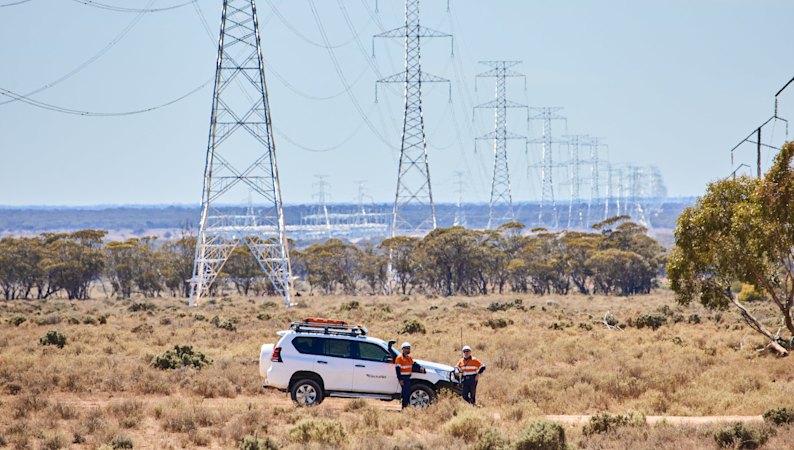
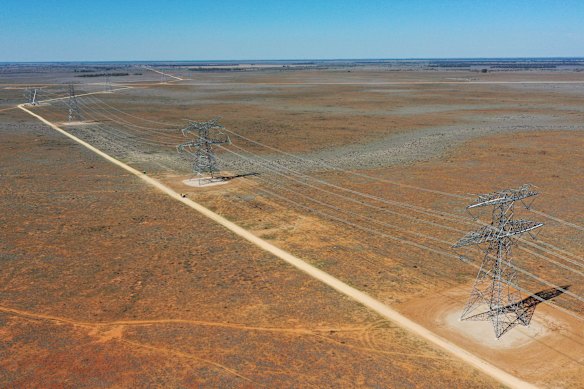
Great news that the power grid expansion has finally been completed, linking NSW, Victoria and South Australia and providing lower-cost electricity across state lines (“High voltage ‘superhighway’ links renewables to the grid”, June 10). Together with the lowering of wholesale electricity prices thanks to grid scale batteries, this is good news for consumers and confirmation that renewable energy is the cheapest and cleanest (“Green energy is shielding Australia from a global power price shock”, June 10). With most of our ageing coal-fired power plants reaching the end of their working lives, it defies logic that the Liberals, Nationals and One Nation promise to abandon the march towards net zero and rail against renewables. This is especially so in light of the NSW Net Zero Commission’s modelling, which reported that NSW’s loss from climate change was about $180 billion in 2024 alone and expected to blow out significantly as the effects of climate change become more severe (“Climate change costs residents”, June 10). Alan Marel, North Curl Curl

It’s good to see some actual figures attached to what we already know to be the case – that the warming climate is going to cost us lots more. With each extreme weather event all levels of government are having to divert resources into community support, repairs and reconstruction of infrastructure, lost productivity, mental health and higher insurance premiums. Seeing that it’s ratepayers and taxpayers that are constantly having to pick up the bill, rather than the fossil fuel companies that have caused the problem, surely it is time for the federal government to require these companies to contribute to a national damage and reparation fund. Catherine Rossiter, Fadden (ACT)
When it comes to the cost per person of climate change, we have to remember that averages are just that, averages. This means, in essence, that some people will be unaffected. Others will have their houses burnt down or washed away and lose everything. It’s these people we should focus on when climate policy is determined. Unfortunately, decision-makers are often those who will remain unaffected. Greg Baker, Fitzroy Falls
We often forget what a marvel it is that we can flick a switch and instantly power lights, heaters, kettles, washing machines and more. Australia’s National Electricity Market is one of our biggest machines, home to the largest and most complex substation in the southern hemisphere and linking 9 million customers across six states and territories through 40,000 kilometres of transmission lines and cables. Let’s celebrate the new 900‑kilometre superhighway that will bring even more solar and wind into this incredible system. Like your correspondent Tom Knowles, I’d welcome more cheery headlines about the renewable energy success story unfolding across Australia (Letters, June 10). Amy Hiller, Kew (Vic)
Hospitals need a lifeline
The problems with the public hospital system will persist until there is joint federal-state responsibility for them (“Westmead Hospital’s wait time blowout”, June 10). The blockage in the hospital’s ED is worsened by the number of beds taken up by patients awaiting a Commonwealth-funded aged or disability care bed – at least 100 at Westmead – while the federal government saves money at the state’s expense. Responsibility for the inexcusably long waiting times for elective surgery and outpatient (gap-free) specialist consultation should be shared with the Commonwealth as the states struggle to fund these, as well as acute care. In my 40 years as a staff specialist at Westmead, I could see the current train wreck coming. Graeme Stewart, Westmead
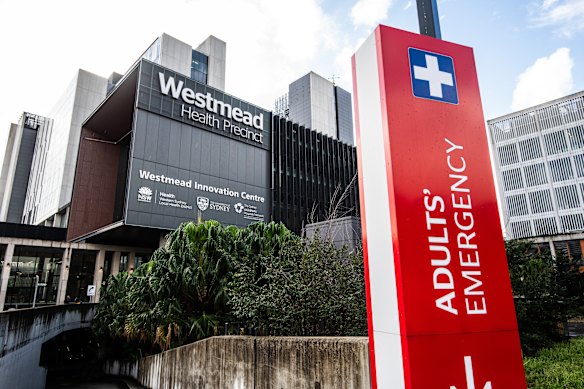
I would like to describe my recent visit to Westmead Hospital. My case was triaged within 20 minutes as urgent. I waited four hours to be seen by the one doctor on duty, then eight hours to be seen by the specialty team. I was in the ED for 36 hours. The specialist team ordered an MRI, for which I waited 68 hours. The result of the MRI took 81 hours to come through to me. I was altogether nine days in the hospital, seven of them in a ward. I wrote to the relevant minister, who contacted the hospital the next day. The minister was given a bureaucratic snow job and got back to me two months later but missed the point I was trying to make, which was that it surely shouldn’t take 81 hours to read an MRI. Michael Hirschhorn, North Rocks
Start with acceptance
I, an 82-year-old gay man, should not be crying at 9am watching the interview with Kane Evans, whose three aims in life were to play in the NRL, to buy a house for his parents and to kill himself (“Former NRL enforcer Kane Evans comes out in emotional interview”, June 9). Far too many of our gay kids entertain thoughts of suicide. Sports clubs and schools all have anti-bullying policies. Why aren’t they working? There have been no openly gay rugby league players since Ian Roberts in 1995. Where are the role models? One gay soccer player, one gay rugby player (thank you, Josh Cavallo and Dan Palmer). Loads of women, of course, and well done to you all. Every sporting code should be telling their coaches, every coach should be telling their players, “Whether you are straight, gay or whatever, we accept you for what you are. Never be ashamed to be yourself.” Every school principal and teacher should be passing on the same message to their students. Every family, all parents, should be passing on the same message to their children. Let’s save some lives. Bruce Laidlaw, Marrickville
Brain drain
Australia can’t compete directly with the major powers in fields such as mass manufacture and AI development. But over the decades the country has shown disproportionately high proficiency in scientific and artistic innovation. Australian scientists are legitimately calling for more expenditure to enable Australia to keep up with world trends (“Nation’s top scientists lobbied for AI funding”, June 10). On this subject, another story is also relevant (“Kwong among consultants dumped in Powerhouse cuts”, June 10). The statutory mission of the Museum of Applied Arts and Sciences involves “promoting education, scientific research, and the development of local industries by showcasing technological and artistic advancements”. The museum community is concerned that this core mission is being downgraded. We await the promised opening of the Parramatta facility in the hope that it does not just become a feelgood entertainment centre. Employment of some specialists in this area would help: an Instagram post recently showed 28 people involved in the commissioning process, not one of whom had any significant arts/museum experience or qualifications. Tom Lockley, Pyrmont

Terry Tao’s appointment as a Companion of the Order of Australia cements his position among Australia’s great mathematicians (“Terence Tao’s groundbreaking maths formula is so simple, anyone can follow it”, June 9). The sad truth is that Australia bats far above its weight in terms of creative and innovative minds, but like Tao, many of them leave for foreign shores to achieve their true potential. More recognition at the highest level may help keep them among us. Peter Thornton, Killara
The right path
Ross Gittins discusses why voters have turned to One Nation (“Why are voters cranky enough to turn to Hanson? I have a theory”, June 10). In short: households are struggling, and the budget did not offer immediate help. One Nation is capturing the sense of grievance about both major parties. In the balance between self interests and national interests, in the end One Nation is in the former camp. It is unfortunate that the media encourages the personal in politics. Witness the league table of “winners” and “losers” after the budget as an example. Labor is fighting to create fair and sound public policy against the tidal wave of special interest groups. Gittins is right: they should persist in this battle. Alan Russell, Unley (SA)
Ross Gittins and Graeme Samuel (“Capital gains tax outcry is sad and predictable”, June 10) produced well-written and balanced perspectives regarding the recent budget tax changes. Yes, the changes are intended to reduce inequality, promote fairness and to address the rising cost of living. The vested interests may continue to howl over broken promises and the impact on their tax minimisation schemes, but future generations will thank Anthony Albanese and Jim Chalmers. Hold your nerve and stay on target. Bruce McKinnon, Mosman
Bravo, Graeme Samuel, for reminding us that sensible economic reform in the public interest deserves support from the electorate rather than the whingeing and whining from critics acting in their own self-interest. As Samuel points out, Australia has enjoyed a robust economy, despite the naysayers, due to the reforms implemented by courageous politicians over the years. Once again, the latest round of much-needed reforms has attracted howls of protest from those who apparently object to taxation applied fairly to all sectors of the population. Sorry, guys, Wally the worker deserves to be taxed no more than Ivan the investment guru, and congratulations to Labor for finally having the courage to begin the overdue reform process. Max Redmayne, Drummoyne
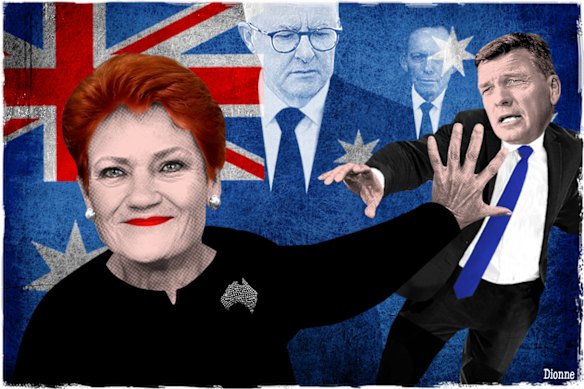
Ross Gittins doesn’t go far enough. Hanson’s rise in popularity is a reflection of the community shifting to the right, of an entitlement mentality that demands minor government intervention and a misunderstood belief in trickle-down economics. Chalmers’ attempt at a modest shift to equality goes against this trend and is therefore unpopular. The Coalition is incapable of providing answers and Hanson is there to pick up the crumbs. Pure and simple. Michael Blissenden, Dural
Courage to change
Angus Taylor may have picked his mark to try to beat up Anthony Albonese, but if he sticks to “broken promises” and “trust” as his main attack points, I suspect he will fail miserably (“How long does Angus Taylor have to save the Liberal Party?”, June 10). As the dust settles from the recent budget, the voters will recognise the facts as being: no one with a pre-existing investment property is adversely affected; negative gearing remains an option for investors, just in new builds (which is what is needed for the housing crisis); and first-time home buyers are already seeing the desertion of investors, which leaves the market more accessible to them. No one adversely affected, no one left behind. Pure Albo. Dale Bailey, St Leonards
The conjecture about broken promises in politics is a bit like arguing what is the correct colour of blue. In every aspect of life, as circumstances change, it is incumbent to react and respond to those changes in the ways seen to best fit. Divorce is probably the prime example. If every government was expected to be held to all its policies taken to an election through a full three- or four-year period, when oil prices go up through no fault of their own, or a pandemic hits, or a meteor strikes, nothing would happen. Except the same people previously involved in demanding they keep to their policies would then be demanding that something be done. Tony Doyle, Fairy Meadow
Rosé-tinted glasses
I’m continually being told that people are “doing it tough”. I’m sure that some are. However, whenever I go out, I see pubs and clubs full of people paying $16 for a chardonnay and $14 for a schooner. I see young people queueing to get into the latest trendy cafe or sandwich shop. I see roads and car parks clogged with expensive, gas-guzzling utes and SUVs, paying $140 to refill. I see queues of a dozen vehicles waiting to pay $60 at a DIY car wash. I hear people boasting about their latest overseas jaunt. I see in the newspapers that we have 17 new billionaires, and the existing ones are up a collective $25 billion since last year. And yet, the opposition continually claims that the government has “wrecked the economy”, and I read of businesspeople threatening to move to New Zealand because they can’t possibly survive in Australia. Meanwhile, the media keeps reporting the “cost-of-living crisis”. As much as I am loathe to quote Pauline Hanson, could someone “please explain”? Leo Sullivan, Haberfield

Hear, hear, Alison Stewart (Letters, June 10), it has long annoyed me that Australians believe they are the only nation experiencing inflation, rising energy costs, rising interest rates and housing supply shortages when it’s happening around the world. We are firmly linked to the global economy and similarly suffer these problems. In the early 1970s, the Whitlam government went through a global fuel shortage and worldwide economic downturn, which led to recession and stagflation in Australia. Just as it occurred then, once again the media and economists seem to be attacking the current government for an economic situation not of their making, while not acknowledging that we are in a far better situation than most OECD nations. Mark Berg, Caringbah South
That’s easy for you to say, Alison, from the leafy green environs of Riverview, where the average house price is $3.5 million. Take a stroll not so far west of the Lane Cove River, scratch the surface and open your eyes – you might see people of every demographic doing it tough. Simon Pitts, Riverview
Press Council finding
Pleased to see the Press Council ruling that confirmed the SMH cartoon earlier this year was completely out of line. Please do better, as my primary teacher would say, encouragingly. Mark Latchford, Seaforth
The Press Council’s adjudication only served to reinforce the uncertain and sensitive atmosphere in which we now live. Each of the groups and individuals portrayed, including the Israeli prime minister, had weighed into the debate over the need for a Royal Commission into anti-semitism in Australia. Understanding and compassion should guide our public and private discourse. The danger, however, is if we narrow and even deny our right to question and discuss issues that affect us all.
Phil Cooney, Wentworth Falls
NDIS rorts
Your correspondent says she knows of cases where deserving NDIS recipients have had their funding cut (Letters, June 10). I know of one case where an NDIS worker has been employed to provide “social support”, only to find herself washing the smalls of her client’s adult sons. It is this sort of exploitation of the system that must be stamped out. Randi Svensen, Wyong
Fur babies
Having paid some vet bills in my time, I would suggest to the young couple interviewed by the Herald that if they didn’t have the two dogs they could probably afford another child (“Cost of second child is too high”, June 10). Jim Croke, Stanmore
- To submit a letter to the Sydney Morning Herald, email letters@smh.com.au. Click here for tips on how to submit letters.
- The Opinion newsletter is a weekly wrap of views that will challenge, champion and inform. Sign up here.


