










Locksley’s mine-to-market game plan is all about breaking that foreign stranglehold. The company aims to fast-track resource development at its Desert Antimony prospect, while teaming up with top US minds at Rice University and Hazen Research in Colorado to pioneer cutting-edge processing and separation technologies.
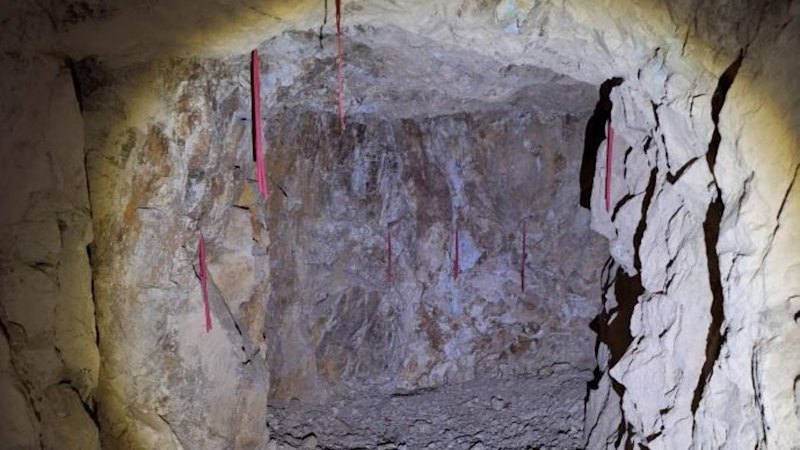
The Desert Antimony prospect sits within the company’s wider Mojave project in California’s San Bernardino County – and while it hasn’t seen action since 1937, it still holds the power to tantalise.
Surface sampling by the company last October lit up the boards with eye-watering grades of up to 46 per cent antimony and remarkably, more than a kilo of silver per tonne, setting the scene for a renewed exploration focus on the prospect.
The strategic parcel of ground is also directly adjacent and along strike from the famed Mountain Pass mine, America’s only operating rare earths mine, held by mining giant MP Materials.
Mountain Pass isn’t just any old critical minerals project either. When it burst onto the scene in 1952, the operation stunned the world with rare earths grades of around 7 per cent – a figure that set the global benchmark for decades.
From the 1960’s through to the 1990’s, Mountain Pass ruled the rare earths world, supplying the bulk of global demand before China muscled in and took over the market.
Carved out of rare earths-rich carbonatite formations and laced with fenite and trachyte dykes, the deposit still stands as a geological marvel. Importantly, it also remains the only place in the United States where rare earths are both mined and processed.
Today, the mine’s strategic importance has skyrocketed, attracting a US$400m investment from the Pentagon and a cool US$500 million from tech bellwether Apple, highlighting the critical role the mine plays in the country’s national security.
Locksley’s latest LiDAR survey marks another tangible milestone in a year of rapid progress for the company. Adding to the momentum, it recently secured a US$191 million (A$288 million) letter of interest from the US Export-Import Bank (EXIM) to support the Mojave development under the Biden Administration’s critical minerals funding framework.
The potential for new funding emerged as a result of the company’s deepening ties with key US Government partners, including the Department of War. That charge is being guided by heavyweight advisory firm GreenMet, brought in to help steer the Mojave project straight into the heart of America’s critical minerals industry and defence supply chain.
With the LiDAR data now in hand, geological modelling underway and Washington’s backing growing stronger by the day, Locksley Resources looks to be positioning itself squarely at the centre of America’s critical minerals revival.
What began as a historic mine rediscovery is fast evolving into a modern, high-tech push to deliver the nation’s first mine-to-metal antimony operation – and potentially rewrite the story of US supply chain independence.
Is your ASX-listed company doing something interesting? Contact: mattbirney@bullsnbears.com.au


