









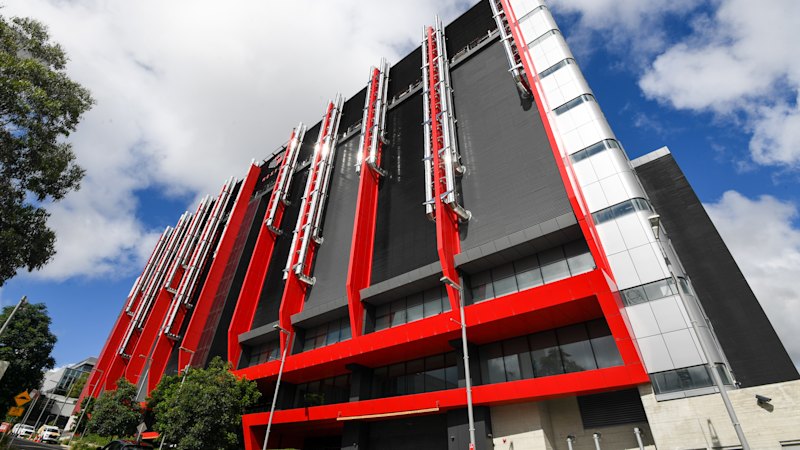


Energy-guzzling data centres will be forced to wind down power use at peak times to guard against blackouts or strain on the grid, Labor has insisted, as it says it must not spurn the advantage of the AI boom as the nation did with its abundant gas supply.
As attitudes towards AI harden in the US, where states are enacting construction moratoriums, Labor’s AI guru Andrew Charlton said Australia’s approach should be “neither boosterism nor alarmism”, as hundreds of millions of dollars of computing investment in NSW and Melbourne prop up Australia’s sluggish economy.
Charlton, assistant minister for science and technology, has announced a “triple-lock” set of obligations to make sure the hundreds of planned physical cloud storage hubs can sustainably fit into the energy grid, at a time when ageing fossil fuel plants and the push to renewables have stoked reliability fears.
In a speech to the Sydney Institute on Wednesday night, Charlton emphasised that tech giants such as Google, Microsoft and Amazon would be expected to “support the [power] system through demand flexibility, to be a grid asset rather than a grid burden.
“That means they must bring their own generation, not draw down everyone else’s. We expect them to pay their full share of grid connection, so those costs are never passed to households and businesses,” Charlton said, according to a copy of his speech provided to this masthead.
“New and clean supply, cover your network costs, and be demand flexible – the triple lock.”
Just as big energy users such as smelters are asked to cut energy use on some hot or cold days, Labor plans to tap the data facilities to power down if the grid is straining and air-conditioning units are running hard across the country.
Data centres took up 2 per cent – not a large proportion – of electricity in the east-coast grid in 2025. However, this is likely to triple by 2030 – roughly equal to the electricity needs of every home in Victoria – according to the Australian Energy Market Operator.
Another obligation Labor plans to impose on owners is that they build enough energy supply to power their operations. This means that in a scenario where a centre powers down when electricity demand is high, households will be able to tap into the privately funded energy flowing from the solar and wind farms that would normally supply the data centre.
At a meeting of federal and state energy ministers last month, Queensland’s conservative government pushed back on the notion of offsetting electricity demand by spending more on renewable energy and storage.
Energy Minister Chris Bowen told this masthead that the majority of states were on board. “Data centres are one of the biggest drivers of new energy demand – we’re acting to make them an asset to the energy grid, not a strain,” he said.
Labor is grappling with the challenge of balancing the risk of job losses and social harm caused by AI with the potentially revolutionary economic uplift. Hundreds of millions of dollars of investment in data centres has propped up Australia’s mediocre GDP as productivity flatlines. Yet unions are raising alarm about potential job losses and debate is rising about the volume of energy consumed by data centres.
In the US, President Donald Trump has raised the vague idea of some sort of public equity stake in big AI companies after OpenAI’s boss put a sovereign wealth fund on the agenda. Last week, Anthropic, the world’s most valuable AI firm, called for a global freeze on AI development due to safety fears, a call welcomed by Charlton.
Pro-AI groups in the US have claimed that China and other malign actors were using the rollout of data centres to foster social disharmony in Western nations, fuelling social media content with exaggerated claims and misinformation about the effect of data centres.
The government is walking a tightrope as it tries to enforce rules to appease voters’ anxiety at the same time as competing for tech sector investment, with major firms asking for speedy regulatory approvals as they decide where they should spend money.
Charlton, a growth-minded minister who helped shoot down an idea from ex-Labor minister Ed Husic to more heavily regulate AI, said Australia should learn from its relatively lax approach to capturing the benefits of its gas supplies.
“We had abundance – but we didn’t lock in our advantage early enough. We built for export before securing supply at home. We became one of the largest gas exporters on Earth and then watched households and factories pay more for gas dug up beneath their feet,” he said. Labor is proposing a gas reservation, as the Greens and teals push for a new export tax.
“That is the real lesson from gas for data centres: it’s far better to get the rules right at the outset than to try to put them right a decade later.”
Charlton said Australia had to get its AI rules right so that the social licence for cloud storage was retained and the nation could build out its own tech industry.
“Moody’s expects global data centre investment to reach three trillion dollars over the next five years. The annual capital budgets of individual firms like Amazon and Google now rival the economies of mid-sized nations. Comparable surges, such as railways, electricity and telecommunications, rolled out over generations. This one is similar in size, but it is being compressed into a single decade,” he said.
Critics of the tech industry have cast doubt on the prospect of Australia creating its own AI products. Tech industry figures have been pushing for a copyright exemption to hoover up Australian content for new AI models, which is being fiercely resisted by creative sectors.
“Over time, the AI boom may have a more profound impact on the Australian economy than the resources boom,” Charlton said.
“[Date centres] are the engine room beneath cloud services, software firms, medical research, financial systems and the next generation of Australian start-ups. Their worth is not just what happens inside the shed. It is what they make possible everywhere else.”
“The nations that hold large-scale computing infrastructure will have far greater capacity to develop, deploy and shape advanced AI, and to do it under their own laws, for their own purposes. When Australian government activities, Australian research and Australian AI models run on Australian soil.”
“In the 19th century, economic power rested on coal. In the 20th, it rested on oil. In the 21st, it will rest on computation; and data centres are where computation is made. AI is the story. Data centres are simply where the AI happens.”
Cut through the noise of federal politics with news, views and expert analysis. Subscribers can sign up to our weekly Inside Politics newsletter.


