



It’s lunchtime in Brisbane’s CBD in late February, and workers flooding out of their air-conditioned towers into a steamy 31 degrees have hit even more stifling conditions in King George Square.
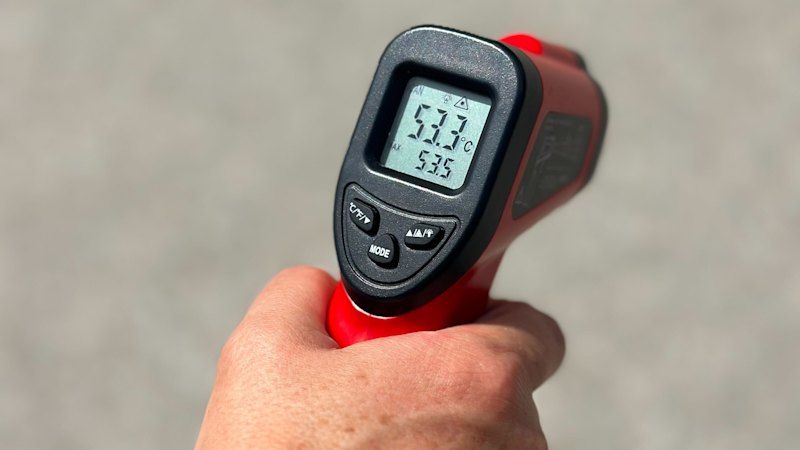
While the dark paved surface reaches 47 degrees, the surface temperature under one of the square’s few shade trees is just 29 degrees, according to a reading from an infrared thermometer gun.
The plaza outside City Hall is one spot in the CBD where temperatures soar in the sun.
Its $28 million 2009 revamp was widely pilloried for removing the fountains and grass lawns. But despite being a council election issue in 2012, 2016, 2020 and 2024, the square remains largely unchanged.
Anna Campbell from Queensland Walks joined this masthead to heat-test city locations on a 31-degree day.
Our testing showed the Bicentennial Bikeway was almost 42 degrees in the sun, but just metres away in a section shaded by the Riverside Expressway, it was 28 degrees.
On the sun-exposed Victoria Bridge, which connects Queen Street Mall to the Cultural Centre, temperatures were recorded at 50 to 54 degrees.
Shade was to be installed on the bridge as a Queensland government condition for green-lighting the Metro project, with an artist’s impression of its shaded footpath on the front page of the council’s Walkable Brisbane strategy.
Three years ago, the plan was shelved to cut costs. But more recently, an application for the $13 million cost of the project was submitted under the SEQ Liveability Fund as part of the City Deal, with a decision expected within weeks.
The Walkable Brisbane strategy, released in 2023, reiterated its target of 50 per cent shade for footpaths and bikeways in residential areas by 2031.
But the ABC last year revealed an internal council review that warned shade cover had declined from 35 per cent to 32 per cent over a 10-year period, and it did not expect the target to be met.
This masthead asked the council what percentage of footpaths and bikeways were shaded this year, and whether it expected to meet its 50 per cent target a year before the 2032 Olympic and Paralympic Games. No response was forthcoming.
Researchers have warned that urban development creates “heat islands”, such as that in Bowen Hills, where a convergence of roads, tunnels and overpasses can push up temperatures by almost five degrees.
Councillor Tracy Davis said the council had planted almost 40,000 trees at bus stops, in parks, along footpaths and at community events over the past three years, and was working with Greening Australia to plant 1 million native plants across Brisbane by 2032.
“About 80 per cent of Brisbane’s suburbs feature more than 20 per cent tree cover, which is far more than Sydney or Melbourne,” Davis, the council’s environment, parks and sustainability chair, said.
Student Amy Limbourn said she usually caught public transport to the University of Queensland, but none of the bus stops near her home had shelters.
Limbourn said she burnt easily and had a family history of skin cancer, so wanted to stay out of the sun.
“There have been instances where I’ve been standing waiting for a bus and I’ve felt faint because it’s been so hot,” she said.
“It just pushes me away from attending uni in the summer months.”
Queensland Walks has launched a campaign, Baked Before Boarding, asking people to nominate bus stops or train platforms where there is little or no shade or shelter, and nowhere to sit.
The organisation is calling for more trees, shelters, cool materials, water access, and better bus stop design and placement.
“Queensland has some of the highest ultraviolet levels and skin cancer rates in the world, and cumulative exposure at everyday places like bus stops and train platforms significantly increases long-term risk,” Campbell said.
“If we want people to choose public transport, we have to make waiting safe, dignified and bearable in the Queensland climate.”
Some examples from the campaign included the Roma Street bus stops in front of the train station, the Milton Road bus stops near the train station, and the west-facing stops on Gympie Road and Caxton Street.
Some of the best cool and covered spots to wait or walk included the underground King George Square bus station, the South Bank green arbour, and the Neville Bonner Bridge.
A Transport and Main Roads spokeswoman said it worked with councils to determine suitable bus stop locations, including potential upgrades or relocations.
“TMR provides a significant amount of grant funding to local councils, as the asset owners, to upgrade existing bus stops and build new ones,” she said.
Neil Backer, from Queensland Rail, said every south-east Queensland train station had shelter and seats, with many also featuring drinking fountains.
Six stations were recently upgraded with improved seats and extended platform shelters to give at least 60 per cent coverage.
Start the day with a summary of the day’s most important and interesting stories, analysis and insights. Sign up for our Morning Edition newsletter.
