







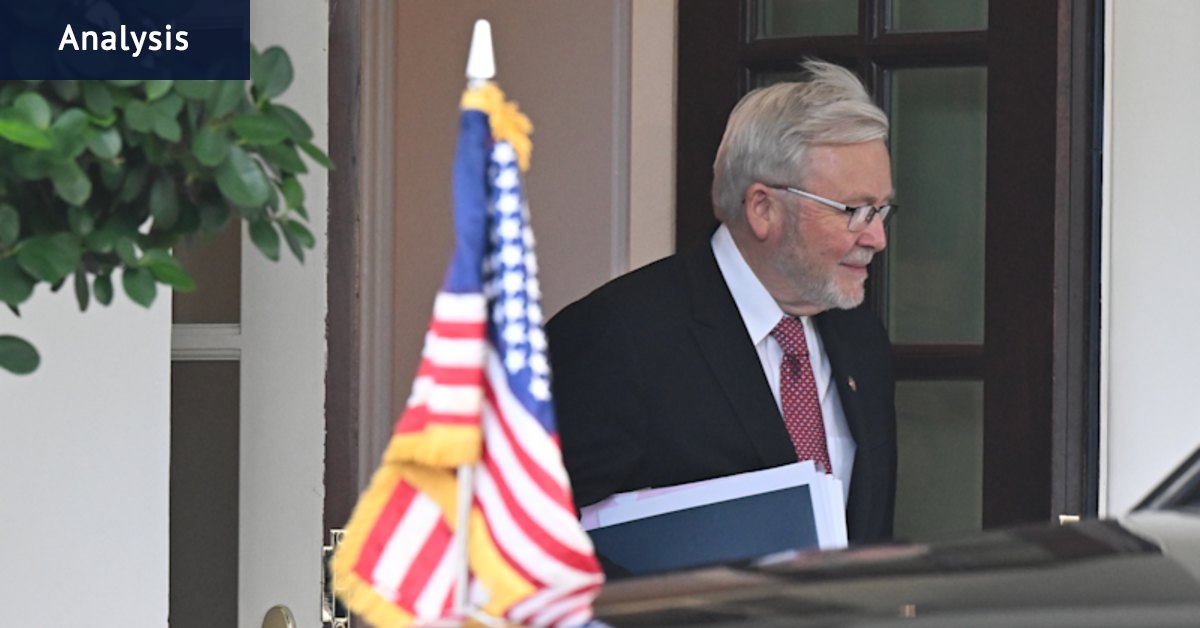
“The driving force from what I understand was Rudd taking the lead on the policy front. But there’s a lot of work to make sure this actually eventuates.”
Edel says Rudd was widely respected in Washington, and regarded as a “ball of energy”. He was able to put the relationship on a stable footing, move AUKUS forward and think critically about how the US and Australia could confront Chinese coercion, particularly on the economy.

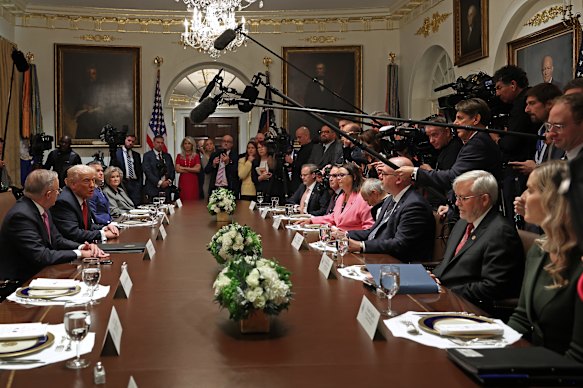
US President Donald Trump (second left) and Australia’s ambassador Kevin Rudd (second right) at the White House in October last year.Credit: Getty
“He leant into all three of those and had results. That’s a successful tenure as ambassador in a very unstable situation,” Edel says.
“There were people he did not get along with, or people who used him for their own purposes. But [Trump’s] cabinet members … got along well with him, had complimentary things to say of him.”
Rudd’s disparaging, deleted tweets about Trump made him a target for Australian conservatives, and for a time, there was a genuine question mark over his capacity to ingratiate himself with the Trump administration. But Rudd changed the narrative, even repairing Australia’s standing among the MAGA faithful.
“A few months ago, we wouldn’t have been able to come here,” one Trump ally and political appointee told me during an Australian embassy event in Washington early last year.
The danger for Australia is that with this administration, nothing is set in stone, and things can change on a whim.
Most new ambassadors arrive with an immediate recognition deficit. They have to spend six months shaking hands on Capitol Hill and sucking up to the White House and other parts of the sprawling administration.
Given Australia’s priorities and Trump’s focus, it would make sense to appoint someone with some level of background in defence and national security, who is ideally known and respected in Washington.
Loading
And they need to be a political animal. This is an intensely political town and under present leadership, there is no room for people who speak the language of bureaucracy rather than brute politics.
They will have to deal with an administration that has displayed significant goodwill towards Australia, but ultimately follows the money and – at least compared to Canberra – likes to move quickly. That will be a real challenge for a newcomer. As Edel notes, “No one will have [Rudd’s] stature.”
The next ambassador will also have to manage tensions created by Australia’s increasingly censorious and illiberal approach to technology and social media.
This is a major concern for the administration, which is intent on protecting market access and profits for American tech companies, and is aghast at digital services taxes, local content requirements for streaming services and censorship of certain viewpoints.
Loading
If the Australian government wants to persist with that approach, it ought to dispatch an ambassador who can thread the needle with a sceptical administration that has demonstrated it’s not shy to criticise or punish allies that it believes are doing wrong.
Rudd, as a former prime minister and high-profile political figure, was a lightning rod for criticism, much of it overstated. Ultimately, it’s what comes out of Canberra that will dictate Australia’s fate with Trump, no matter who Albanese picks to step into the lion’s den.
Get a note directly from our foreign correspondents on what’s making headlines around the world. Sign up for our weekly What in the World newsletter.


