


Opinion

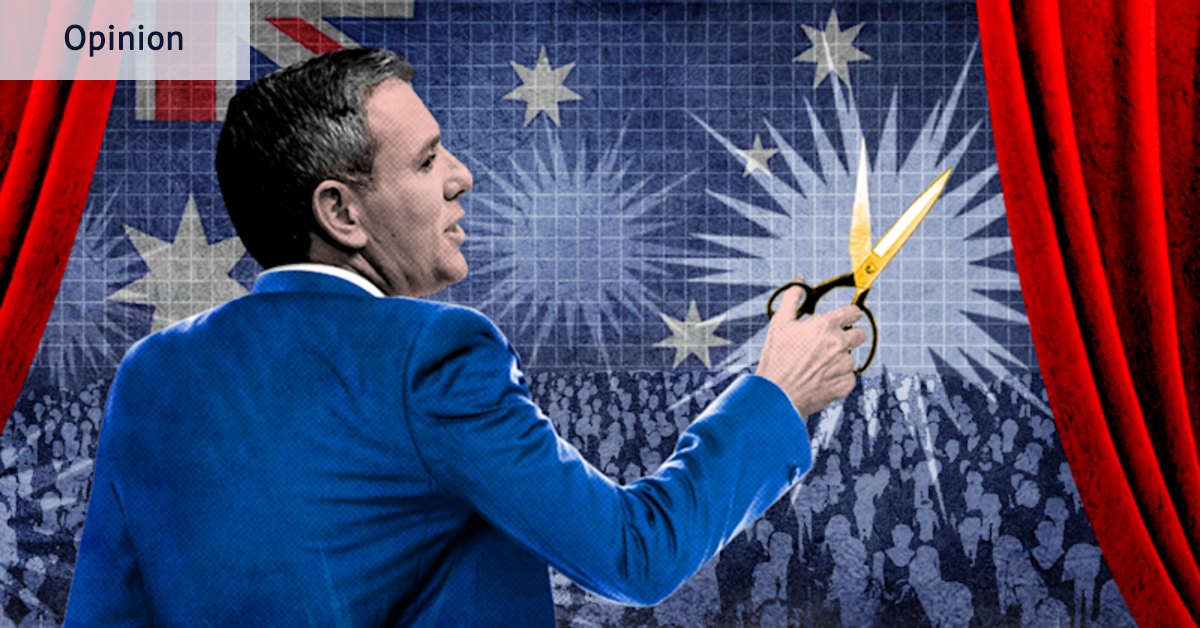
A dramaturg once explained to me that if you want to hit your audience with a particular emotion at the end of a scene, you have to start with its opposite. A scene that ends in a fight between a couple, for example, should begin with them laughing together, thoroughly enjoying each other’s company. Then, when the fight arrives, it is emotionally potent. On this basis, I draw two tentative conclusions. One: Treasurer Jim Chalmers is dramatist. And two: some time in the next two budgets, he will announce significant income tax cuts. Here’s why.
In explaining his tax reform package on Tuesday night, Chalmers outlined what I think is the budget’s most compelling underlying philosophy. “This will help rebalance a system which is more generous to assets than it is to labour,” he said, adding it would encourage investment in “productive assets”. This is the test against which the budget should be measured. It’s what gives the headline policies their meaning. It’s worth noting those ideas, reducing tax concessions for trusts and capital gains, and limiting the benefits of negative gearing, are versions of what Bill Shorten’s Labor proposed ahead of the 2019 election. But the sales pitch then was considerably different.
Shorten couched this all in terms of “fairness”, which boiled down to making wealthy (and some less wealthy) investors pay more tax. That is largely a politics of redistribution, but it says precious little explicitly about production, and our incentives to be productive. Partly as a result, it came off as being tax, rather than tax reform. The Coalition happily framed this as the politics of envy, and sold a story of aspiration all the way to an unlikely victory.
Chalmers’ formulation is sharper and deeper. Sharper because it takes a fuzzy concept like fairness and gives it definition by explaining that the unfairness begins with work being taxed less favourably than passive investment. Deeper because that definition goes to the very fundamentals of how our tax system is built. Yes, this is about our ballooning crisis in housing affordability. But it’s about more than that. It’s about the fact our tax system tells you that if you earn money by working, you’re a fool. You should instead be earning it by owning an asset whose growth is basically guaranteed, and which requires you to do nothing much. Then, you should proceed to do nothing much.
That’s obviously perverse. We should be taxing what is productive less than what is not. And that has always been the problem with our national property obsession. Working is self-evidently productive. Buying an existing house as an investment property is not. It produces nothing that didn’t already exist. If we want more of what’s productive, it follows we should send tax concessions to workers and not to investors in existing property. But we do the reverse.
A similar analysis applies to different kinds of assets. Building a new property is productive, which is why the government wants to retain the negative gearing concessions it attracts. But equally, investing in businesses via shares, or building a business of your own is also productive. A business is the result of innovation, risk, and a huge amount of work. It puts new products and services in the world and likely employs people. In a case like that, a capital gains tax concession is a very good thing. It gives people an incentive to take on the necessary risk. And yet, on capital gains tax, this budget treats all assets the same: businesses and existing property alike. Yes, there are other tax concessions available to business, but even so, it is confounding that the noose on capital gains tax is tightening just as much for these entrepreneurs as for the unproductive investor.
Perhaps as a matter of narrative, such distinctions are lost in the weeds. Far more pronounced is the absence of any serious income tax reform. If your aim is to “rebalance” the tax system in favour of “labour” rather than “assets”, you need to approach it from both directions. Shorten’s mistake in 2019 was that when he targeted investor tax concessions, he didn’t tie this to tax cuts for workers. Had he done that, it would have been a very different public conversation. Shorten has since admitted that if he could do it over, this is exactly what he would do.
So, Chalmers announced a tax cut. The trouble is that its centrepiece is an underwhelming tax offset, weighing in at $250 per year, to be paid from mid-2028. The Greens’ line that this amounts to $4.81 per week in two years’ time is a quietly devastating one. This policy left a gaping hole for the Coalition to fill in the form of a more generous tax cut. If the government wants to give the impression it is changing the fundamental equation in favour of the worker, it needs a bigger statement. To this extent, the budget falls short of its own test.
Imagine, for example, if Chalmers had announced he was indexing tax brackets to inflation, eliminating bracket creep in a stroke. The pro-labour message of that would have been unmistakable. If the inflationary effect of this is a worry, it could have been announced now with a delayed start date, much like the current offset: a statement of clear intent without the fiscal irresponsibility.
How dramatic would that have been? Actually, too dramatic for any government because no government will give up the budgetary windfall of bracket creep. But also, too dramatic this far out from an election. That’s why I suspect this story isn’t over. Only serious tax cuts will complete Chalmers’ narrative. Perhaps he reasons they’ll be most potent if the tax-cut scene begins as it did this week, in a relatively underwhelming place. That sets up a theatrical election eve with the most dramatic story arc. If so, full marks for dramaturgy. But it only works if the Coalition hasn’t stolen the show in the meantime.
Waleed Aly is a broadcaster, author, academic and regular columnist for The Age and The Sydney Morning Herald.
The Opinion newsletter is a weekly wrap of views that will challenge, champion and inform your own. Sign up here.
 Waleed Aly is a broadcaster, author, academic and regular columnist for The Age and The Sydney Morning Herald.