


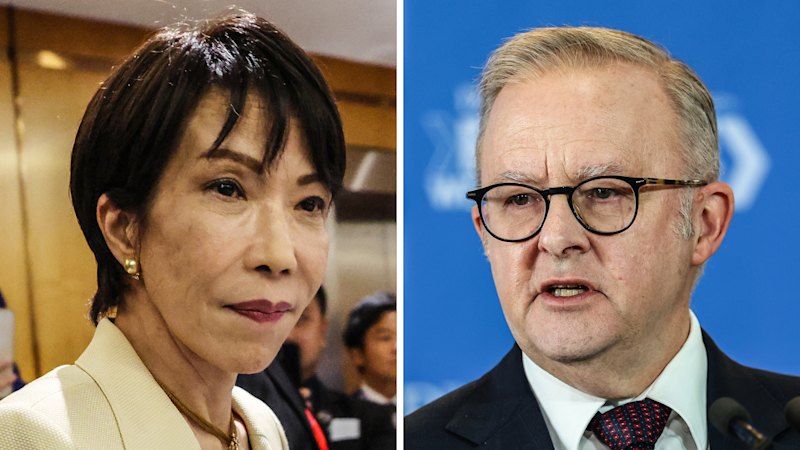

Australia’s plan to acquire nuclear-powered submarines through the AUKUS pact is so risky the nation should ask to lease submarines from Japan as a fall-back option, a former senior defence official has said as Sanae Takaichi arrives in the country for her first visit as Japanese Prime Minister.
Japan’s first female prime minister,– who won a landslide election victory in February after taking a hawkish approach to China, was due to arrive in Canberra late on Sunday night ahead of meetings with Prime Minister Anthony Albanese in Canberra on Monday.
It is expected that Albanese and Takaichi will focus on bolstering economic security by shoring up energy and gas supplies in response to the closure of the Strait of Hormuz and partnering on critical minerals to minimise the risk of economic coercion by China.
Japan’s former ambassador to Australia Shingo Yamagami urged the leaders to work together to ensure the Trump administration remains focused on the Indo-Pacific and does not allow Beijing to fill a power vacuum in the region.
Richard Gray, who served in several senior defence roles, including as deputy director of defence intelligence, called for Albanese to ask Takaichi whether Japan could offer Australia a “plan B” in case AUKUS hits major hurdles.
Gray said there was a troubling chance Australia could be left without a sovereign submarine capability if problems emerged with the plan to extend the life of the navy’s ageing Collins-class submarines, to acquire Virginia-class submarines from the United States and to develop a new class of nuclear-powered submarine with the United Kingdom.
“To assist in managing these three areas of separate but compounding significant risk, Australia should explore the back-up option of leasing or otherwise rapidly acquiring small numbers of an advanced conventional submarine capability from Japan,” Gray writes in a new report for the Australian Strategic Policy Institute.
“Japan has a comparatively large, ‘young’, highly capable conventional submarine fleet. It has two active production lines that together turn out an advanced submarine each year and have the potential to ramp up production even further.
“It’s also one of Australia’s few international partners with the depth of trust and a similar view of the international security situation necessary to make this option a viable one.”
Leasing conventionally powered diesel submarines from Japan could tide Australia over until the more potent, long-range nuclear-powered submarines arrive, he said.
“Given the depth of the request that Australia would be making of Japan, engagement needs to begin now for this option to be a realistic possibility,” he said.
“As well as the political and diplomatic dimensions, there would be a significant number of practical matters that would need to be put in train as soon as possible, including investigating costs and funding, industrial production, visits by crew and vessels to begin familiarisation, and so on.”
Gray noted that the Japanese military operated a fleet of 24 diesel-electric attack submarines, including seven Oyashio-class, twelve Sōryū-class and five Taigei-class vessels.
“Japan possesses a large, modern, technologically advanced submarine fleet with, potentially, capacity to spare,” he said.
Gray said that, unlike some defence experts, he was not calling for Australia to abandon AUKUS, but he said leasing a small number of boats from Japan “would avoid most of the risk of a decade-long gap in submarine capability”.
The chair of a British parliamentary inquiry examining AUKUS last week said “cracks are already beginning to show” with funding of the pact, underlining the challenges the three nations face to make it a success.
Australia has signed a contract to buy Mogami-class frigates from Japan, reflecting the deepening defence ties between the nations.
Senior defence official Hugh Jeffrey told a conference in March: “Defence has been directed to pursue AUKUS and we are pursuing AUKUS and that’s our plan. I would not venture into the space about ‘Plan B’ or ‘Plan C’.”
Shingo Yamagami, who has known Takaichi for many years and advises her informally, said her decision to travel to Australia soon after her crushing election victory reflected the growing importance of the Japan-Australia relationship.
Asked what the priority should be for the trip, Yamagami said: “We need to compare notes, and we need to speak with one voice as two leading resident powers in the Indo-Pacific.”
With the Trump administration focused on the war with Iran, he said: “In the absence of US attention to this region, there will be increased likelihood of adventurism by authoritarian states. There is certainly a power vacuum going on, and we can be careful not to create any sort of vacuum which can be taken advantage of by our adversaries.”
Yamagami, who served as ambassador from 2020 to 2023, said he believed Takaichi would be “willing to have a very, very candid dialogue with Anthony Albanese on China”, noting she has a much more conservative worldview than the prime minister.
“When it comes to China, Albanese is eager to stabilise Australia’s relationship with China, whereas Japan would like to stop being sycophantic toward the Middle Kingdom,” said Yamagami, who attracted attention in Canberra for his hawkish commentary on China and left his posting earlier than expected.
However, the pair share a love of music: Takaichi played drums in a heavy metal band and Albanese has a love of DJing and rock music.
Takaichi last year told the Japanese parliament that a Chinese attack on the self-governing island of Taiwan could constitute an “existential crisis for Japan”, allowing it to take military action.
A furious Chinese government cut off the supply of rare earths to Japan as retaliation, but Takaichi’s stance proved popular with the Japanese public, who handed her a parliamentary supermajority.
 Matthew Knott is the foreign affairs and national security correspondent for The Sydney Morning Herald and The Age.Connect via X, Facebook or email.