


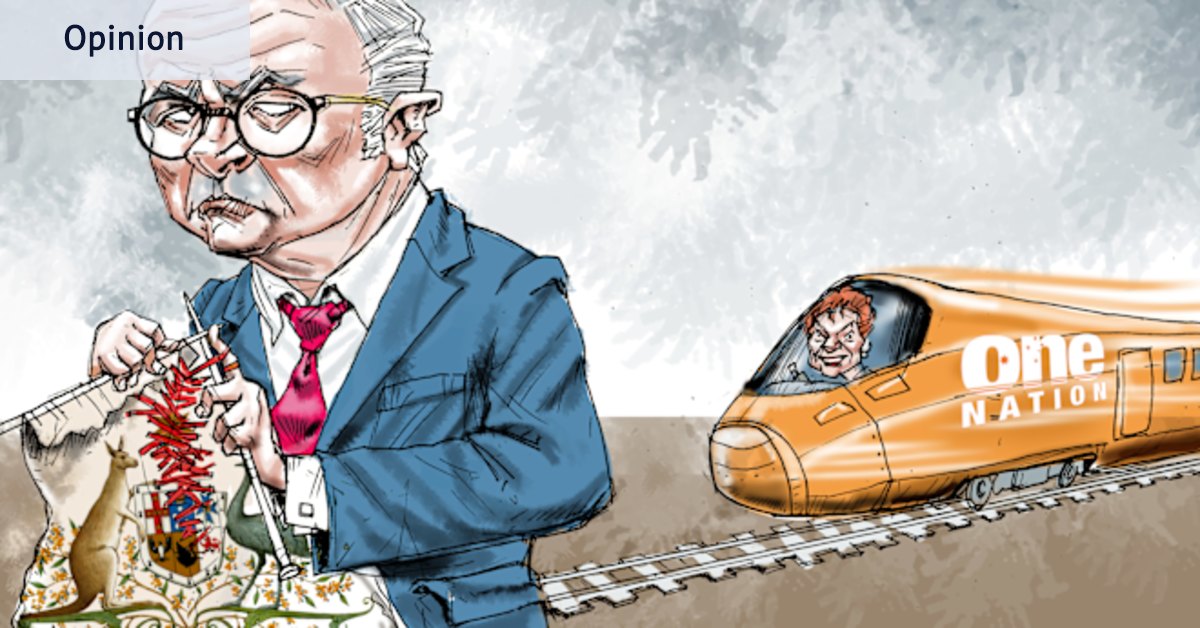
Australian politics right now is operating in three worlds. Those worlds are separate – atmospherically and substantively – but are beginning to overlap. That intersection will dictate the coming months and possibly the next election.
The first world is politics-as-normal. Despite the One Nation drama, this remains the central narrative: the throughline. It lies in actions rather than words: the government delivered a budget and is now fighting to deliver it. Despite feverish commentary, post-budget polling has not yet been calamitous for the government and Labor has responded correctly: kept calm and carried on. This is in keeping with Labor’s tone since 2022. More on that story later.
The second world is the One Nation Express and the crazed sense of drama surrounding it. This will likely increase this week with Pauline Hanson’s appearance at the National Press Club. These speeches are usually seen as consequential. This one may be. But it is equally possible it is irrelevant: that there is nothing Hanson could do at this early point that would derail her.
The truth is that nobody knows precisely what’s behind One Nation’s rise. Its rapidity suggests that voters are volatile, that there is a high degree of emotion in the electorate: anger, frustration, bewilderment. It is also connected to the fading ties between voters and major parties. But these are not explanations so much as restatements of the facts.
There is much talk of the Bondi atrocity as a factor – but also, just beforehand, Barnaby Joyce joined One Nation, which confuses things. You could say the budget contributed to One Nation overtaking Labor, but again it was preceded by another significant event, the Farrer byelection.
The clearer fact is this: One Nation’s rise began not long after the last election. As my colleague James Massola has noted, that partially coincides with Coalition chaos. The other coinciding fact is that, after falling for some months, inflation began to rise again.
A simple argument presents itself: that the second coming of inflation dramatically exacerbated people’s frustration with their lives and with government and occurred while the Liberal Party was proving itself unviable. Voters have to express their anger somehow – and that’s what we’ve seen.
It would be too easy for Labor to see this as a repeat of its first term: inflation makes voters angry before Labor wins them back. This could happen. But a story that begins the same way does not always end the same way. In this case, assuming that it will risk skating over a significant but so-far unaddressed question. Instead of only asking what made possible One Nation’s rise, we need to begin asking what its rise makes possible.
The mere fact of its rise makes the situation different to Labor’s first-term inflationary crisis – in two ways. The first is that it could normalise the racism One Nation deploys, allowing ugly sentiments to bubble to the surface of public debate even more than currently. A kind of angry, performative, xenophobic selfishness might spread.
The second is that One Nation’s polling success could make voters everywhere see that change is possible. Describing this merely as protest misses its potential. It begins in protest – the sense of being against something. But momentum can be generative: suddenly, others – even those unsympathetic to One Nation – begin to contemplate the fact that something new is possible, in party politics and society more broadly. This shift could head in any number of directions, turning into further support for One Nation or the creation of new parties, with new policies.
Here we come to the way in which Labor is not merely maintaining the tone of its first term. Then, its rhetoric was often conservative, as columnist Shaun Carney noted early. When Anthony Albanese explained what he meant by “fighting Tories”, he said “not giving up gains that have been made”. In pursuing “the Australian way”, he meant not becoming American. Labor presented itself as the option you chose if you wanted to keep things as they were.
Now, though, in remarks he must know will be noticed in the current environment, Albanese speaks of “a system that isn’t working for people”. People’s frustration with the economy failing to serve them, he says, is “not just a vague feeling – it’s a reality”. This is a significant admission from the leader of the nation that the structure of our economy and society is failing. And this comes in the context of a budget in which Labor – having spent four years trying to bring everyone with them – took a side, that of the workers over those earning income from assets.
The question facing Labor, then, is whether it can straddle two positions: the steady-as-she-goes approach of its first term and the more revolutionary attitude of its second. Take Chris Bowen’s words on the weekend, trying to do exactly that: “Anthony Albanese will lead a stable, reforming, changing government.” In this attempt, has Labor found the right balance? Or, in trying to be too many things, does it risk failing in all? In which case, does it need to go still further in the direction of dramatic change to the “system”?
The other world on its way to us is that of massive change wrought not by governments but by other forces. A strong El Nino may be on the way, bringing climate chaos. AI seems set to bring huge changes to work. Labor will have to incorporate these, too, into the approach it lands on.
We appear to be entering a crystallising moment for this Labor government. Its character is changing, but the precise nature of that change remains undefined. What does it keep from the old and what does it take from the new? How does it achieve some level of consistency while also meeting the moment?
Not coincidentally, voters now face much the same question, as we begin to grasp that the political landscape of recent decades is not permanent. What do we keep from the old – and what might we actually want, if something new is genuinely possible?
Sean Kelly is a regular columnist and was an adviser to former prime ministers Julia Gillard and Kevin Rudd.
 Sean Kelly is author of The Game: A Portrait of Scott Morrison, a regular columnist and a former adviser to Julia Gillard and Kevin Rudd.Connect via X.