



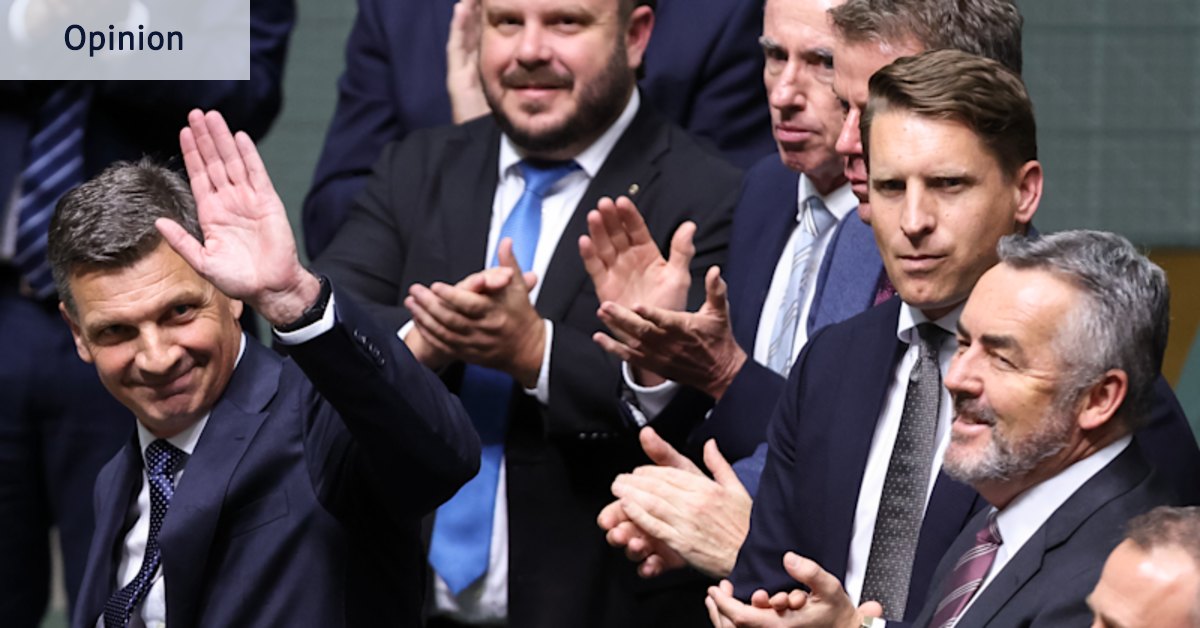




NSW Liberal leader Kellie Sloane wants us to stop “bagging men” and calling them “toxic”. Instead, she says, we should celebrate “healthy masculinity” and “champion top blokes”.
As reported in The Daily Telegraph this week, the opposition leader announced that, if elected to government, she would set targets for reducing male suicide, and improve access to men’s health services. The article had the unhelpful headline: “Male lives matter, too”, which was both defensive (who said they didn’t?) and had the capacity to make others defensive because it sets “male lives” against the lives of another, unnamed group, which can only be women.
The headline is a shame because Sloane is onto something. Men do have unique challenges in their physical and mental health. And while the term “toxic masculinity” has entered the lexicon for a reason – it describes something tangible and easily observable in our culture – it probably does alienate the majority of men who are not abusive or misogynistic.
Whatever the justice of the cause, Sloane, as a politician, is also latching onto an issue that she believes will be popular; something that will gain traction with a segment of voters she needs to win over. With One Nation lining up as the Coalition’s biggest electoral threat nationwide, that voting cohort is easily identifiable – socially conservative voters who might be tempted to vote One Nation.
Such a voter might think that feminism has gone too far, and has ended up with men being neglected by policymakers, or even actively disadvantaged by them.
Anti-feminism is a gateway to right-wing populism – the idea that increased feminisation of societies has neutered men, destroyed traditional families and emasculated the male breadwinner. But a concern for male mental health does not make you an anti-feminist. There is evidence that men are suffering social isolation at greater rates than women.
In most Western countries, men’s suicide rates are higher than women’s, although women have higher levels of suicidal ideation and suicidal behaviour, including self harm. Researchers call this the gender paradox. (It’s worth noting, too, that Indigenous Australians die by suicide at twice the rate of non-Indigenous Australians – a fact that is rarely mentioned when suicide comes up in the context of discussions of male mental health.)
Since the pandemic, and since the rise of a sharp gender divide driven by social media and the ravages of populism, there has been much talk of a male loneliness epidemic, particularly in the United States. A 2021 study for the Survey Centre on American Life found that only 26 per cent of men reported having six or more close friends. In similar polling from 1990, Gallup had put the figure at 55 per cent. The same 2024 study found that 17 per cent of men have no close friends at all, which was a huge, fivefold increase since 1990.
But the American Institute for Boys and Men reports something more nuanced. “On broad measures such as overall loneliness, satisfaction with emotional support, number of close friends and time spent alone, men and women look similar,” it says.
Indeed, in 2023, the World Health Organisation declared a non-gender specific loneliness epidemic and launched a commission into the problem. The US Surgeon-General, appointed to lead the commission, said the mortality effects of loneliness were equivalent to smoking 15 cigarettes a day.
However, according to the American Institute for Boys and Men, men do report more social disconnection; that they don’t belong to a community or have a place in the world. They are also more socially isolated in older age.
However, “the large friendship gaps by education level suggest it plays a bigger role than gender in shaping social isolation”. The institute concluded that “the class gap deserves more attention than the gender gap”. In other words, poverty and social disadvantage breed loneliness, regardless of gender.
Data from the Household, Income and Labour Dynamic in Australia (HILDA) survey shows that, across all age groups, men have consistently reported higher levels of social isolation than women.
Social isolation is linked to poor health outcomes, and to suicide. But social isolation – the objective number of relationships one has – is measured separately to loneliness, which is a subjective feeling, and one that Australian women are slightly more susceptible to than men.
On the loneliness measure, the HILDA survey shows loneliness has been pretty stable since 2001, staying between 16 and 20 per cent, but “in most years between 2001 and 2024, females were slightly more likely to report loneliness than males”.
So why all the talk of a male loneliness epidemic? It actually seems to be linked to the rise of the term “toxic masculinity” – because there is so much debate about what causes it.
The idea of a male loneliness epidemic also accords with anecdotal evidence. It seems self-evident that many men struggle to express emotion; that their hurt might lead them to emotionally isolate themselves, and that they believe masculinity means never showing “weakness” in the form of vulnerable feelings.
It is a very broad generalisation, but male friendships tend to be oriented around group activity, whereas female friendships are more likely to be oriented towards mutual emotional intimacy.
As Dan Repacholi, the government’s special envoy for men’s health, tells me: “Where men struggle a bit different to women, is we don’t talk about it as well; we are not as open with having those conversations.”
As for their physical health, men are definitely neglecting themselves. According to the Australian Medical Association, two in five men die prematurely, before the age of 75.
Women are more likely than men to visit a GP in any given year, and 63 per cent of men believe that gender stereotypes, like the idea of “toughing it out” have affected their healthcare choices. Funnily enough, such gender stereotypes are precisely what the term “toxic masculinity” grapples with.
These ideas hurt men and boys as well as women. If we socialise boys to “tough it out”, then we encourage them to ignore their instincts and override their own pain. We teach them to isolate themselves, to not seek help when it’s needed.
As author Ruth Whippman, who wrote a book about being a “boymom”, put it in The New York Times: “Under patriarchy, boys and men get everything, except the thing that’s most worth having: human connection.”
The unique health challenges of boys and men are worthy of earnest attention from governments, and sensible policy responses. But we need to be careful to get the facts straight, so we know exactly what we are dealing with. And we can’t let a focus on men be co-opted by anti-feminist forces because, as the data shows, loneliness is not gendered. It is an inevitable part of the human condition, and it’ll only get worse, the more we are set against each other.
Lifeline 13 11 14
Jacqueline Maley is an author and columnist.


