



It has been more than 30 years since Australia experienced a “real” recession.
The 1990-91 downturn, which pushed unemployment beyond 10 per cent and led to the collapse of many businesses, while scaring the banking sector, remains imprinted on those who lived through it.
Since then, there have been two defining periods of economic turmoil.

Australia, famously, was just one of three developed nations to avoid a recession during the global financial crisis. So successful was the combination of government handouts, deep cuts in interest rates and an enormous stimulus unleashed by China, that tens of thousands of Australian expatriates returned to their homeland from financial centres such as New York and London.
A decade later, the Morrison government shuttered the economy to protect people from a new, unknown and deadly virus – COVID. The economy contracted by 6.8 per cent in the June quarter of 2020, the single largest quarterly contraction since the depths of the Great Depression in the 1930s.
But huge levels of government and Reserve Bank stimulus, and the reopening of the most stringent COVID-related restrictions, meant the economy bounced back from this downturn. Many people and businesses ended the recession with more cash in their pockets than at its start.
Recessions are rare and usually leave behind economic carnage, which in turn has very real human costs. It took almost 15 years for unemployment to return to its pre-1990 level, so devastating was that decade’s downturn.
And yet, according to a Resolve Political Monitor poll, more than one in 10 Australians believe the country is already in a recession, while 64 per cent believe it is destined to sink into one some time over the next 12 months.
Just 15 per cent of those surveyed believe the country will avoid a recession. More people are unsure about the economic outlook (22 per cent) than those who think the economy will get through the next 12 months relatively unscathed.
The war against Iran, and what it has done to oil prices in just eight weeks, has left Australian businesses and consumers so bereft of confidence that they believe economic Armageddon is not just on the doorstep – it has crossed the threshold and is sitting in the loungeroom.
It’s something that Treasurer Jim Chalmers touched upon during his visit last week to Washington, where discussion among treasurers, finance ministers and central bankers was dominated by the war.
Burnt by Donald Trump’s “liberation day” tariff war of April last year, and the supply chain inflation unleashed at the end of the pandemic, there was an air of weariness to Chalmers’ comments.
“It seems every time we meet we’re dealing with new perils and pressures,” he told the assembled ministers and bankers.
“Two major upheavals in two years; five in two decades; a half century now bookended by major oil shocks.”
Chalmers is a regular at the International Monetary Fund meetings that are held in the northern hemisphere spring every year. At each of these gatherings, the fund releases its best guess at how the global economy will perform over the coming 12 to 24 months.
But the uncertainty caused by the war is so high that even the IMF has struggled to get a handle on its impact. It offered three scenarios, ranging from a mild downturn to a global recession that would be dominated by high inflation and high unemployment.
If some of the world’s best economists are unsure about what the future holds, pity shoppers and business owners.
Little wonder consumer and corporate confidence has nosedived, and many believe the country is about to slam into an economic disaster.
The economic reality is that just before the Iran war, the economy was growing at a three-year high of 2.6 per cent, while the jobless rate was sitting at 4.3 per cent. That’s nothing close to a recession.
But the other key indicator of an economy’s performance, inflation, had clearly stepped up, reaching 3.7 per cent. And when the next monthly inflation report is released next week, the first report that will cover the time since the war started, it will have climbed much higher.
Petrol, the single largest weekly expense for most Australians, shot up 47 per cent through March. The national average price grew from $1.71 a litre to $2.53. It’s been worse for diesel users, as prices rose 76 per cent to an eye-watering $3.19 a litre.
For those who prefer to fly rather than drive, Qantas and Virgin added fuel surcharges to their tickets as the cost of aviation fuel almost doubled.
And when transport costs go up, so does just about everything else.
The world’s largest condom manufacturer, Malaysia-based Karex Bhd, said it could have to push up its prices by between 20 and 30 per cent because of higher shipping costs and hits to the goods it needs to make brands such as Durex and Trojan.
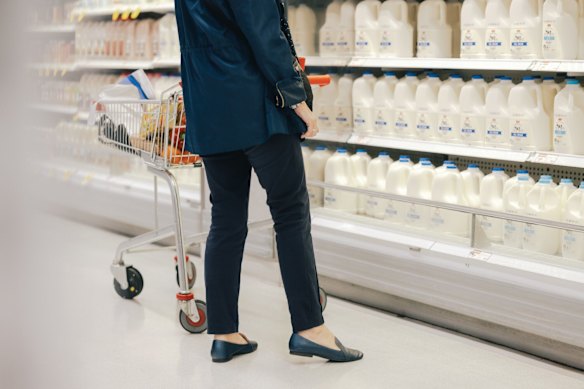
This week, Coles revealed it was pushing up the price of its brand of milk by 20¢ on a one-litre bottle to help cover extra payments to dairy farmers and the price hikes on transport and packaging.
From a trip to the corner shop for milk to go on Corn Flakes, to a roll in the hay, the cost of living is climbing rapidly. And that means many Australians believe this demonstrates we are already in a recession, even if official figures say we aren’t.
Which makes it all the more complicated for Chalmers and Finance Minister Katy Gallagher as they prepare what is one of the most important budgets this century.
Expectations around the May 12 document have been elevated ever since last year’s emphatic election victory. With the government holding a large majority in the House of Representatives, and options to pass contentious laws through the Senate, the politics of a reforming budget are the clearest since Joe Hockey’s disastrous 2014 version.
Years of economic underperformance under both sides of politics, plus the financial headwinds noted by Chalmers, have added to the economic case for major change.
This was amplified by last August’s economic roundtable and the completion of five major research projects by the Productivity Commission into everything from company tax to the aged care sector.
In a major scene-setting speech delivered in Melbourne in late March, Chalmers confirmed the budget would have three major packages covering spending cuts, productivity-enhancing reforms and tax.
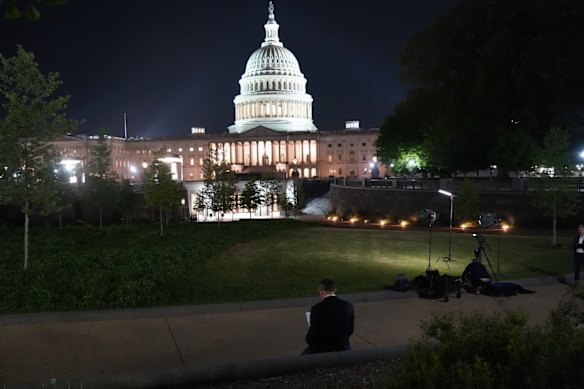
Discussions of a change to the capital gains tax concession, which Albanese could have shut down at any turn, have been left to run.
Some treasurers and prime ministers, faced with the turmoil unleashed by the Iran war, may have tempered expectations, declaring now is not the time for change.
But the government has ploughed on.
At the meeting in Washington, Chalmers said he was doubling down.
“The perils and pressures of 2026 are no reason to park the hard but necessary reforms to make our budgets more sustainable and our economies more productive,” he said.
“The economic fallout from this war is no excuse to turn inwards.”
They are brave words. But as proven by Joe Hockey, who used his 2014 budget speech to draw a line between “lifters and leaners”, words need to be backed by action.
AMP chief economist Shane Oliver reckons that to alleviate inflationary pressures in the economy and make the budget more sustainable, Chalmers has to consider spending cuts equating to a cumulative $102 billion over the next four years.
Not even Hockey’s 2014 budget announced such a large cut. His was a “modest” $29 billion, although bigger cuts in education and health were pushed to unsuspecting states and territories.
“This would require cuts to the NDIS, more aggressive cuts to the public service and more means testing of welfare,” Oliver said.
On Wednesday, Health Minister Mark Butler gave a large sign that Oliver’s hopes may be answered – and signalled reform would be central to the budget.
He revealed the biggest overhaul to the NDIS – the budget’s third-largest expense – since its inception, with expected savings worth $35 billion over four years. Over a decade, the saving approaches $150 billion.
Butler also announced winding back a Howard government-era change to ease the cost of private health insurance.
As Butler noted, the change only hit people over the age of 65.
“In 2026, it’s a policy that’s harder to defend,” he said. “It means two households on the same income receive different levels of government support, based only on their age.
“That’s not fair between generations.”
The extra cash will go into aged care, but Butler’s more general point – equity between generations – is one that will be central to Chalmers’ budget.
The growing anger, evident in support for previously fringe political parties, among young people at the political and economic system has not gone unnoticed by the government.
Many younger Australians, shut out of the housing market and facing enormous insecurity over their employment prospects as tech giants beat the drum of AI, believe the economic dice are loaded against them.
Chalmers’ budget will mark recognition of these and other gripes of young Australians.
But voters who already believe the nation is in recession will have to be convinced by Chalmers that the country needs a tough-love budget with reforms, tax changes and spending cuts that will hurt.
That may be a tough ask. Resolve asked 1807 people how much they believed the government spends on certain discrete areas.
On average, they thought $59 billion would be spent on foreign aid this year. The actual amount is just $4.5 billion.
Those quizzed believed that $66 billion would be spent on unemployment benefits under the Jobseeker program. The real number is $17 billion.
Perception is a long way from reality.
As the impasse in the Strait of Hormuz continues, the chances of long-term damage from the war permeating the economy and the budget grow.
The United Nations, for instance, has noted that without free passage through the strait by June, up to 45 million people in poor nations will go hungry. The absence of fertiliser out of Gulf nations has run into the northern hemisphere planting season.
A crash in corn and wheat production, which could be impossible to make up, looms large.
Poor nations will go hungry. For consumers in rich nations like Australia, it will mean expensive milk poured on expensive Corn Flakes.
Voters could just as easily blame Jim Chalmers and a tough-minded budget for their expensive breakfast as Donald Trump and the Iranian Revolutionary Guard.
Get a weekly wrap of views that will challenge, champion and inform your own. Sign up for our Opinion newsletter.