







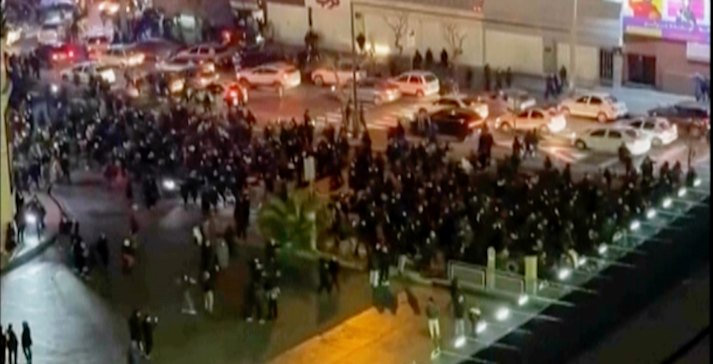
The size of the crowds on Thursday night reminded some participants and observers of the 2009 Green Movement, when an estimated 3 million Iranians took to the streets on a single day in Tehran. In Iranian demonstrations since then, turnout has tended to be smaller and more scattered, in part due to the security crackdown. But not so on Thursday night.
Yaser, a Tehran resident, said in a voice message to The Washington Post while in the midst of a march about 8.30 p.m. that men, women and children had joined in. “They’re out as families,” he said. “You won’t believe it.” Videos shared by Persian-language news outlets outside Iran corroborated his account of large marches in the capital.

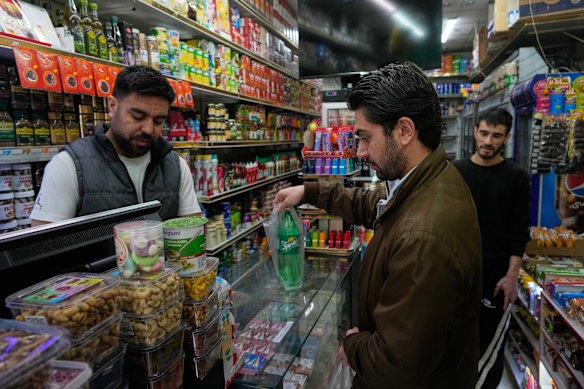
A government cost-of-living handout of $10.45 a month has failed to stem the protests.Credit: AP
Enghelab (Revolution) Street, a popular site for protests, was packed, Yaser said. Some people had lit rubbish bins on fire to ward off the effects of tear gas, he said, though there were far fewer security forces out on the streets than he had expected. As he spoke, chants of “death to the dictator” could be heard in the background.
The internet monitoring group NetBlocks said Thursday that Iran was “now in the midst of a nationwide internet blackout.” The government has throttled the internet in past rounds of unrest, trying to block information about developments from circulating.
Sohrab, 50, a resident of the northern city of Rasht, said earlier that there had been protests at the city’s Shahrdari Square on Wednesday morning. Most shops were closed, and the scene was tense and chaotic, he said.
“A few minutes ago a plainclothes agent was beating a guy in his head and face in front of me,” he said Wednesday. “And then on another corner a group of them started running behind two young guys, but it was impossible to say what they were escaping from and what the forces were after. It is like random bits and pieces of violence here and there.”
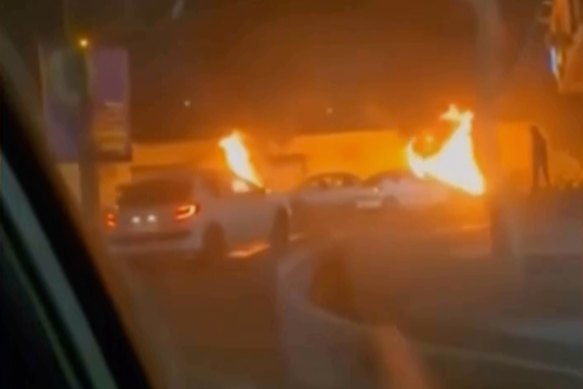
This video grab from footage released by Iranian state television shows burning vehicles during a night of mass protests in Tehran.Credit: AP
Nazanin, 35, lives in Semnan, a city in north-central Iran that has seen little unrest in the past, even during the widespread demonstrations in 2022. But this week, there was a small protest there, she said, with people chanting, “Javid shah,” or “Long live the king,” an expression of support for Iran’s deposed monarchy.
On Thursday, Nazanin said, at least a third of the businesses in Semnan were closed. And they were not alone. In western parts of the country, where the country’s Kurdish population is concentrated, businesses appeared to largely abide by a call by Kurdish political parties to shutter their businesses.
People in Tehran, Rasht and Mashhad – major Iranian cities in different parts of the country – said in interviews that the vast majority of shops in their areas were also closed. Shops that were open included supermarkets, where Iranians were having trouble finding basic goods, especially cooking oil.
Loading
If the suspension of economic activity continues, it could prove significant. Large-scale closures of businesses have been largely absent from past rounds of protest in Iran in recent decades.
“Everyone is on a strike now,” said Amir, a food vendor in Karaj, near Tehran, on Wednesday. “The economy has collapsed. The bazaar has collapsed. One of my acquaintances in the bazaar said, ‘If they want to shoot and kill us, let them! We have had enough’.”
Iran’s government has repeatedly faced street protests, especially since 2017 – an average of one mass protest movement every two years. Each time, the authorities have managed to suppress the demonstrations through force, including mass arrests and killings.
Several Iranians interviewed by The Post pointed to President Donald Trump’s public support for the protesters as adding to people’s motivation to resist. Trump has said the United States would intervene if Iranian authorities kill protesters, though it’s unclear what that intervention would look like.
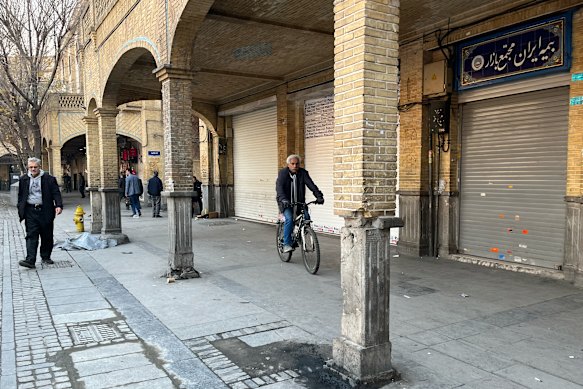
A man rides his bicycle past shops that have been closed during protests in Tehran’s centuries-old main bazaar earlier this week.Credit: AP
Authorities have also been calling and threatening people who post messages in support of the protests on their social media accounts. One woman, a book blogger in her 30s with about 35,000 Instagram followers, said she received such a call last week after praising the bravery of Iranian protesters and urging solidarity. The caller identified himself as an intelligence officer and told her she had 30 minutes to remove her posts or she would face a criminal case.
“This time, all of those injustices that have been done to us have accumulated, and people are out on the street because of those injustices,” she said. “There is a lot more anger this time, and people are much more hopeful. The more it goes on, the more people are coming out.”
Ali Sharifi-Zarchi, a widely respected computer engineering professor at the elite Sharif University of Technology in Tehran, posted a simple, five-word message in Persian on his X account on Monday: “Ali Khamenei’s not my leader.”
It was a startling statement in a country where criticizing Khamenei so directly has long been considered to be crossing a red line, even as Iranian presidents and other officials are often harshly attacked by their rivals and the media. Employment at a public university like Sharif, and indeed any prominent institution in Iran, is impossible for those considered to be firmly and openly opposed to the government. Sharifi-Zarchi did not immediately respond to an email requesting comment.
Loading
Outside Sharifi-Zarchi’s office door, the Basij, the state militia that often cracks down on protests, pasted images of his post, social media posts by Trump and a sign that read, “Speaking in the same voice as the enemy.” The group posted a picture of what it had done to the X platform.
Sharifi-Zarchi, in turn, shared a screenshot of the Basij’s X post and wrote: “The enemies of the Iranian people are those who attack hospitals, deploy tear gas in the metro, and respond to unarmed protesters with live ammunition.”
On Thursday, he had a simpler message: “The victory of the Iranian people is near.”


