







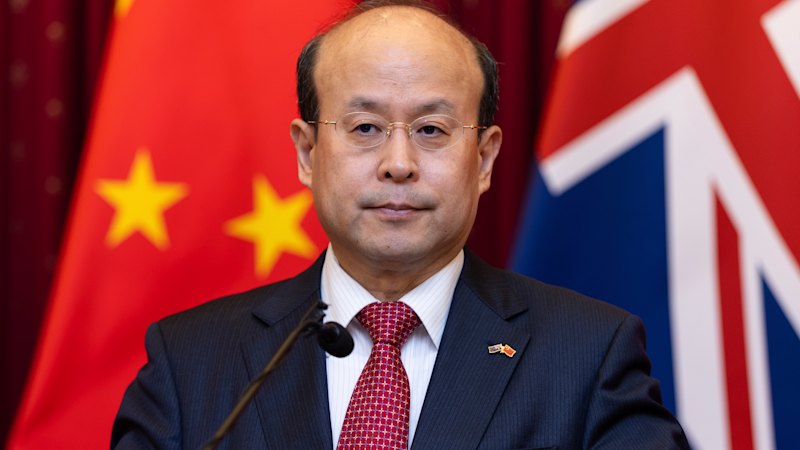
China’s ambassador to Australia says the country’s military activity in the South China Sea and Tasman Sea shows it can no longer be easily bullied by other big powers.
In a rare interview, ambassador Xiao Qian also conceded Iran could be using Beijing’s sophisticated satellite navigation system BeiDou to target US and Israeli military assets in the Middle East, but said his country was not directly involved.
He described the killing of Iran’s supreme leader in joint US-Israel airstrikes as a violation of international law.
“The BeiDou system has been there for decades. It’s for everybody’s use, on a public basis or a commercial basis,” he told 60 Minutes. “And we don’t differentiate who can get access to it or not.
“We are asking for an immediate stop of the war, of the military actions, and for negotiations between relevant parties to solve their problems and solve their disputes through peaceful means.”
China has just increased its military spending by nearly 7 per cent and, as the conflict in the Middle East consumes American resources and shifts focus away from the Indo-Pacific, speculation about its plans to take control of Taiwan have been growing.
Late last year China intensified military actions around Taiwan, a move Xiao described as “a warning” and a “direct response to the large American arm sales to Taiwan”. He said there was no timetable but “in my personal view, as soon as possible. We’ve been capable for decades … we’re waiting for a peaceful reunification.”
Xiao’s comments align with a new US intelligence assessment, which reported that while “Beijing probably will continue seeking to set the conditions for eventual unification with Taiwan … Chinese leaders do not currently plan to execute an invasion of Taiwan in 2027, nor do they have a fixed timeline for achieving unification”.
Nevertheless, Xiao warned that those who did not support China’s reunification, or attempted to obstruct the process, would pay the price.
“There are countries in the world who have been supporting China’s One China policy … but there are also countries who are going the other way around. I expect Australia to keep its promise on One China policy,” he said.
He also rejected claims by the Australian Defence Force that earlier this month a Chinese military helicopter had performed an “unsafe and unprofessional manoeuvre” when it flew dangerously close to an Australian Seahawk chopper over the Yellow Sea.
“The Chinese military has to take actions to protect our sovereignty, territory, integrity, and our reaction was legitimate, reasonable, it was appropriate,” Xiao said.
Last year, in separate incidents, a Chinese fighter jet released flares near an Australian surveillance aircraft in the South China Sea, and a flotilla of Chinese warships circumnavigated Australia and launched live-fire drills in the Tasman Sea.
While Xiao was keen to emphasise the incidents “had nothing to do with the China-Australia relationship”, he admitted they were a clear demonstration of China flexing its military muscle. “We’re no longer a country that can easily be bullied by other big powers.”
He also declared that China – an authoritarian state run by the Chinese Communist Party – was “a democracy in our own way, with Chinese characteristics”.
Tensions between Australia and China have largely thawed under the Albanese government, but the 2020 trade war between the two countries remains a sore point.
Xiao denied Beijing ever placed sanctions on Australian exports in response to the Morrison government calling for an inquiry into the origins of COVID-19.
“That was a response from the Chinese public. The Chinese public were so unhappy about the Liberal-led Coalition government on China’s question of Taiwan … the talk about China being the creator of COVID. When they are angry, they hate to go to the same shops to buy the same products,” he said.
Start the day with a summary of the day’s most important and interesting stories, analysis and insights. Sign up for our Morning Edition newsletter.


