






Tiffany Hsu and Stuart A. Thompson
MAGA merchandise is its own pocket universe in the world of retail.
There are official diamond-studded gold watches for $US100,000 ($145,000), promoted by President Donald Trump. There are less official bobbleheads of Trump, smeared with blood, memorialising an assassination attempt against him.
The industry is a cornerstone of Trump’s political movement, and it is only continuing to evolve.
The president has built a merchandise behemoth unmatched by any other American politician. The vast economy of knick-knacks and trinkets has become a visceral proxy for the energy behind his political movement, with the products acting as billboards for membership in the club.
Trump and his family have made millions from the products – more than $US1 million from guitars and at least $US2.8 million from the watches alone, according to annual disclosures from the president. And he misses few opportunities to market the wares. He shows off hats and T-shirts at his political rallies, his coins and colognes in advertisements and his cuff links and candies to visiting dignitaries in a room next to the Oval Office.
But most of the merchandise business operates beyond the Trump family. A sprawling bazaar of third-party sellers hawks unofficial MAGA wares on card tables during parades and next to animal pelts and Jesus figurines at gun shows. At one point, more than 40 storefronts dedicated entirely to Trump, dotted America’s highways and strip malls. They sell everything from Trump-themed coffee to aprons decorated with the president’s face.
Through dozens of interviews and scores of financial documents, The New York Times mapped the contours of an ecosystem of Trump trinkets that is worth more than $US300 million a year, according to one estimate from a market research firm. The reporting reveals that a once-peripheral world of campaign souvenirs has exploded into a wide-reaching marketplace that both feeds off Trump’s power and reinforces it.
“Every time somebody buys a hat and wears it, it’s like a yard sign,” said Ronald Solomon, president of the MAGA Mall, a retail and wholesale operation based in Florida that sells MAGA merchandise, including at least 160 distinct hats. “It creates votes for him.”
Trump’s official merchandise bolsters more than his campaign coffers – often, it personally enriches the president and his family. He is intent on protecting it, even threatening copycats with cease-and-desist letters and lawsuits. The Trump Organisation won a trademark infringement case just last month.
David Warrington, the White House counsel, said in a statement that the president “has no involvement in business deals that would implicate his constitutional responsibilities”.
“President Trump performs his constitutional duties in an ethically sound manner,” he added, “and to suggest otherwise is either ill-informed or malicious.”
Davis Ingle, a spokesperson for the White House, said Trump was “motivated solely by what is best for the American people”.
Trump has traded on name recognition for nearly his entire adult life. He attached “Trump” in towering letters to buildings in the early 1980s; just a few years later, in 1989, “Trump” was on a board game and an airline he acquired for $US365 million. For a few months in 2007, Sharper Image carried the $US999 Trump Steaks Connoisseur Collection, promising “by far the best tasting, most flavourful beef that you’ll ever eat.” They didn’t sell well.
Trump continued his role as chief marketing officer when he entered politics. In the two months before he announced his first presidential campaign in June 2015, his team spent nearly $US18,000 printing T-shirts to test their popularity.
Trump first donned a MAGA hat in July 2015 – though “Make America Great Again” was not his idea. Ronald Reagan had the slogan printed on buttons and posters during his own presidential campaign in 1980 and Bill Clinton used the phrase when running for president in 1991 and 1992. Trump was the first to trademark it and to profit from it financially.
His campaign eventually spent at least $US2.9 million on hats before the election. By 2016, he had opened an official flagship Trump Store at Trump Tower in New York.
Soon after, entrepreneurs – not all of them supporters – spotted an opportunity.
Richard Kligman sold only kites and beach supplies at his store in Myrtle Beach, South Carolina, in 2016 when something unusual started happening: customers were walking into his store asking for Trump merchandise.
Kligman, who describes himself as apolitical, contacted one of his merchants and asked for Trump flags. The customer demands didn’t stop there.
“It just became more and more and more,” Kligman said. When it seemed likely that Trump was going to win on election night that November, he rushed to his computer.
“I immediately emailed my vendor,” he said. “I said, ‘I need 500 red hats.’ ”
Now half of his store, Klig’s Kites, is devoted to MAGA. He opened a second location in Myrtle Beach and one of his stores was skewered in an episode of South Park. (A third location was closed late last year.)
Many other unofficial merchants began selling bootleg Trump banners and buttons around the same time as Klig’s Kites. These vendors marketed their wares on sites such as Etsy and eBay, on beach boardwalks and state fairs, in strip mall storefronts. They began producing merchandise in the span of hours, printing slogans freshly uttered by the president onto stockpiles of T-shirts – fast fashion, MAGA style.
But their efforts really escalated in 2020. MAGA-minded entrepreneurs in Florida, Ohio, Pennsylvania, Virginia and elsewhere – some of whom had previously worked for carnivals or other businesses crippled by the pandemic shutdowns – saw an opportunity as Trump’s re-election campaign galvanised his faithful.
Last year, there were at least four dozen Trump stores in 22 states, selling everything from bullet-shaped saltshakers to car fresheners scented like piña colada and looking like Trump’s face. In eastern Tennessee, in a county that has not voted for a Democrat presidential candidate for well over a century, at least four Trump stores were operating within just 24 kilometres of one another.
What motivates Greg Chapman, a retired engineer who has helped his wife open three Trump stores – in Alabama, Nevada and Tennessee – is being in on the joke.
“The people who come in here have a great sense of humour,” he said. “Really, that’s at the heart of it – we’ve been accused of worshipping the guy, and nothing could be further from the truth. We laugh with him.”
Trump has embraced an expanding assortment of official merchandise. Revenue from products plastered with his mug shot, including shirts, mugs and posters, added $US1.7 million to his most recent re-election campaign. In 2024, he unveiled a gilded pair of Never Surrender high-tops at a sneaker convention. They cost $US399.
He has even ventured into digital merchandise, offering a speculative crypto product – known as a non-fungible token, or NFT – that he rebranded as digital trading cards. The project netted him $US1.16 million.
No other sitting president has tried to make money from the office the way Trump has, according to several ethics watchdogs. For members of Congress and many federal employees, using public office for private gain is explicitly forbidden by their codes of conduct. There are no comparable rules for the president.
But by fuelling the merchandise economy, the ethics experts said, Trump has created new conflicts of interest and new incentives to leverage his public platform to bolster his own brand.
No other sitting president has tried to make money off the office the way Trump has, according to several ethics watchdogs.
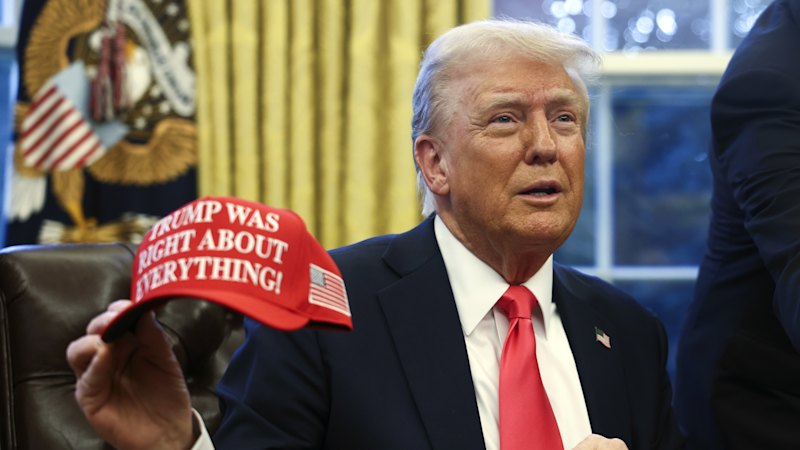
Trump seems unperturbed by the ethics concerns. At an Oval Office event early last year, he held up a red hat with white embroidery and marvelled at it.
“See that?” he asked the room, explaining it was sent in by a fan.
In all caps, it read, “TRUMP WAS RIGHT ABOUT EVERYTHING.”
“I think we should make some of them, right?” he said.
He is not always so complimentary. His team fired off cease-and-desist letters to online merchants such as CafePress in 2015 and several Republican campaign committees in 2021 for selling unofficial Trump products. In 2024, his campaign demanded that a Republican group in Virginia stop selling products featuring Trump after the assassination attempt that summer in Butler, Pennsylvania, referring to the “bootleg Trump merchandise” as a “ghoulish activity” and “in extremely poor taste”.
The Trump Organisation filed a lawsuit last year against unnamed sellers based in Asia for using the word “Trump” on their merchandise. It accused them of infringing the “Trump” trademark by offering “inferior imitations” of Trump’s official merchandise.
This year, a judge issued a default judgment in favour of the Trump team after none of the companies responded to the lawsuit, ordering the 132 largely anonymous sellers – with names such as hot_years1 and Sports Fans Store – to each pay $US100,000 in damages, totalling a payout of about $US13.2 million.
Whether the Trump Organisation will collect is uncertain.
But for a president who thrives on attention, the existence of any Trump product ends up benefiting the brand, said Raji Srinivasan, a marketing professor at the University of Texas at Austin.
“Counterfeits, unsanctioned products, licences, products coming from Trump Org – they’re all vehicles for the core Trump brand,” she said. “It’s Teflon-coated, and this just adds more visibility to it.”


