






About 40 minutes into his 54-minute appearance as a witness in the AFL’s first ever disciplinary tribunal hearing, Frankston’s 22-year-old inside midfielder Darby Hipwell, a law student, leaned forward.
A copy of Hipwell’s record of interview with an AFL investigator had filled the screen minutes earlier as Michael Borsky, KC, a Saints board member, probed him with the intensity that has made him a formidable Supreme and Federal Court barrister.
Hipwell paused before revealing how he had interpreted a question an AFL investigator had asked him, the day after he reported to an umpire that St Kilda opponent Lance Collard had called him “a f—ing f—–” during a melee at Kinetic Stadium during a Friday-night VFL match.
“She was pretty much asking me if I was a homosexual,” Hipwell said.

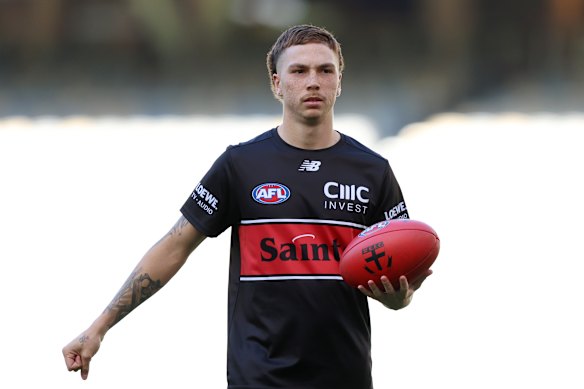
Respected AFL investigator Lyndsey Hicks, a Wakka Wakka/Goreng Goreng woman, had been assigned the job partly because it involved Collard, a Noongar and Yamatji man.
She interviewed Hipwell, his Frankston teammate Bailey Lambert, the field umpire Sam Morgan and others by midday Saturday, the day after the incident.
Hicks had followed due process in her conversation with Hipwell that led him to believe he was being asked whether he was gay. She had to determine whether the case fell under the AFL’s rule covering vilification, known as the Peek Rule, and no one involved was critical of her.
The AFL’s position was that if the person who hears a slur has “the vilified attribute,” then the Peek Rule, introduced as rule 35 in 1995 to deal with racial vilification (since expanded to include other areas, including sexual orientation) via a conciliation process with strict confidentiality provisions, would be invoked. This was established during a review of the rule in 2021.
If not, from the AFL’s perspective, the charge should be laid under the “conduct unbecoming” rule.
Hipwell told Hicks he had not been personally offended. “It didn’t offend me personally, however I have got family members, I have got friends who are homosexual, and I recognise that it can’t be said and it should not be done in that game,” he told Borsky during the hearing.
His response meant if the case proceeded it would fall under rule 2.3 (a) (conduct unbecoming).
It was an exchange that did not go unnoticed.
The AFL said this week they were reviewing the operation of the disciplinary tribunal in the Collard matter – including its impact on witnesses – cognisant of the need to consider how those who appear before the league’s tribunals, including those facing charges, are impacted by the processes. They will also review how to deal with circumstances where the person vilified doesn’t have the “vilified attribute”.
By the Saturday night, the chance for anonymity had passed anyway, with Collard named in the media as the player under investigation for allegedly using a homophobic slur.
The incident
Late in the third quarter the teams came together in a melee after Collard felled Frankston’s Jackson Voss. As the players remonstrated, Lambert turned to umpire Morgan, pointed in his direction and told him he’d heard Collard say the “f” word to Hipwell.
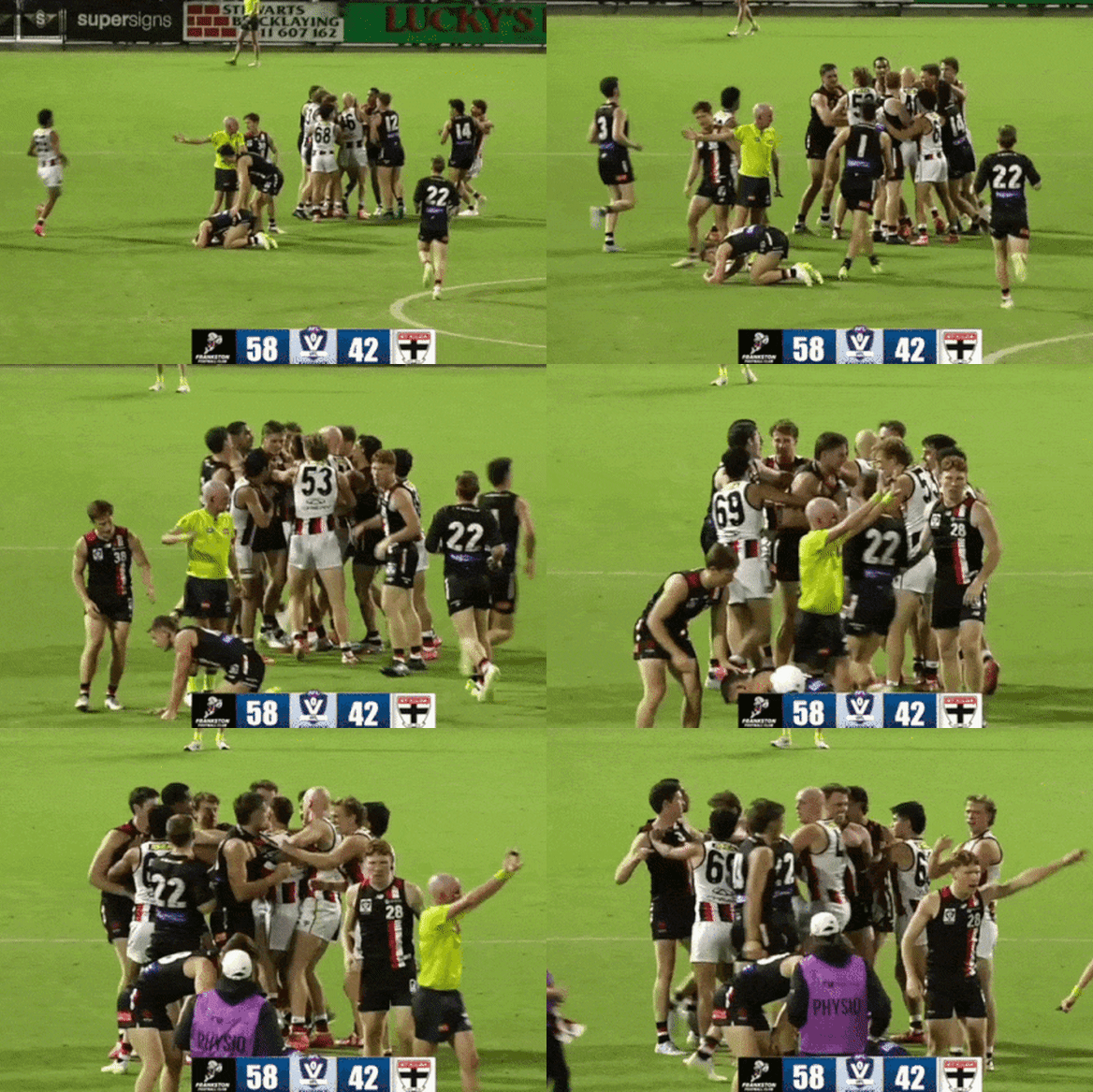
Lambert admitted he was looking for a 50-metre penalty, but he also knew the phrase was outlawed and that Collard had been suspended for its use in a game against Williamstown in 2024.
Hipwell heard it, too. He decided after the game he would make a report, as players are asked to in their training on vilification. The online training – called “Respect is the Ultimate Team Sport” – was developed in consultation with Pride in Sport, with face-to-face training for first-year players.
Post-game, Collard told Saints’ development coach Damian Carroll and football manager Lenny Hayes he had, in fact, called Hipwell “a maggot”.
Morgan alerted the AFL and the AFL integrity unit began their investigation.
As with all such cases, the league’s investigative arm was under pressure to collect evidence and reach a position quickly.
There is logic to the haste – memories fade, positions change, more people become involved, potential publicity affects witnesses.
But the main reason for the urgency is that the public and the clubs involved demand a quick resolution.
After 11 witness interviews, it became clear by Monday night that only two Frankston players had heard the alleged slur. Their version of events conflicted with Collard’s.
This left the AFL with two choices under the conduct unbecoming rule, neither particularly attractive.
The first was to put the incident in the too-hard basket, not reach a finding and leave the complainant and others wondering whether the issue of homophobia was taken seriously.
It wasn’t a realistic option.
The second was to send the matter to an AFL disciplinary tribunal, where a contested hearing that included cross-examination could be brutal. That is also the path if mediation under the Peek Rule fails.
AFL senior counsel Stephen Meade decided on the disciplinary tribunal.
At St Kilda’s request, the hearing would be open to the media.
Inside the hearing
The hearing began via a video link at 1pm on Thursday April 9, 12 days after the alleged incident.
Jeff Gleeson, KC, chaired the panel consisting of former Adelaide player Scott Stevens and Melia Benn, an Indigenous barrister described in her profile as being “passionate about assisting First Nations clients navigate the justice system”.
Andrew Woods, representing the AFL, sat in his office. He sought a 10-week penalty, as it was Collard’s second transgression.
Woods’ proposal alarmed onlookers. Former Magpie and Kangaroo Jaidyn Stephenson was the only player in recent memory to receive a similar penalty, banned for 10 matches in 2019 for placing bets on a game he was playing in.
No player in the game’s history had received 10 weeks (weeks were specified so byes were counted) for using a slur.
Borsky, the only person other than Collard dressed in a suit and tie, sat at a table inside his legal office beside the accused Saint and club legend, the polo-wearing football manager Hayes.
Normally, the cost of assembling such legal nous would be prohibitive, but the AFL pays an honorarium and most lawyers represent clubs pro bono or on a reduced rate.
It did not diminish their approach. The tension was clear.
A five-minute break would be the only pause in the next four hours of exhausting discussion which saw Hipwell grilled for 54 minutes, Lambert for 25 minutes, Morgan for 10 minutes and Collard for 18 minutes. Pride Cup CEO Hayley Conway and Saints Indigenous welfare manager Aunty Katrina Amon were also called by Collard’s legal team to give evidence on the Saint’s behalf.
Hipwell was forthright. Lambert had been convinced to appear when told he might be compelled to do so if he resisted, a reasonable contemplation given he had a family connection to the Saints and had to miss work to give evidence. “We were told at the start it was gonna be one statement and that’s it … but it’s turned into this massive thing, and is huge, obviously taking up so much time,” Lambert said.
His evidence and tone were compelling.
Hipwell and Lambert had nothing much to gain. St Kilda’s lawyer asked them whether they understood the effect a strong penalty could have on their opponent’s career.
The gruelling process raised concern among advocates, including Monash social psychologist Dr Erik Denison, who has been studying the causes of homophobic language in sport and looking for solutions since 2013, about whether it would deter bystanders from calling out slurs in future.
Collard, a quietly spoken young man from Western Australia, appeared nervous and uncertain when his turn came to speak.
It was no wonder.
The stakes for Collard were high. In and out of St Kilda’s side, and contracted until 2027, a long patch out of the game would do his career no favours.
Borsky dramatically described the potential outcome as “one of those sliding-doors moments which could set Lance Collard back on the wrong path and ruin his life”. The tribunal heard he had not had a significant male role model in his life and was financially supporting an ill family member. A family history of incarceration was later aired during the appeal.

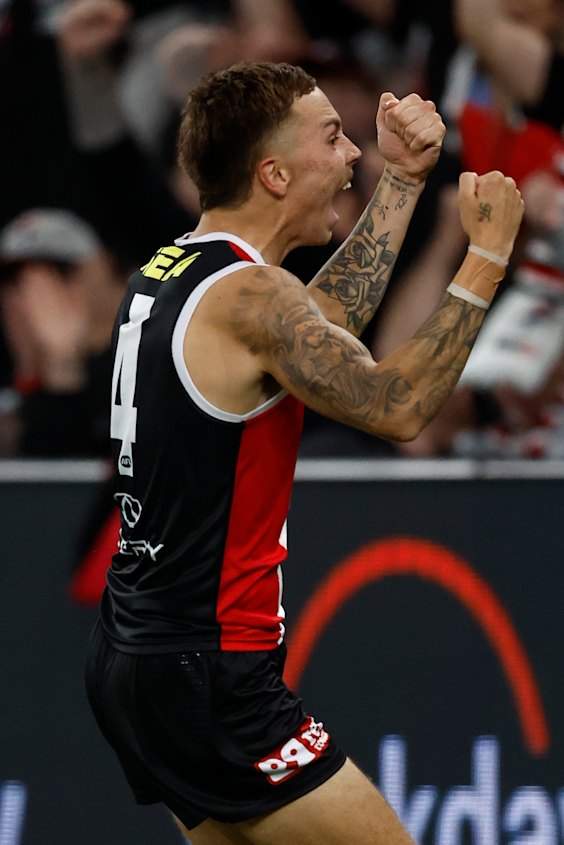
Conway, who ran Collard’s Pride training program after his 2024 transgression, told the tribunal “he was quite remorseful, shy and also really thoughtful in his comments, especially as the session went on”.
Speaking to this masthead after the case, Conway articulated the frustration among many in the LGBTQI+ community that the process led to a heavy focus on the length of the sanction rather than the broader issue.
“There was a lot of concern for the impact on Lance’s career, which I think was reasonable, but there was no concern, no mention and not really any recognition about the careers of gay and bisexual men who have never had the chance to perform in the AFL,” Conway said.
In her evidence, Conway also explained the impact of such cases on the LGBTQI+ community.
“Passionate supporters of football clubs who are on the receiving end of those sanctions don’t often turn their vociferous support towards the actions of their football club, but they turn it towards the LGBTQI community … so we will suffer the consequences as well of ever-increasing sanctions,” Conway said.
“It’s important that sanctions aren’t left as the final port of call. [There needs to be] really proactive engagement with the LGBTQI community and engagement with fans.”
The sanction debate
Sanctions for homophobic abuse have ranged from three to six matches since Jeremy Finlayson was suspended for three games in 2024.
The AFL hoped the deterrence would stop people using homophobic slurs. It hasn’t. Brisbane’s Koby Evans this week became the eighth player suspended in that time when he received a four-match ban for using homophobic language in a VFL game.
“People are using this word because it’s in their vocabulary because we have not done the work to take it out of their vocabulary,” an industry source said.
Another thinks a reset of the length of penalties is needed, with a greater focus on strategies to change behaviour rather than bans. That source said if the penalty was too high, it would become a disincentive for players to make an admission, increasing the likelihood of charges being fought.
Denison says evidence-based strategies are needed, requiring engagement from a club’s coach, captain and influential players to embed an inclusive culture.
He also believes that players found guilty of the offence should, when they are ready and assuming they show the same remorse as Adelaide’s Izak Rankine did after he was banned for four matches at the end of last season, be invited to become advocates for change.
Of course, the purpose of a football club is to win games of football.
They see the potential for distraction.
Others see a shift in club culture as an opportunity for improved performance.
The decision
Collard did not budge on his position once, under interrogation from AFL investigators, pre-trial discussions with Borsky, when signing a statutory declaration on April 2 or during questioning at the hearing.
“I’m being 100 per cent honest. I’m not lying,” he said during the hearing, which his housemate and teammate Nasiah Wanganeen-Milera was following closely.
Hipwell and Lambert were equally adamant about what they heard.
It was left to the tribunal panel to do what courts do every day, weigh up the evidence and reach a decision. They found Collard guilty after contemplating the evidence overnight.
Five days later, a two-hour sanctions hearing was held.
The Saints proposed a suspension of four weeks (with two suspended). The AFL Players’ Association presented a letter on Collard’s behalf. They asked the tribunal to take a holistic approach and find the right penalty (without stating what that was), rather than view the six-match penalty he received in 2024 as their starting point.
The AFL argued for a 10-week ban. At a bare minimum, they sought a higher penalty for a second offence than the six matches Collard copped in 2024.
The tribunal suspended Collard for nine weeks (with two suspended). In effect, with byes he would have missed five matches. It remained a massive penalty. Collard returned to Western Australia for a short break, shattered. The Saints were outraged.
In his reasoning, Gleeson neatly questioned whether penalties were appropriate while his decision showed he felt he had little choice but to increase the penalty for a second offence.
The Saints could not reconcile how Collard received a nine-week ban when others were fined for verbally abusing an umpire or given five matches for violently striking an opponent. They also thought Collard’s circumstances should have been given more weight.
Simultaneously, they emphasised that homophobic language had no place in the game.
After seeking the counsel of two former judges, they lodged an appeal.
Outrage and misunderstanding
The ties were back on as Will Houghton, KC, chaired the appeal process on April 23, supported by panel members Georgina Coghlan, KC, and Stephen Jurica, the former Tiger who sat in heavy glasses in front of a painting depicting a judicial wig.
Arguments related to whether the incident should have come under the Peek Rule, then whether it was open to the tribunal to find Collard guilty, and then, if all else failed, that the penalty was manifestly excessive.
Another 80 minutes passed (bringing the total hours of debate since the disciplinary hearing began to four) before Houghton brought the arguments to an end and the appeals board retired to consider a verdict.
Just 18 minutes later Houghton delivered their decision, along with what would become a controversial reasoning. He dismissed the appeal of the verdict, finding it was open to the tribunal to find Collard guilty before explaining why he thought the penalty manifestly excessive. It was reduced to four matches with two suspended, a finding in line with the Saints request.
His view was clearly that Collard’s career should not be wrecked for the use of a homophobic slur, but part of his reasoning led to another outcry.
Houghton wrote that the offence was less serious than the one in 2024, before citing Collard’s age, background and the fact he is Indigenous as relevant. He then used Hipwell’s response to whether he had been personally offended – he had not – as a reason to reduce the ban.
Sources spoken to admit that whether personal offence is taken is not relevant, although they acknowledge the Peek Rule’s application would indicate that it might be.
There was also a general concession among AFL and industry insiders that a player reporting homophobic language should never be left with the impression they are being asked to declare their sexual orientation, and that the case had exposed a flaw.
In any event, none of those factors had been raised in arguments to reduce the sanction.
If all this was not enough, Houghton outraged the AFL’s perception of themselves when he said it was “commonplace that players can employ language from time to time which is racist, sexist or homophobic whilst on the field.” He also wrote that evidence had been presented to show a lengthy ban would be “crippling” on Collard, when it was a submission.
The next day, four weeks after Hicks interviewed Hipwell to get the ball rolling, Houghton was dismissed from his role as appeals chair.
It was a terrible ending to an elongated process that, in the opinion of many working in the fields of football and inclusion, failed to advance the cause of eliminating homophobia from the game.
The AFL is not hiding from the questions it raised. Their review of the tribunal system will consider the hearing and sanctions for vilification, including homophobic slurs.
Conway summed up the dissatisfaction.
“We have collectively allowed it to become a judicial system where we only address individuals and individual offences. When you focus on that you take the focus away from the systemic challenge, and that was the greatest travesty for LGBTQI+ people in the whole Collard process,” Conway said.
A week later Collard returned to play for the Saints in the VFL against Carlton. Frankston were advised not to comment, so Hipwell’s thoughts on the outcome remain unknown.
An unfortunate thought entered a source’s head as they reflected that “more harm may have been created by the process than what was said on the field”.
“A deeper learning opportunity was lost,” they said.
Keep up to date with the best AFL coverage in the country. Sign up for the Real Footy newsletter.


