








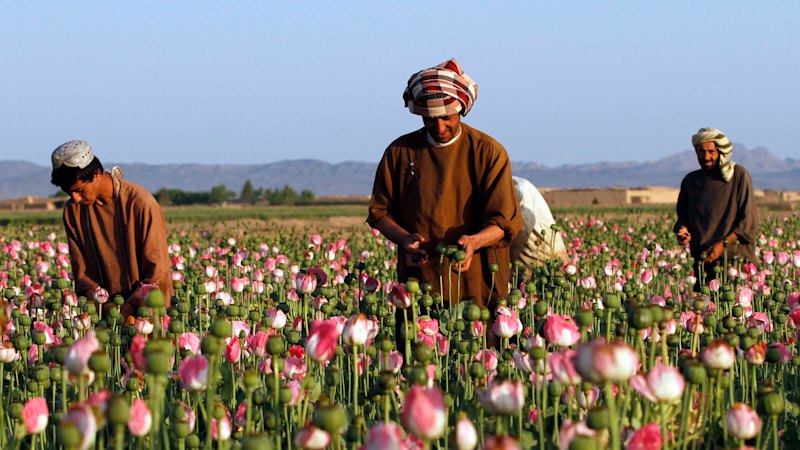
In 20 years of grinding war in Afghanistan, the United States dropped a multitude of weapons from the skies: millions of tonnes of ordnance. Hellfire missiles launched from Predator drones. Even the “Mother of All Bombs”, the most powerful non-nuclear bomb in existence. And, amid the more conventional projectiles, tiny poppy seeds. By the billions.
On and off for more than a decade the CIA conducted an audacious, highly classified program to covertly manipulate Afghanistan’s lucrative poppy crop, blanketing Afghan farmers’ fields with specially modified seeds that germinated plants containing almost none of the chemicals that are refined into heroin, The Washington Post has learnt.

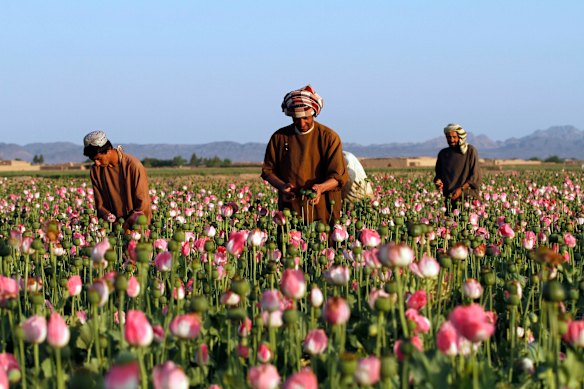
Afghanistan was once the source of most of the world’s raw opium, used to produce heroin.Credit: AP
The covert program, which has not previously been disclosed, is an unreported chapter in the 2001-2021 US-led war in Afghanistan, and in the long, chequered history of American efforts to combat narcotics globally, from Latin America to Asia. Its existence was confirmed by 14 people familiar with aspects of the secret operation, all of whom spoke on the condition of anonymity to describe a classified project.
The program’s disclosure comes as the war on narcotics is again dominating the security agenda. US President Donald Trump has declared war on drug cartels in the western hemisphere, ordering more than a dozen lethal strikes on alleged drug boats in the Caribbean and the eastern Pacific, designating cartels as terrorist groups, and moving a vast naval and air force to the region. He has also authorised the CIA to take aggressive covert action against drug traffickers and their supporters.
Loading
This latest effort, like the fight against opium in Afghanistan two decades ago, faces uncertain success, according to former officials who participated in drug wars of the past.
In Afghanistan in the early 2000s the burgeoning opium trade was thwarting US goals as American troops engaged in a deadly struggle to defeat the Taliban, eliminate terrorist groups and stabilise the weak, Western-backed government. Afghan heroin fuelled corruption in then-president Hamid Karzai’s government and in the provinces. It helped pay for the Taliban’s weapons and equipment. And it accounted for the majority of global heroin supplies, with most of the drugs bound for Europe or the former Soviet Union.
Western allies and US government agencies argued bitterly over which strategies would dent the crop without undermining rural Afghan support for Karzai. Diplomats and drug enforcement officials debated everything from aerial herbicide spraying to purchasing the entire Afghan crop and sending it overseas to be processed into medicine.
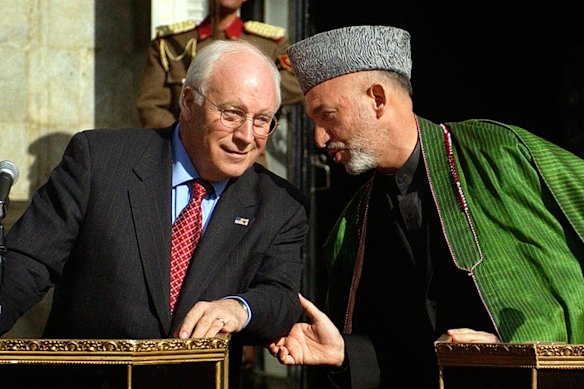
Former Afghan president Hamid Karzai speaks with then-US vice president Dick Cheney at the presidential palace in Kabul in 2004.Credit: AP
Unbeknown to almost all of them, the CIA was operating its own secret heroin-eradication program, run by the spy agency’s Crime and Narcotics Centre, which was flush with funds during the Afghan war. The airdrops of modified poppy seeds began in the autumn of 2004, three people familiar with the program said. The operation was paused at least once and ended about 2015, those familiar with it said.
Clandestine operators, initially using British C-130 aircraft, made night-time flights to avoid detection, dispersing billions of the specially developed seeds over swaths of Afghanistan’s extensive poppy fields, people knowledgeable about the program said. The airdrops took place over the Afghan provinces of Nangarhar and Helmand, centres of poppy cultivation, they said.
As far as is known, the seeds were not genetically engineered with gene editing – a technology not widely available until more recently – but grown and selected over time to produce a plant that harboured less of the alkaloid chemicals used to produce heroin. Details of when and how the seeds were developed remain unclear. However, one person noted that cultivation took several years and involved crossbreeding with natural poppy seeds.
Once the seeds were dropped, the goal was for the plants sprouting from them to cross-fertilise with native plants and become the dominant strain over time, degrading the overall crop’s potency.
Many aspects of the program remain classified, including its budget, how many flights took place, and hard metrics on its efficacy. It was so closely held that some senior Pentagon and State Department officials involved in Afghan policy under presidents George W. Bush and Barack Obama said they were unaware of it or had only heard rumours.
Loading
The CIA required a classified written authorisation, known as a “finding”, from Bush to conduct the flights and other aspects of the operation, which fell under the spy agency’s covert action powers, two former US officials said. The finding made the program legal, at least as far as the US government was concerned.
A CIA spokesperson declined to comment after the agency was given a list of specifics that the Post planned to report. Former spokespeople for the Bush and Obama administrations also declined to comment.
The Afghan government, led by Karzai, was not informed when the CIA began the program, people familiar said. It remains unclear whether the Afghans found out later. Karzai did not respond to a request for comment made through an aide.
The British embassy in Washington did not respond to a request for comment.

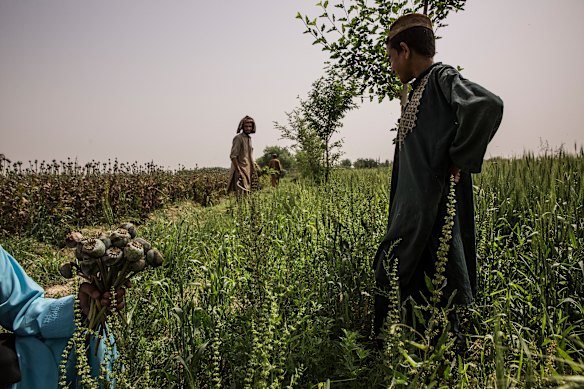
Farmers tend an opium crop in Helmand province in 2015.Credit: NYT
Antonio Maria Costa, who led the UN Office on Drugs and Crime from 2002 to 2010, said he heard whispers about a program like the one the CIA conducted but never had any confirmation.
As the program in Afghanistan was coming to an end in about 2015, US officials discussed using the same unorthodox method against opium poppy fields in Mexico, another major heroin producer, two people familiar with the program said.
That plan was ultimately dismissed because poppies in Mexico are grown in small plots in hilly terrain, making them a much tougher target for aerial seeding than the flatlands of south-west Afghanistan, where the bulk of that country’s poppy crop was grown, one of the people said.
‘Out-of-the-box thinking’
The overall counternarcotics campaign in Afghanistan was an abysmal failure, Western officials acknowledge. It was doomed by interagency bickering in Washington; US frictions with allies, including Britain, which led the international effort; intermittent support from Karzai and his government; and the entrenchment of poppy farming in rural Afghanistan’s culture and economy.
The Pentagon repeatedly resisted deeper involvement in the Afghan drug war, arguing it distracted from its mission of eliminating Islamist terrorists and fighting the Taliban.
Several former CIA and State Department officials, however, said the spy agency’s seeding program to degrade the potency of Afghanistan’s poppy crop was successful for a time. It was also tremendously expensive, chewing up the CIA Crime and Narcotics Centre’s operational budget.
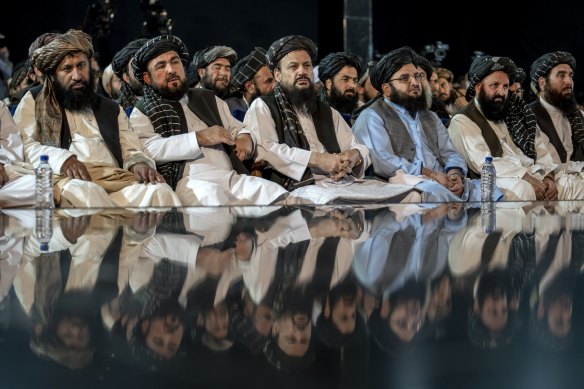
Taliban leaders reflect on the 10th anniversary of the death of Mullah Mohammad Omar, the founder of the Taliban, in 2023.Credit: AP
The budget of the CIA unit, which, under Trump’s second administration, has merged with the agency’s western hemisphere centre, is classified.
“There was a sense that it worked. But maybe over time it worked less well. That the juice wasn’t worth the squeeze,” said a former US official who read reports on the program. “This is actually an example of creative, out-of-the-box thinking by the agency. It was dealing with a problem in a non-kinetic, non-military way.”
Others aware of the program were less impressed by the results, saying it made no lasting dent in Afghan opium production and helped Bush administration policymakers avoid tough decisions in the war on Afghanistan’s drugs.
A 2018 report by the US Special Inspector General for Afghanistan Reconstruction (SIGAR) concluded: “No counter-drug program undertaken by the United States, its coalition partners or the Afghan government resulted in lasting reductions in poppy cultivation or opium production.” SIGAR was not privy to the covert CIA operation.
Beginning in 2001, the United States spent about $US9 billion ($13.7 billion) to try to stem the tide of heroin flowing out of Afghanistan. Afghanistan’s poppy crop declined notably from 2007 to 2011, before rising again and skyrocketing after 2016, the SIGAR report said, citing UN and CIA data. The Taliban profited off the heroin pipeline for years, although US officials clashed over how central it was to their finances.
The war over spraying
The United States has spent decades fighting illegal narcotics globally, interdicting shipments, penetrating trafficking networks, and extraditing drug lords. Trump has deemed the problem a national security threat on par with international terrorism and he has authorised the use of military force to allow strikes on alleged traffickers at sea that many former officials and legal experts say violate international law. He has used economic power, too, suggesting he would lower tariffs on China if it curbs the export of precursor chemicals used to make the deadly synthetic drug fentanyl.
Loading
With plants grown for their narcotics, Washington has tried multiple approaches. In Colombia, US funds paid for widespread aerial spraying of the herbicide glyphosate over plantations of coca, used to make cocaine. US officials claimed the program was successful in reducing the crop. In Peru, American drug-control agencies tested a pellet containing herbicide but it was never dropped, a former US official said.
In Afghanistan, the State Department’s Bureau of International Narcotics and Law Enforcement argued for aggressive aerial spraying of herbicide, based on the Colombia model.
The Pentagon, the CIA and the British government opposed spraying, arguing it would hurt efforts to win over the Afghan population from the Taliban. So did top Afghan officials, who said the chemicals could poison the groundwater in their heavily agricultural society.
US officials were so confident the Afghan government would eventually approve the herbicide plan that they moved glyphosate and equipment for ground-based spraying into Kabul.
Then-US ambassador to Afghanistan William Wood, previously ambassador to Colombia, was so adamant about the spraying that he offered to sit, clad in a Speedo bathing suit, in a vat of glyphosate in Kabul’s Massoud Circle to prove its safety, three former senior officials said. Wood became known as “Chemical Bill”.
“I’m a spraying guy,” Bush told Karzai in one video teleconference, a former senior Bush administration official recalled. “Not in Afghanistan, you’re not,” the Afghan president shot back.
US officials were so confident the Afghan government would eventually approve the herbicide plan that they moved glyphosate and equipment for ground-based spraying into Kabul, the SIGAR report said. But the Afghan cabinet rejected the idea in January 2007. No significant herbicide spraying of Afghan poppies ever took place, according to multiple former US officials.
As the deadlock over spraying stretched on, the Bush administration explored more unconventional control strategies.
“They were constantly looking for some sort of silver bullet,” said former journalist Gretchen Peters, who wrote a 2009 book on ties between the Taliban and drug traffickers.
Some proposals were exotic. State Department officials debated using mycotoxins, poisons produced by fungi, two former officials said. Beginning in 1998, the United Nations and the United States had funded research at a former Soviet laboratory in Uzbekistan on a fungus that infects and kills opium poppy plants.
But there was a problem: The poisons might inadvertently kill not only poppies but Afghan food crops, leading to starvation.
“We could not use a pathogen that was not safe. That’s biological warfare,” said John Walters, Bush’s director of the Office of National Drug Control Policy. Walters, now president of the Hudson Institute, declined to comment on the CIA poppy seed program.
A grim harvest
The covert CIA program went forward even as the debate over herbicide spraying raged, with airdrops beginning in 2004. It involved careful timing and elaborate orchestration and it was preceded by years of secret agricultural research. The seeds had been grown at a site in the United States, crossed with normal poppy plants to test the outcome, and then produced in mass quantities, one person said.
The seeds had to be dropped in late autumn, when Afghan farmers were planting their own seeds. You had to “take care to make sure it didn’t stand out too much”, so that an Afghan poppy farmer would notice nothing amiss but also “to ensure over time it did become the dominant crop”, or strain of poppy plant, said a former senior US official familiar with the program’s beginnings.
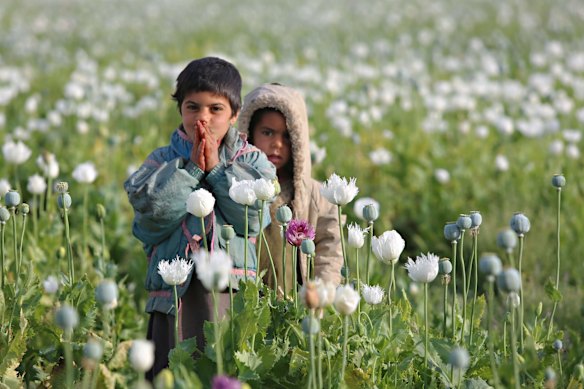
Afghan children work in an opium poppy field in Helmand province.Credit: NYT
The American plants not only contained virtually no morphine but they were bred to sprout early and produce especially vivacious red flowers, making them attractive to Afghan farmers who, the CIA hoped, would harvest and replant their seeds.
There was also a hope, several officials said, that the farmers would keep and sell some of the seeds, propagating them through the country’s brisk agricultural markets.
Areas subjected to airdrops were targeted again in subsequent years with the aim of making the modified plants the dominant strain of opium poppy, the former senior US official said.
The program’s progress was assessed in multiple ways, two people familiar said. Aerial surveillance and satellite imagery showed farmers ridding their fields of unproductive plants. Electronic eavesdropping picked up conversations among opium growers. There were even occasional on-the-ground checks at farmers’ fields, with US officials disguising the true purpose of their visit.
The CIA operation continued after Obama took office in 2009 and it was discussed at White House meetings of the Deputies Committee, a group of high-level national security officials from across government.
The program, which had always been expensive, ended because of money woes, numerous people said. The CIA counter-narcotics centre’s budget was being squeezed, and the spy agency tried to convince other agencies – the Pentagon, the Drug Enforcement Administration, the State Department – to fund the poppy seed drops.
Loading
In its final years the State Department’s Bureau of International Narcotics and Law Enforcement picked up the cost of aircraft fuel, maintenance and repair, but it never conducted airdrops, those familiar with the program said.
For nearly two decades there had been persistent rumours among Afghan farmers that foreigners had fouled their poppy crop, either by covertly spraying it, adulterating the fertiliser they used, or deliberately spreading disease. Those rumours, it turned out, were not entirely unfounded.
When the US military – and the CIA – finally withdrew from Afghanistan in chaotic fashion in 2021, the opium trade represented between 9 and 14 per cent of Afghanistan’s gross domestic product, or between $US1.8 billion and $US2.7 billion, according to the UN Office on Drugs and Crime.
After regaining control of the country, the Taliban banned opium production. By 2023, cultivation had plummeted by 95 per cent. But the crop rebounded last year by 19 per cent, the UN said, and shifted to the country’s north-east, away from the traditional poppy-growing areas once targeted by the CIA.
The Washington Post
Get a note directly from our foreign correspondents on what’s making headlines around the world. Sign up for our weekly What in the World newsletter.


