






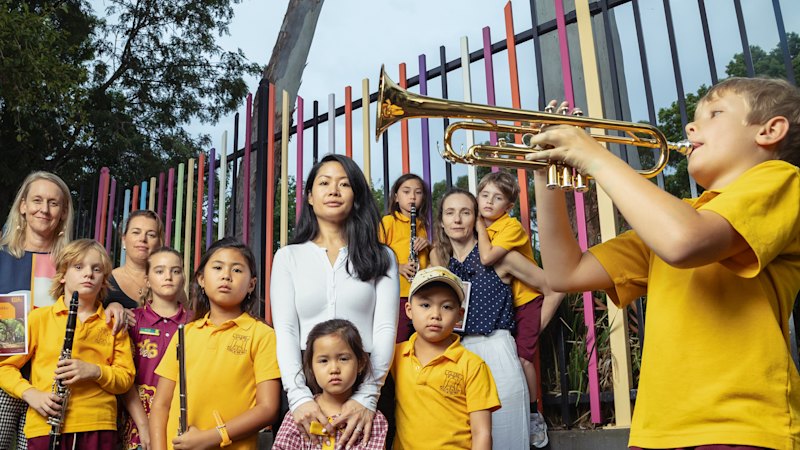


When Stephanie Dunstan enrolled her son at Glebe Public School, she did not realise what she was getting.
“It’s not until you’re in the school that you realise it is an amazing school,” she said.
Glebe has its own music teacher, a band program, and extremely strong growth in NAPLAN scores compared to other schools. Essentially, the school was the whole package.
But Dunstan, who is now the president of the school P and C, realised it also had two problems: it has lost about 100 enrolments since the pandemic, and is not doing a great job at selling itself to future parents.
“From other parents I speak to, other schools do not have a band program or a lunchtime writing club,” she said.
“It is the stuff people want – it’s what I imagine is offered in private education – a chance for their child to play great music or write short stories and have a great librarian who inspires critical thinking.”
Like many schools in the inner city, inner west and eastern suburbs, Glebe Public is seeing dramatic declines in kindergarten enrolments as parents either opt for private or Catholic schools or simply leave the area because of surging rents and house prices.
“People are leaving Sydney – it’s just too expensive. They’re going out of the inner city and going to Central Coast, Queensland or Tasmania,” Dunstan said.
“There’s this realisation that public education has been undersold. It is not great at communicating how good it is.”
To fight the flight from public schools, she is attempting to raise Glebe Public’s “brand awareness” in the community. The P and C has produced a 12-page dossier highlighting the school’s achievements with parent testimonials, information about after-school care and details of literacy and numeracy gains for current students.
“If you’re a prospective parent trying to understand the options, it’s really hard to understand what makes a school tick. The public school websites, although very recently improved, are really basic and you don’t have a sense of the school and the community,” she said.
Last year, parents at Waverley Public successfully lobbied the Department of Education to install a selective stream for year 5 and 6 students. Parent Anh Tran-Nam said since then, the program had proved extremely popular to existing high-potential students as well as attracting new ones.
“Students have joined from both government and independent schools, overall attracting students to the public sector,” she said.
A Department of Education spokesman said its new program, called Inspire, was providing gifted students opportunities to challenge themselves and thrive across academics, the arts, leadership and sport.
“Schools are actively sharing more information about the opportunities available for students with their local communities and prospective families,” he said.
Across all schools, department technicians have worked to install new websites and strict enrolment rules have been relaxed in a bid to attract more students.
To stem the flight to other schools, the department has also launched a campaign highlighting famous and successful public school alumni. It declined to answer questions on whether that campaign had improved enrolments.
Social researcher Mark McCrindle, who is also on the board of Independent Schools NSW, said private schools were typically better at communicating the essence of their school community and their offering. “What a great example, at Glebe, where a government school is doing the same thing,” he said.
He said research showed that while parents valued academics, they were drawn to the extracurricular activities on offer and the sense of community.
“In the past, you didn’t need schools to provide extracurricular activities because children might have been in Scouts or a sporting club or youth group in church and yet, these days, young people are less connected. Really, parents are outsourcing that to the school,” he said.
Glebe Public parent Alena Maher, who assisted with the campaign, said it could be difficult for new parents to gain information about schools.
She said: “It is hard for the school to self promote. The school websites are dictated by the Department of Education, so we were just saying, how do we tell people?”
Brady Downes, managing director of Look Education, a marketing agency that has worked with public schools in other states as well as private schools, said independent institutions were better resourced to produce bespoke websites, professional photography, digital campaigns and brand development.
“Public schools often don’t have that same level of budget, and in many cases key assets like websites are delivered through department-wide templates. While that creates consistency, it can also make it harder for an individual school to clearly express what makes it distinctive.”
He said community trust mattered more than advertising alone.
“[The] school’s community, parent advocacy, and word of mouth often become some of its most effective marketing tools,” he said.


