








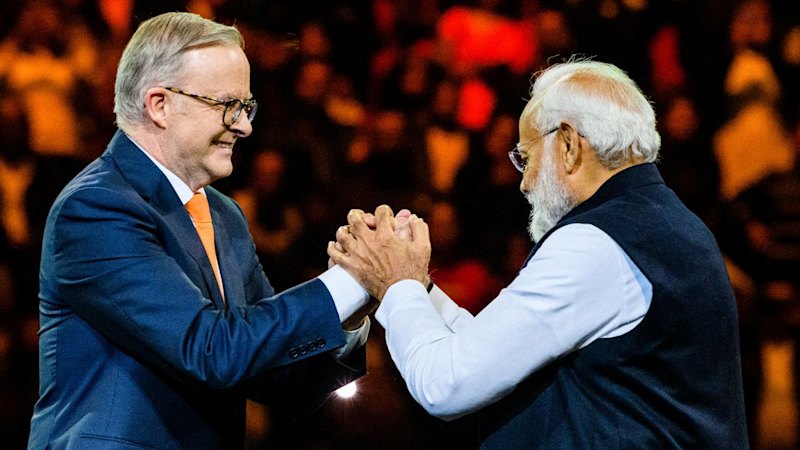


Indian Prime Minister Narendra Modi is hoping to use a visit to Melbourne and Sydney next month to unlock a flood of uranium imports and boost defence ties with Australia in a move that will be closely watched by China.
Australia and India struck a historic deal to allow uranium exports in 2014, but there have been only negligible shipments in the following 12 years.
India is planning a major expansion of nuclear power driven by the surging demand for new data centres used for artificial intelligence.
Modi, one of the world’s most important political leaders, is expected to visit Australia in the second week of July, including meetings with Prime Minister Anthony Albanese in Sydney and a stadium rally for members of the Indian diaspora in Melbourne.
He will also visit Indonesia and New Zealand during the same trip.
Albanese hailed Modi as “the boss” during a packed rally of 20,000 people at Sydney Olympic Park during his most recent visit in 2023, sparking debate about whether Albanese was ignoring human rights violations occurring under Modi’s watch.
On Albanese’s trip to India in March 2023, he was ferried around a stadium in Ahmedabad in a chariot decorated with golden cricket bats.
Indian External Affairs Minister Subrahmanyam Jaishankar said during a meeting with Foreign Minister Penny Wong last month: “On the energy side, we have energy trade, we are looking to expand that as well into the uranium supplies.
“Our own nuclear sector has undergone reform, which will grow nuclear energy.”
The Organiser, an Indian publication with close ties to Modi’s right-wing Hindu nationalist government, reported this week that “expectations are high for progress on uranium supplies for India’s civilian nuclear energy program under safeguards” during the visit.
Australia’s high commissioner to India Philip Green told Indian outlet World is One News last week that the countries were also “shooting towards a new and higher level joint declaration” on defence, noting the countries had not signed a defence agreement since 2009.
India, Australia, Japan and the United States are members of the Quad grouping, a partnership of democracies that works to provide a counterpoint to China’s growing influence in the Indo-Pacific.
Labor changed its policy platform in 2011 to allow uranium exports to India, removing a longstanding ban that had been in place because India is not part of the Nuclear Non-Proliferation Treaty.
Australia made its first shipment of uranium to India in 2017, but the trade has not taken off since that small and largely symbolic delivery.
The state-owned Nuclear Power Corporation Of India recently said the country plans to add 18 more nuclear reactors to its energy mix by 2032, almost tripling the nation’s nuclear power capacity.
India is the world’s most populous nation with 1.47 billion people. Major tech companies such as Google, Meta and Amazon are pumping billions of dollars into the Indian data centre market.
Minerals Council of Australia chief executive Tania Constable said bans on uranium mining in NSW, Queensland and Western Australia would hold back export opportunities to nations like India.
“Australia has the world’s largest uranium resources yet ranks only fourth in global production, and the opportunity to supply a potentially immense Indian nuclear generation program with Australian uranium exported under strict safeguards will add further impetus to overturn outdated and ideologically-driven bans on uranium mining,” Constable said.
“Australia should be given every opportunity to cement our already strong minerals trade with India in coal and gold by backing our uranium miners to help deliver reliable, zero emissions energy.”
Ian Hall, an expert on Indian politics at Griffith University, said expanded access to each other’s air bases and naval ports would be the best practical way to drive forward the defence relationship.
“A little bit of energy has come out of the bilateral relationship recently because both nations have been distracted by other things,” Hall said.
Albanese and Modi will also seek to make progress on a free trade agreement, but it is famously difficult for overseas farmers to gain access to India’s market given the power of its agricultural sector.
Human Rights Watch’s latest report on India said the country’s “slide to authoritarianism under the Hindu nationalist Bharatiya Janata Party (BJP)-led government continued [in 2025], with increased vilification of Muslims and government critics”.
Modi’s BJP lost 63 seats in India’s 2024 elections, forcing him into minority government.
Cut through the noise of federal politics with news, views and expert analysis. Subscribers can sign up to our weekly Inside Politics newsletter.


