








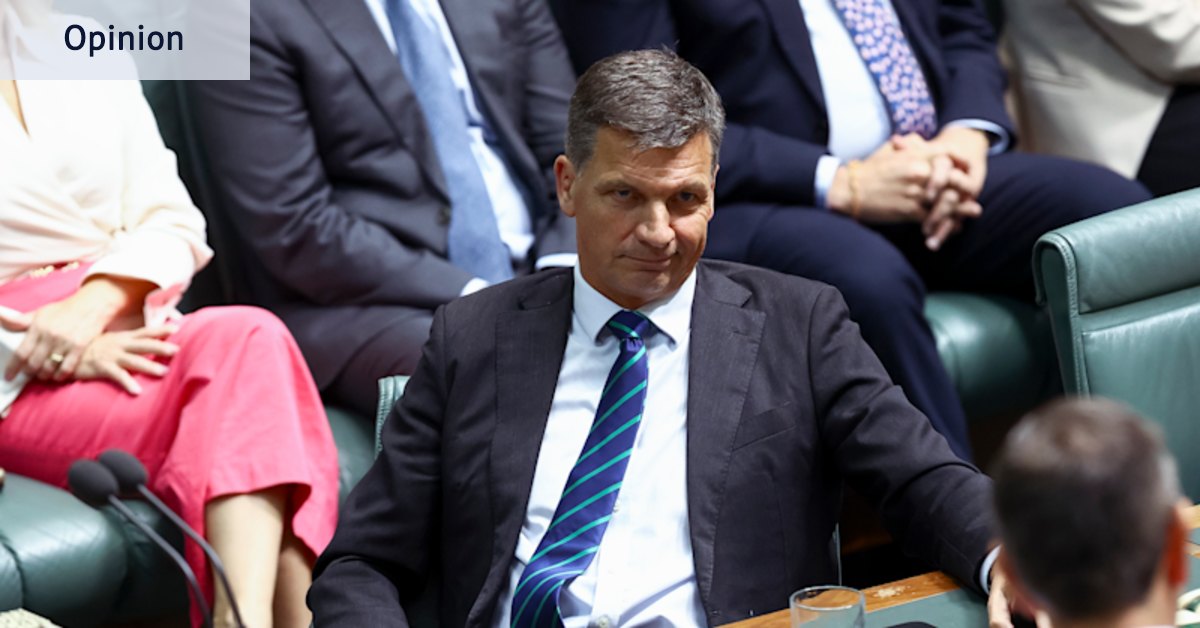
Angus Taylor’s budget reply speech was the opposition leader’s best, and last, chance to make an enduring impression on Australian voters who aren’t paying much attention to politics, most of the time.
From this moment forward, Taylor has to present as an attack dog who can take the fight to Labor, reassure Australians he is a competent alternative leader and present compelling alternative ideas.
Why? Because after just three months in the job, Taylor’s Coalition was thumped in Farrer last weekend by One Nation and lost a seat it had easily retained just a year ago (and since its inception in 1949). In Pauline Hanson, Taylor faces an alternative opposition leader who is eating his lunch and stealing his voters, and whose grievance politics suit the times perfectly. But more on Hanson’s surge, and what underpins it, in a moment.
Liberal leadership aspirant Andrew Hastie is also sitting quietly on the sidelines. Taylor and Hastie share a birthday (September 30), but Hastie is 43 and has time on his side, whereas Taylor, at 59, does not. This could be his one shot as leader, which is what makes the weeks ahead so consequential.
Helpfully for Taylor, Labor has presented one of the most ambitious federal budgets in decades, replete with broken promises – paring back negative gearing and capital gains tax breaks – and cracking down on the use of trusts to avoid tax. For a John Howard-style Liberal like Taylor, the tax changes are red meat. Already he has promised to oppose these tax changes and repeal them if the Coalition returns to government. Taylor and his people are spoiling for this fight.
As one of those people puts it: “Those of us who have been around for a while are licking our lips at dusting off our 2019 campaign against these Labor taxes and getting every stakeholder who fought with us against them then to fight them again, too.”
Or as Taylor put it on Thursday morning: “What you will see tonight is us fighting back, fighting like hell, against the vision of Australia that is completely at odds with the Liberal and National parties and completely at odds with what I believe Australians want to see for their own country.”
Taylor’s budget reply had five key themes – immigration, housing, attracting more investment to the economy, energy security, and tax – and at least a couple of ideas that will be popular on talkback radio and Sky after Dark. Those include blocking non-citizen residents from access to 17 welfare and benefit programs, including the NDIS, and linking the number of migrants allowed in to Australia to the number of new houses built.
The opposition is also eyeing tax cuts aimed at reducing bracket creep, while Labor’s Jim Chalmers made it plain during budget week that the government had further tax cuts planned ahead of the next election. Those Labor cuts would seek to entrench a new distinction introduced earlier this week – between people who earn their money from working versus those who earn it from passive income such as investments (and who have typically paid a lot less tax than wage earners).
The so-called working Australians tax offset, an idea borrowed from the US, raises the tax-free threshold for workers so they pay less tax. Younger people get a bump; retirees miss out.
The distance between the two major parties has grown significantly this week. Taylor supports the old, less targeted model that cuts income tax across the board. Labor wants to be more selective in picking and choosing who gets tax cuts, and when, with an emphasis on people in the workforce. That’s a big shift that will have ramifications for years to come.
Which brings us to what One Nation wants. Consider the following:
“Pauline Hanson wants [to win over] Labor battlers suffering the squeeze on blue-collar labour. From the Nationals, she wants family farmers watching the disintegration of their independence and way of life through the relentless momentum towards big corporate holdings, and rural workers rendered jobless with the introduction of new farm technology. From the Liberals, she wants struggling small business people, especially in the regions, and older, socially conservative self-funded retirees.
“It is potentially a serious political movement in a world where the old divisions of labour and capital are breaking down and the gap between rich and poor is ever-widening. People in all political camps are losing their living standards while some – ‘the elite’ in One Nation parlance – benefit, sometimes obscenely, from the new global system they keep saying is good for everyone.”
Those are not my words about what Pauline Hanson wants. They were written 28 years ago by former Sydney Morning Herald journalist Margo Kingston in her book Off the Rails, about Hanson’s disastrous first national campaign in 1998. Kingston travelled with Hanson for the entire campaign. She was even on hand when the One Nation founder campaigned in Farrer, which started well enough but ended badly for the inexperienced Hanson, with former Nationals leader Tim Fischer comfortably holding the seat.
Kinsgton’s description of what Hanson wanted was spot on. If anything, it applies more so today as the community’s sense of disaffection with big corporations, the “elites” and the “system” grows. The massive rise in support for One Nation and independents bears this out.
Labor’s budget is an attempt to fight back against that cynicism and discontent, and to tell people who believe the system is stacked against them that the government is listening and trying to change the system. The decision to so blatantly break promises is reframed as a virtue. The message to voters is that Labor doesn’t care about the “gotcha” game played by the opposition and media. Rather, it cares that the housing crisis is solved, even if it has to break a promise to do it.
It is an attempt to inoculate Labor against One Nation, which, as Barnaby Joyce said last Saturday night, now has its sights set on the ALP’s western Sydney stronghold.
For Angus Taylor, the gamble at the heart of his budget reply is that his thoroughly orthodox economic and political response in such unorthodox times may fall well short of what is needed to turn around Coalition fortunes. The challenge for Taylor is unprecedented: never before has a Coalition leader had to win back so much support from both Labor and One Nation. In trying to thread the needle to win back both sets of voters, he must risk satisfying no one. And he may only get one shot at it.
James Massola is chief political commentator.


