





[ad_1]
It’s 11.30am on Wednesday – about half an hour before Shanghai Street opens its doors – and people are already lining up outside.
Inside the restaurant, kitchen staff are sitting down to enjoy a quick meal in their remaining moments of peace before a constant stream of customers bursts through the doors.
Among them is owner Sammy Shi, his restaurant manager Jessie Zhu and his head chef Xioan Liao. For Shi, the restaurant’s success is about more than just his team; it’s about his contribution to Melbourne’s devoted dumpling culture and the way this has connected him to the city.

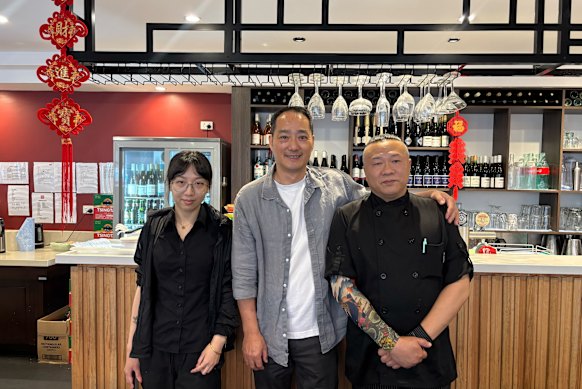
“This year we have been here 14 years,” he says, smiling. “The people, they like the dumplings, they like the xiaolongbao, every time people [say] ‘wow’.”
The shop on Little Bourke Street has a steady line-up of CBD workers, students and tourists. They don’t take bookings, Zhu says, because they don’t need to. Nor do they need to advertise.
Less than six years ago, the shop faced a darker financial reality. As Melburnians grappled with the first of many lockdowns, the CBD resembled more of a ghost town than a bustling hotspot.
While Chinatown tried hard to keep regular customers and students living in the city coming through their doors, there were no crowds of happy diners and no lines for dumplings outside restaurants.
Since then, Melbourne has become an “80 per cent city”, according to an analysis of City of Melbourne pedestrian data, which looked at six key inner-city locations, and found that four out of every five footsteps had returned to CBD pavements.
The data in the interactive map above shows that the busy pockets of Melbourne CBD tell a similar story during the working week: foot traffic plummeted during lockdowns and hasn’t yet reached near pre-pandemic levels.
However, Chinatown has endured the downturn better than most. Weekday foot traffic was sitting at 86 per cent of pre-pandemic levels in 2024-25.
That compares with just 53 per cent at Bourke Street Mall, 65 per cent around Southern Cross Station and 77 per cent in the Flinders Street Station underpass.
On weekends — when Chinatown is usually at its busiest — foot traffic has all but recovered. Average daily numbers have climbed back to 93 per cent of pre-pandemic levels.
Before COVID-19, almost 16,726 people a day on average walked through Chinatown on weekends. During lockdown, that number fell to just 7000. Now, the area attracts 15,607 people on weekends on average, just 7 per cent shy of pre-pandemic numbers.
Resistance, recovery and reinvention
To understand Chinatown’s recovery, Andy Chen, owner of Shanghai Village, says you have to look at its floor. While other parts of the city struggled to rebound, Chinatown did not because it never bottomed out quite as deeply.
Even in lockdown, he says, business did not seem to plummet as dramatically as other popular CBD areas like Bourke Street or the Paris end of Collins Street.

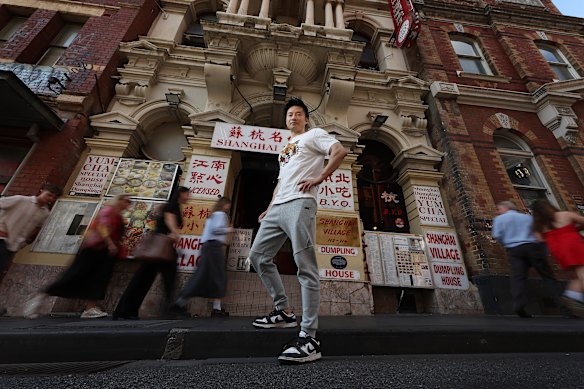
“There were periods where we were allowed to open for a short period of time, and… it was actually quite busy because during lockdown, people had nothing to do,” he recalls. “They were really bored. They wanted a place to go.”
A little way down Little Bourke, Shi recalls that while they managed to keep the restaurant afloat with delivery services and payments from the government, it was his team that suffered.
“Only citizens and permanent residents could get government payments,” restaurant manager Zhu says. “We only had a couple of staff that could stay because a lot of people decided to either get a new job or move back to China. It was really tough.”
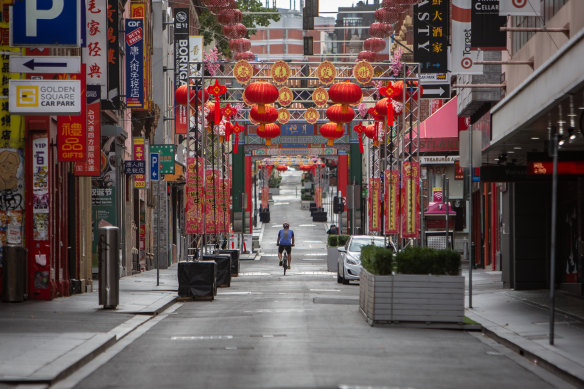
Variety is another reason local traders think Chinatown is thriving. “You don’t only come to Chinatown for dumplings,” Christina Zhao, head of the area’s business association says.
“We have lots of hidden bars people come to after dinner. They could have had dinner in the Italian precinct and then walked to Chinatown for a drink. We also have a Japanese spa here now.”
And theatre, too.
Chris Mitchell, creative director at Spiegel Haus Melbourne, chose the Golden Square car park in the area to open up a theatre because Chinatown, to him, has always felt electric.
As an 11-year-old, Mitchell remembers visiting Chinatown for the very first time – on a quest to find illegal fireworks. “I was a bit of a brat,” he says, laughing. “We used to skateboard through the city. Chinatown was always just such a fun place to hang out.”
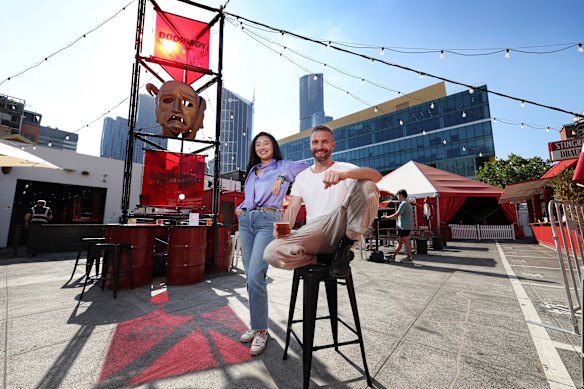
Chinatown, for him, has never lost that sense of fun. “There’s something really kind of kooky, and kind of mystical or enigmatic about Chinatown – the aesthetic and the smells and the experiences and the options it has. It’s very Melbourne.”
“I always say that if you were to drop a pin in the centre of Melbourne, it would probably land in the Golden Square car park. This is the heart of Melbourne, and Chinatown, in many respects, is the main veins feeding out of that heart.”
His theatre venue, coupled with the bathhouses and the bars are slowly redefining the entire precinct. “A lot of our guests will plan their night and go to a local restaurant. ”
Nonetheless, history and tradition remain potent here, says Zhao.
“I think for a lot of business owners who have been in Chinatown for a long, long time, the restaurants [were] opened by the grandparents, and then they pass it to the parents, then to the third generation. It’s not just making money. It’s about heritage, family.”
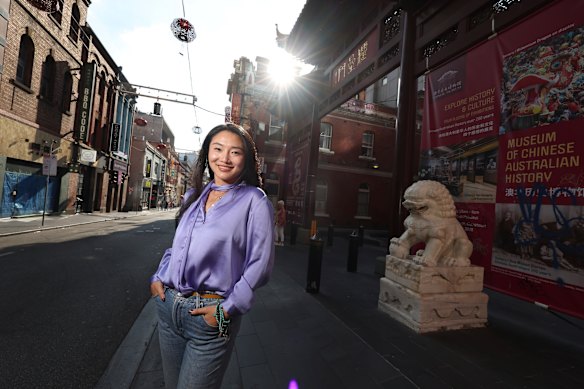
Back at Shanghai Street, Shi watches passersby stop to peer through his shop window, watching as staff prepare hundreds of xiaolongbao dumplings.
“This is why we do it,” he says. “I will keep doing it, never change, and make the people happy.”
Start the day with a summary of the day’s most important and interesting stories, analysis and insights. Sign up for our Morning Edition newsletter.
[ad_2]

