


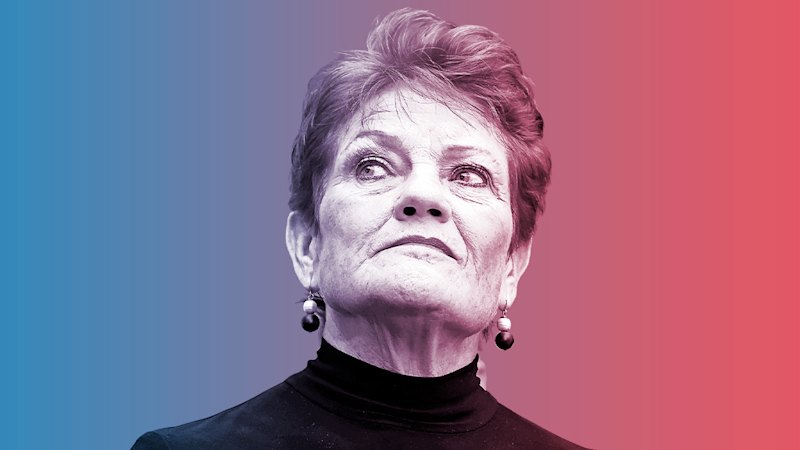
Pauline Hanson’s One Nation now has more women supporters than men, according to an analysis of a year’s worth of polling by the Resolve Political Monitor, while the number of young people, well-off and people living in the inner city who support the party has surged in the last year.
Analysis of a year of data from the Resolve poll, conducted for this masthead, shows One Nation has significantly expanded its reach and appeal across all demographics, ages, income and education levels.
And while a typical One Nation voter is still more likely to be aged over 55, living in a rural or regional area and be either retired, unemployed or holding a trade qualification, rising support for the party across the board underscores the growing threat Hanson’s outfit poses to both major parties.
Hanson told this masthead that women were flocking to One Nation because “women voters are seeing what I’ve warned about”.
“These woke ideologies being taught in classrooms, boys in girls’ toilets, men in women’s sport, the late-term abortion changes,” she said.
“The uni parties have gone too far and are breaking the spirit of Australian households.”
In the most recent Resolve Political Monitor, One Nation recorded 24 per cent of the primary vote, just four percentage points behind Labor’s 28 per cent and ahead of the Coalition on 23 per cent.
Hanson said on Monday that she was ready to be prime minister, should One Nation’s polling deliver her the numbers to form government. The veteran senator, 72, is considering a move to the lower house and is said to be eyeing either the Coalition-held seats of Capricornia and Wright or the Labor-held seats of Oxley and Blair.
The Resolve analysis covers 12 months of polling from May 2025 to May 2026 and is broken up into quarterly data. The sample size for each set of quarterly data is about 5400 people, and has a margin of error of about 1.3 per cent.
Twelve months ago, just after the last election, 7 per cent of men and 6 per cent of women said they would vote for One Nation. Since then, support among men has risen to 22 per cent and among women it has risen to 24 per cent.
One Nation’s primary vote at the last election was 6.4 per cent.
Party member Railene Turner, 56, said she thought One Nation made women feel heard.
“I don’t think that people feel heard by the major parties, and I think that the younger demographic – not just women – want somewhere to go, and I think that because Pauline is, she’s a real person, you know, like the One Nation candidates are real people, they don’t pretend they’re perfect,” she said.
Turner, a business owner and infrastructure consultant, said it was important for single women to feel like they could provide for themselves, which was difficult with the rising cost of living and unaffordable housing. She pointed to One Nation’s income splitting and family tax policy as a major draw.
“That makes so much sense … one partner might not be well, and they can’t work, so to be able to split that income makes a massive difference,” she said. “It’s an even bigger benefit for people where both partners are working and they’re low-income earners.”
Turner said she had been a Liberal Party member, but left for One Nation after Malcolm Turnbull rolled Tony Abbott in 2015. When she moved into the New England electorate, she signed up to the Nationals because she liked the member, Barnaby Joyce. When he left for One Nation last year, so did she.
“I look for conviction politicians. Pauline certainly is, Barnaby certainly is, and I don’t think that the two major parties have that level of understanding,” she said.
According to the Resolve analysis, just 4 per cent of 18-34 year olds said they backed the party at the last election, with 38 per cent supporting Labor, 21 per cent the Coalition and 26 per cent the Greens.
Since then, the proportion of One Nation supporters in the demographic has almost quadrupled to 15 per cent, with support bleeding from the two major parties and the Greens.
In the same time period, support for One Nation among people aged 35-54 rose from 7 per cent to 22 per cent and among people aged over 55, support grew from 7 per cent to 31 per cent. The huge rise in support for One Nation among those aged over 55 has come equally from Labor and Coalition, with support for the government falling 8 percentage points to 24 per cent and 11 percentage points to 29 per cent for the Coalition.
Support for the party has grown from two per cent to 18 per cent in the inner city, a ninefold increase in one year, but is running at 24 per cent in suburban Australia, 25 per cent in regional areas and 27 per cent in rural Australia.
Similarly, people with a higher education who now say they support One Nation has grown from 2 per cent to 15 per cent, while among people with a high school education support has risen from 8 to 26 per cent and from 8 to 28 per cent for people with a trade qualification.
Almost one in three retirees, 29 per cent, now support One Nation, up from 7 per cent a year ago, while 22 per cent of both unemployed and employed people back the party.
Resolve pollster Jim Reed said One Nation had started out taking votes from the Coalition in regional and rural areas last year, “but we quickly started to notice their gains spread to the suburbs and Labor’s base. This is not just a right-wing, conservative fragmentation, but a wave of change”.
“They still do best among older, lower-income voting groups who aren’t voting Greens or teals, but the bigger picture is the relative homogeneity of One Nation’s gains. They appeal equally across the states, among men and women, and it’s now winning them seats at elections and byelections.”
Cut through the noise of federal politics with news, views and expert analysis. Subscribers can sign up to our weekly Inside Politics newsletter.
 James Massola is chief political commentator. He was previously national affairs editor and South-East Asia correspondent. He has won Quill and Kennedy awards and been a Walkley finalist. Connect securely on Signal @jamesmassola.01Connect via X or email.
 Brittany Busch is a federal politics reporter for The Age and Sydney Morning Herald.Connect via email.