





In 11 days, Pauline Hanson will enter hostile territory that she has avoided for 30 years.
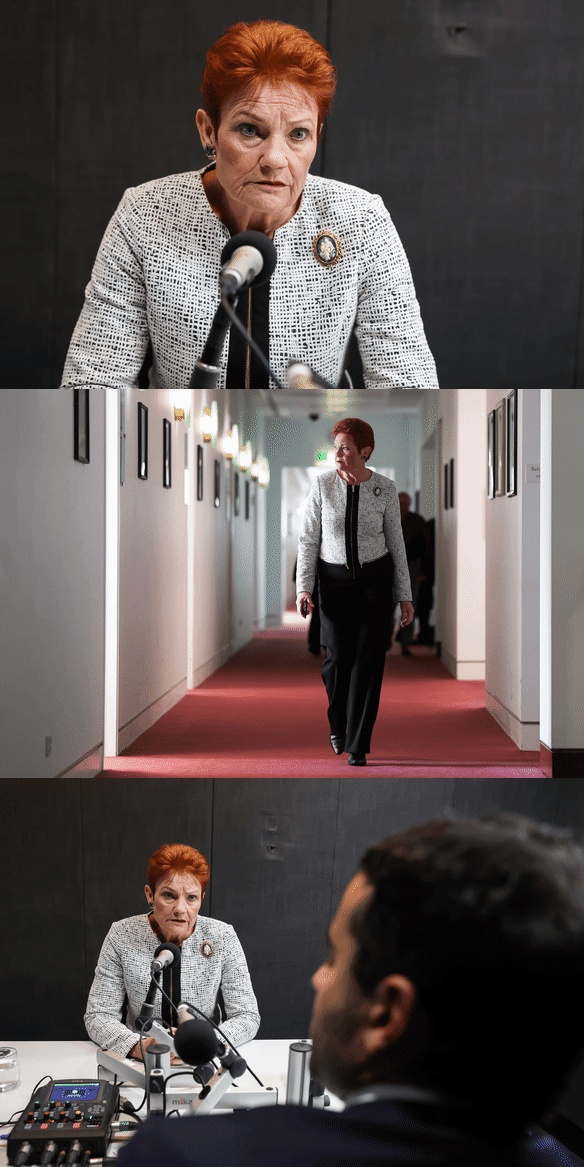
For the first time in her political career, Hanson – first elected in 1996 and ever-present on the margins of Australian political life ever since – will address the National Press Club of Australia.
As is custom, Hanson will sit down at the head table beforehand with club chief executive Maurice Reilly, club president and Sky News presenter Tom Connell and the rest of the club’s directors to break bread before she steps to the lectern at 12.30pm on June 17.
Nothing could better symbolise Hanson’s transformation from fringe voice to a member of the political establishment than her decision to address the club, facing down seasoned interrogators disinclined to wrap their questions in compliments.
In an interview with this masthead’s Inside Politics podcast this week, Hanson declared that “having One Nation on the scene means that the other political parties have to stop taking people for granted”.
“The rest of the country has caught up with me, that’s what people say, I’ve been consistent with what I have been saying over years.”
One Nation’s new era
It’s broadly true that Hanson has been consistent, but not completely accurate.
Asked by podcast host Paul Sakkal this week why she had switched her focus from the perceived dangers of Asian immigration to Muslim immigration, Hanson stated that “it’s totally different to Asian immigration … because it’s actually happening, we didn’t have the impact of Muslim immigration on the country back in 1996”. She adds two points: she raised concern about Muslims migrating to Australia in her (second) maiden speech to the Senate in 2016, and that many Asian-Australians now embrace her policies.
“These political parties is the reason why this country is in a hell of a mess and I know there has to be a change in direction, policies and vision for Australia, and that’s what I’m going to be pushing.”
In other words, Hanson has not given up her fervent desire to blow up the system and start again. Her chief of staff and political svengali, James Ashby, goes even further than his boss.
In an interview with this masthead, Ashby outlines plans to abolish the Climate Change department (previously announced) and the Environment department (he argues it duplicates state departments), and warns that any departmental secretary who gets in the way would face the sack under a One Nation government.
“If you don’t like it, we will move you on,” he says.
“What is important is we will always take the advice of professionals, industry, from bureaucrats, but you don’t get the final say. Governments are elected to make decisions for the betterment of the Australian people, and I don’t think that has been happening for decades.
“One Nation will rebalance the books, someone has to be the adult in parliament, start paying down debt, making sure that debt and destruction is not left as a legacy to future generations.”
Anyone rorting the National Disability Insurance Scheme is in One Nation’s sights, too.
“People rorting the NDIS, we are gonna catch you, strip you of your assets and jail you. The good news for the Australian people is we will save them money.”
Ashby wants to reshape Australia and install his boss as prime minister, to upend the political establishment, remake the country and finally put Australia back in the hands of “real” Australians.
He is hardly the first person to dream about changing the country. But his boss is enjoying a surge in the polls (and moment in the sun) the likes of which Hanson could have only dreamed of in 1998, when she lost her lower house seat of Oxley after one term.
An overnight rise, 30 years in the making
After briefly capturing the nation’s attention, Hanson and her band of supporters quickly flamed out 30 years ago, riven by disputes, disorganisation and disunity.
Hanson endured years in the wilderness, time in jail (the convictions were quashed on appeal), several failed attempts to return to politics, a star turn on the Seven Network’s Dancing with the Stars and, finally, in 2016, she found her way back into the federal parliament.
Her popularity has now grown to such levels that serious conversations are being held about a Hanson-led government.
In the most recent Resolve Political Monitor poll, conducted for this masthead, One Nation recorded 24 per cent of the primary vote, just 4 per cent behind Labor’s 28 and ahead of the Coalition on 23.
In the most recent Redbridge poll conducted for The Australian Financial Review, One Nation was in front of Labor and the opposition. It recorded a primary vote of 31 per cent, three percentage points in front of the government.
With Ashby’s help, Hanson has steered a path towards mainstream acceptance, collecting big donors such as Gina Rinehart, setting up branches across the country and generally assuming some of the trimmings of a mainstream political party.
But Hanson has not changed her spots. Even as a quarterly analysis of the Resolve poll showed that One Nation’s support is increasing with groups of people that have typically shunned her – women, wealthier voters, more educated voters and people living in the inner city – it remains true that for many Australians, she remains an anathema, someone they could never vote for, because of her far-right views.

Nationals leader Matt Canavan says his party is taking the threat seriously and recognises that “we have no entitlement to any seat, we will have to fight really hard, people are pissed off and they are right to be.
“We have to work hard and we have to have strong conservative policies like secure borders, spending to be restrained, and ending this green energy madness that is destroying our industry.”
Canavan says the Nationals, as part of the Coalition, have to primarily focus on fighting and defeating the Labor government, more so than One Nation, but “we have to fight for the Australian people, first”.
He believes that by 2028, the times will suit the Coalition.
Greater visibility, greater scrutiny
Two of the biggest challenges facing One Nation, which has bedevilled the party for years, are the lack of a proper network of branches across the country and a lack of professionalism.
The party’s highest-profile recruit, Barnaby Joyce, a former Nationals’ deputy prime minister, gave a spectacular display of the disorganisation on Thursday evening when appearing on Andrew Bolt’s program on Sky News.
Joyce twice said it was One Nation policy that permanent residents would be included in plans to force foreign owners of Australian property to sell within two years. After a hasty series of phone calls to head office, Joyce went back on the air to re-record his answer and correct himself, clarifying that permanent residents of Australia would not have to sell their property.
It was a stark reminder that while One Nation’s popularity has surged and it has become a genuine electoral threat, the party still has a long way to go in terms of professionalising its operations.
Former Sydney Morning Herald journalist Margo Kingston wrote the definitive book, Off the Rails, about One Nation’s early days and Hanson’s failed bid for re-election in 1998.
Kingston now lives in northern NSW seat of Lyne – once held by independent Rob Oakeshott and currently held by the Nationals’ Alison Penfold – it’s exactly the sort of seat that One Nation strategists believe they can win at the next election.
Recently, Kingston attended a One Nation branch meeting at the Taree Sports Club and wrote about it on her Substack account.
“We’re looking at a movement on rocket fuel at the moment, and I think it’s a must, finally, for Labor and Coalition to state clearly the challenges we face, a vision for future-building Australia and a plan to get there, for all of us. They must PERSUADE,” she wrote earlier this week.
Kingston says the One Nation leader Australians see today is a very different person to the one who first entered the political scene back in 1996. Advisers like Ashby have helped her become more professional, while decades of experience and even her stint in jail have also helped shaped Hanson into a much more formidable force.
“In one way, One Nation is a cult, there is nothing without her. She has clearly had a bit of media training, she has a lot of money, and she now has a professional, extremely top-down organisation,” Kingston says.
“It’s reminiscent of the professionalism of the community independents movement. I think over time the reality [of One Nation] will be exposed, but it has to be done carefully, with civility and with persuasion. They are a protest, a scream saying ‘fix things’. It’s a genuine movement.
“It is really important that people who disagree with people who support her listen and be civil and not lecture.”
In Kingston’s view, the major parties can beat One Nation, which currently seems immune to just about any sort of attack or critique of the leader or the party, only by gently picking apart its policies rather than scolding anyone thinking about voting for the party.
Hanson was asked this week whether she was up to the task of being prime minister. She vowed that she was, despite the fact she will be 74 by the time of the next election in 2028.
Kingston isn’t so sure.
“In my opinion, no, she can’t win, I think Labor will handle her and I also think there will be an enormous tactical vote to keep her out, even among Liberals.”
Hanson and Ashby disagree, with the party leader defiant on the Inside Politics podcast.
“We are coming into an election that is probably unprecedented, what we are doing, because there are really three major parties in it. I’m a major party, I’m not just a minor party out on the fringes,” she said.
‘Into the lion’s den’
The first person to ever address the National Press Club, back in 1963, was Garfield Barwick, who was at the time minister for external affairs and would later earn a knighthood and serve as chief justice of the High Court.
The club has been addressed by every prime minister and opposition leader (other than Peter Dutton) for decades.
As the club’s chief executive Maurice Reilly explains, the press club has invited Hanson to speak because: “The board of the National Press Club recognises that Pauline Hanson and the One Nation party is a party that will have significant influence in the make-up of the next parliament.”
Nothing could better symbolise Hanson’s quest for political legitimacy and recognition than her decision to address the press club, which is emblematic of the Canberra establishment that Hanson and her supporters have railed against for three decades.
As Ashby explains, “she knows she is stepping into the lion’s den, there are no holds barred, no vetted guest list. It is the press club’s domain and for the first time she has accepted it and will face these people. The media don’t have to accept her or her policies, but she wants a fair hearing.”
That quest for a fair hearing has been at the heart of Hanson’s 30 years of protest politics. And it’s a desire shared by more Australians than ever before. Time will tell whether she can ride that wave of grievance all the way through to the next election.
Cut through the noise of federal politics with news, views and expert analysis. Subscribers can sign up to our weekly Inside Politics newsletter.