
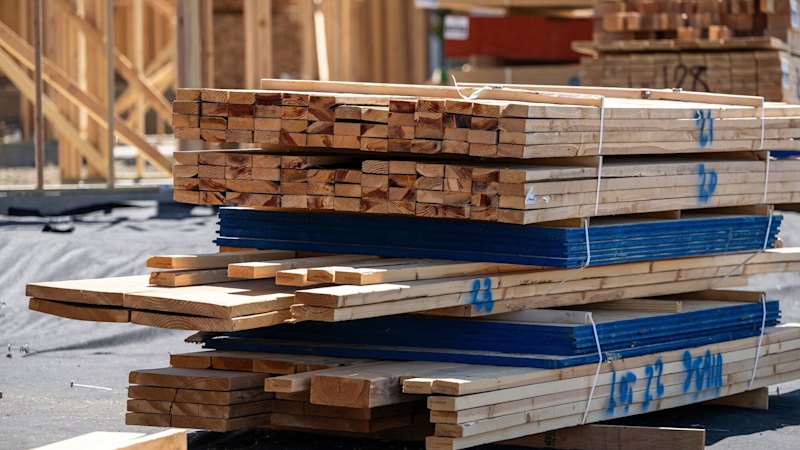




Significant amounts of Russian timber are entering Australia after being laundered through China and other countries, evading tariffs imposed after Russia’s invasion of Ukraine and sparking demands for government action.
The phenomenon – similar to the flow of Russian “blood oil” into Australia after being processed overseas – means thousands of Australian home builders could be inadvertently aiding Vladimir Putin’s war effort.
The Australian-Ukrainian community and local timber industry are calling for the government to impose a ban on Russian-origin timber, extend tariffs and improve country-of-origin testing to slash the amount of Russian-origin wood making its way into the country.
“It is evident that Russian timber is coming into Australia rerouted through third-party countries, undermining the intent of the tariff regime put in place due to Russia’s invasion and war in Ukraine,” the Australian Forest Products Association said in a submission to a Senate inquiry examining the effectiveness of sanctions on Russia.
Acting chief executive Richard Hyett estimated up to 100,000 cubic metres of annual imports could include Russian timber, with up to 15,000 new homes built each year likely containing Russian timber.
The association said the “evidence is clear that a large volume of Russian timber is being transferred and/or transformed through China”, escaping a 35 per cent tariff on Russian imports.
It said back-door imports were having a devastating impact on the local forestry sector.
“Australian domestic producers are losing market share due to an influx of imports at well below market prices, crippling our manufacturing industry,” it said in its submission.
“Unlike the EU, US and others, Australia has not undertaken any action to stem the flow of Russian timber rerouted through third nations and has now become a focus for these exports.”
Russia, which has more than a fifth of the world’s forests, was a major supplier to Australia before the war in Ukraine, accounting for up to 50 per cent of the local market for laminated veneer lumber.
A 35 per cent tariff on Russian goods imposed by Australia after Putin launched his full-scale invasion in 2022 caused Russian timber imports to plummet and saw a surge of imports from China.
Kateryna Argyrou, chair of the Australian Federation of Ukrainian Organisations, said: “The Australian government is allowing Russian blood money to fund the murder of Ukrainian civilians, and it must stop now.
“Whether it is Russian timber laundered through Chinese factories or Russian crude oil refined in India and Brunei, it all arrives here legally, with a clean bill of origin, while the Kremlin collects its cut.
“We are calling on the Albanese government to close these loopholes immediately – to extend sanctions to all products derived from Russian materials wherever they are processed, and to stop allowing Russia to wage war on Ukraine with Australian money.”
The European Union issued a warning last year that plywood purchases posed a major risk of breaching its ban on buying wood products originating in Russia or Belarus.
The United Kingdom has also banned any direct or indirect purchase of Russian timber products.
A report commissioned by the Department of Agriculture, released under freedom-of-information laws last year, found the provenance of more than half of all sampled timber products could not be accurately verified.
“The risk importers face of sourcing conflict timber (knowingly or not) is significant and can only be mitigated through due diligence activities,” the report by verification firm Source Certain found.
Mark Corrigan, a chemical engineer who has tracked imports of Russian-origin oil into Australia, said: “Russian birch plywood and Siberian larch beams continue to flood our market, dodging tariffs and avoiding conflict timber status.
“Hidden behind plasterboard and flooring, and without labels to even hint at Russian provenance, Australian home builders are unwittingly funding Putin’s home destroyers.”
Industry group Timber NSW said in its submission it believes “huge volumes of timber imported into Australia” may have originated in Russia. It urged the government to add timber products directly or indirectly sourced from Russia to the national sanctions list.
A Department of Foreign Affairs and Trade spokesperson said: “Australia remains steadfast in its support for Ukraine and its commitment to imposing costs on Russia.
“Australia has imposed a 35 per cent tariff on the import of goods from Russia and Belarus that applies to timber of Russian origin.”
The spokesperson said the government “takes tariff compliance seriously and importers are expected to do necessary due diligence on their supply chains”.
This masthead reported on Saturday that the impending arrival of the Russian women’s water polo team for the world cup in Sydney in July has prompted calls for the government to investigate potential breaches of Australian sanctions law.
Start the day with a summary of the day’s most important and interesting stories, analysis and insights. Sign up for our Morning Edition newsletter.