







This quickly changed, and anxious Aussies were able to go back for another try. But it exemplified the chaos caused by new directives, often sprung on frontline staff with little explanation.
“I’ve had hundreds of emails in the last couple of weeks, asking the same [questions]: Have I understood this right? Is this what’s going to happen?” Pugh says.


Pugh arranged “democracy sausages” for some of the 30,000 Australians who voted at the New York consulate.
During the crisis, he leapt into action, organising webinars with immigration experts to reassure Australians – and others who are part of the network – about their rights and what to expect. Rather than take the risk at a nearby consulate, many have opted to make the long journey home to renew their visas, causing appointment waiting times in Australia to blow out.
But now that things have calmed down, Pugh’s advice is effectively: “Chill out.” He has seen this show before, during Trump 1.0, and knows there is usually a way to overcome whatever roadblocks pop up on the journey.
Another significant change President Donald Trump made was to impose a $US100,000 ($153,000) fee for new H1-B visas, used by US employers to hire temporary foreign employees – largely the tech industries, and predominantly Indians.
Loading
The E-3, a product of the US-Australia free trade deal, is unaffected. That flexible, affordable visa is what has allowed Australia to have such an outsized impact in New York and around the US, Pugh says, citing popular coffee chain Bluestone Lane, started by Melburnian Nick Stone. Losing that visa “would really hurt the impact we’ve had as a culture”, he says.
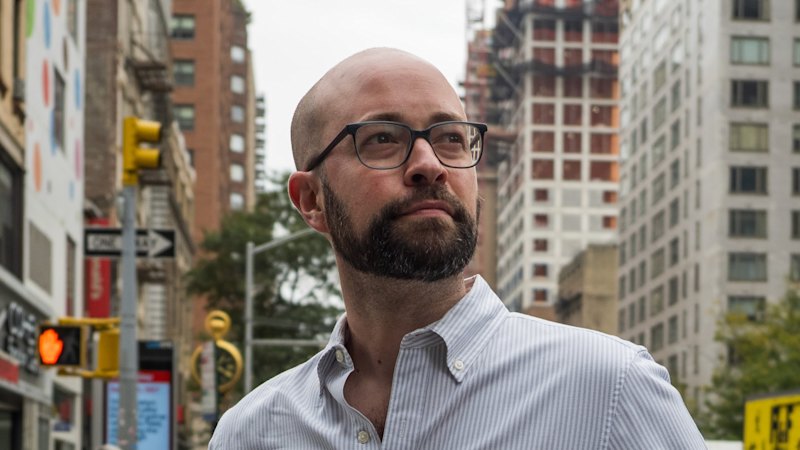
Pugh is a highly American Australian; he speaks fast and assuredly, enjoys activities and loves meeting new people. And he is well accustomed to the great New York pastime of talking about the city.
Over delicious baguettes, Pugh tells me his New York story, starting with his frenzied first year. “I was like, ‘Oh my god, this city doesn’t stop’. If you keep saying yes to things, you’ll just explode,” he says.
Things moderated when he met Stacey on dating app Hinge at the end of 2017. “We’ve balanced each other out really nicely. Some nights you have to learn to say no.”
During the COVID-19 pandemic, which hit New York brutally, they got married. The wedding took place in their apartment over Zoom, with a celebrant they found on TaskRabbit and just a few people watching – a best man in Sydney and Stacey’s cousin, the maid of honour.

Pugh shortly after arriving in New York in 2017.
COVID also changed his blossoming side project, America Josh, which went from helping people move to the US, to building a community. Pugh hosted online trivia every Friday for 35 weeks; he interspersed the questions with breakout sessions so people could chat. Afterwards, he says, “we saw people stay online for hours”.
Pugh also organises an annual “Big Aussie BBQ” in August, complete with Bakers Delight-style bread, Australian beers and football; this year, 700 people showed up. And he has hosted a coffee group every Friday for four years.
The operation now takes up two days of Pugh’s week, and he has hired an event manager, Julie Brock, to help with the workload. Digital marketing is his day job, but he would like to turn “America Josh” into a full-time gig.
Pugh was 29 when he moved to the US; he’s now 38. The lure of New York – and all that it offers and represents – remains enticing for many young Australians. But it is increasingly difficult to afford and doesn’t always live up to those great expectations.
Pugh also arranged “democracy sausages” for some of the 30,000 Australians who vote at the New York consulate.
“It’s this idea that you get here and it sort of carries you, this hustle,” Pugh says. “But it’s a sweaty, dirty place that a lot of the time will kick your arse.”
Pugh compares it to “Paris syndrome”, a phenomenon notoriously afflicting Japanese tourists upon their first visit to the French capital, when it doesn’t necessarily live up to its fairytale image.
“Some people who have the dream of always wanting to live here, they find it really difficult. You need money, you need a job,” he says. “If you don’t have the money to say yes to things here, you don’t get the connections, you don’t meet the people, you don’t build the community.”
Loading
Now, after eight years, Pugh has left New York – technically. He and Stacey have moved just across the Hudson River to Jersey City, 20 minutes by train from central Manhattan. It is hardly suburbia, but he is adjusting well.
“I realised I’m not going out every night any more,” he says. “I’m not hitting up clubs and pubs and bars and things every day. Now we come into the city to do things, as opposed to constantly being bombarded by it.”
In another big change, Pugh also became an American citizen. One morning last month, he trudged out to Newark for an interview and civics test, before a US official swore him in and played a video message from Trump. The whole thing took about three hours.
Pugh is still adjusting to being a dual citizen. “I’d find it odd to refer to myself as an American, and really still identify only as an Australian. But I’m comforted by the idea that I now have two homes.”
Get a note directly from our foreign correspondents on what’s making headlines around the world. Sign up for our weekly What in the World newsletter.


