










The fossil hunter had the object of his childhood dreams within his grasp: the ultra-rare bone of an ancient mammal hailing from the age of the dinosaurs.
It was 1996, and for a decade, Dr Thomas Rich and his wife, fellow palaeontologist Professor Pat Vickers-Rich, had jack-hammered, drilled and detonated explosives in the fossil-rich rock of Victoria’s Dinosaur Cove in their quest to uncover such a treasure.
And what a discovery it was: the suspected humerus of a Cretaceous monotreme. The 105-million-year-old bone would catalyse a debate about evolution’s most famed and fascinating products, the echidna and the platypus, that continues to this day. Another blockbuster paper based on the bone recently hit the scientific press.
But before any of that, Rich had a debt to settle. A pound of flesh to pay. A price that cast a pall of dismay over his Eureka moment.
For he had promised whoever found this bone a one-tonne block of chocolate.
“It was just a flippant promise,” says Rich, curator of vertebrate palaeontology at Museums Victoria.
His obsession with ancient mammals began with a book he received on Christmas Day in 1953 called All About Dinosaurs.
“There was this cartoon picture showing two little beady-eyed mammals eating dinosaur eggs. And at 12 years old, I made the connection – that’s us,” he says.
“I’ve named a few dinosaurs along the way, but it’s the mammals that have always grabbed my attention.”
Five years of painstaking work aided by hundreds of volunteers had unearthed plenty of dinosaur bones at Dinosaur Cove, Rich’s famous site near the Otways Ranges, but no mammals. Hope dwindled.
“Helen Whitelaw, who was one of the volunteers, came up to me and said, ‘What would you give me if I found a mammal here?’. And, knowing that she was a chocoholic, I flippantly said, ‘A cubic metre of chocolate’.”
A few years later, the Dinosaur Cove site closed.
But piles of leftover material remained. And from these rocks, a curious fossil emerged. It was initially identified as a turtle’s arm bone and it was considered so insignificant its discoverer didn’t put their name on the label.
Upon re-examination, it was reclassified as the humerus of a prehistoric echidna-like creature: the oldest fossil of a monotreme limb ever found in Australia and a precious addition to our record of mammalian ancestors which had fossicked at the feet of dinosaurs. The palaeontologists had won their prize.
“And so I had a bit of a problem,” says Rich. “It’s hard to write a grant proposal for a cubic metre of chocolate. How do I keep this promise?”
The cube would weigh about a tonne and cost at least $10,000.
As luck would have it, though, one of Rich’s volunteers taught a boy whose father ran the local chocolate factory. In a move worthy of Wonka, the man decided to step in.
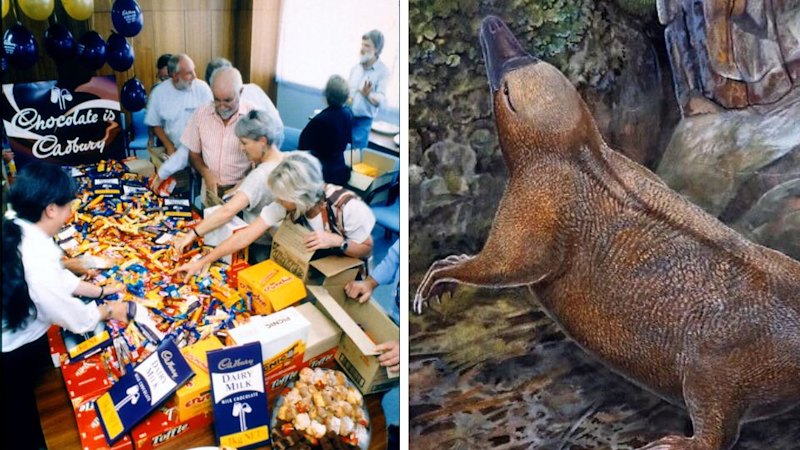
On a February day in 1998, every volunteer who had helped at Dinosaur Cove was invited to the Cadbury chocolate factory in Ringwood.
The staff presented them with a giant cube of cocoa butter (even the master chocolatiers of suburban Melbourne couldn’t craft a cubic metre of actual chocolate because it wouldn’t set).
“Then they rolled it away, they opened a door, and there were thousands of Cadbury chocolate bars,” Rich says. “And they said: ‘Take what you want!’.”
Like a Mesozoic feeding frenzy, the volunteers descended on the chocolate-laden room and bagged as much as they could carry.
“And so that’s the way this promise was fulfilled.”
It’s also how this creature earned its scientific name: Kryoryctes cadburyi.
The pinky-length bone was recently re-examined using the Australian Nuclear Science and Technology Organisation’s neutron radiography device, called DINGO, which is one of the world’s most powerful imaging machines.
Although the bone on the outside resembles that of an echidna, its internal structure is more in line with a platypus. The bone is dense, which is common in water-going species including hippos and sea otters, who use their bones as ballast to help stay underwater.
“It was most likely an animal that swam, maybe in rivers, and spent time digging through mud as well,” said ANSTO’s Dr Joseph Bevitt, co-author of the resulting paper. (For the record, he prefers Lindt.)
The finding shows platypus and echidna may have evolved from a common aquatic ancestor.
The idea echidnas evolved from a water-dwelling animal is an extraordinary one, according to lead author Professor Suzanne Hand. Mammals, generally, have evolved from land to water, as is the case for whales, dolphins, seals and beavers.
A semiaquatic mammal doing the opposite marks a thrillingly unique evolutionary event.
It could explain why echidnas’ hind feet are turned backwards like rudders helpful for swimming, and why they possess an oxygen-saving dive reflex.
Rich’s greatest lesson from the saga, though, has nothing to do with prehistoric monotremes: “Never make a promise you think you will never have to keep.”
The Examine newsletter explains and analyses science with a rigorous focus on the evidence. Sign up to get it each week.


