





[ad_1]
“So they will show more or less what the athlete feels or experiences,” he told this masthead. “I believe that two things we may see is that these drones may become a little bit more capable of flying for longer periods of time.”
The Olympic broadcasting director said the other transformation by 2032 would be greater variety of “cinematic” camera angles.

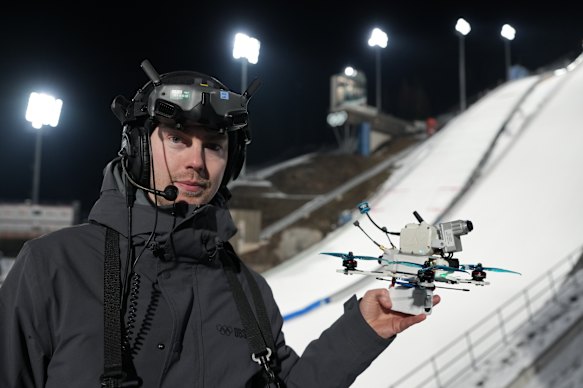
Drone pilot Jonas Sundal.Credit: AP
“I think it will add to the storytelling.”
In 2032, the technology would allow more summer Olympics sports to be tracked. At a briefing this week, the OBS director suggested that surfing and the marathon were events that would be in the drone zone for Los Angeles 2028. And most sports would be drone-feasible for Brisbane. “There is an opportunity for those sports that take place in long fields of play.”
Ominously, it is possible that by then drones could be piloted by AI, too. This would not be the preference of the current OBS chief, who wants drones in human hands.
One impact of the extreme technology at Milano Cortina is that some, though not all, of the action is better only appreciated on a screen, including at the venues.
For downhill events, this has long been the case, but even figure skating is more easily and accurately watched – the Quad God’s aerial contortions, not least – on a screen that boasts real-time 360-degree replays.
For short-track speed skating, in which the whole track is visible at the venue and the frightening speed of the skaters is overpowering, the live experience is nonpareil.
Milano Cortina has 25 drones operating at all outdoor competition venues and has a staggering 1800-plus microphones planted in every conceivable position.
The Olympics are beamed to hundreds of millions via 800-plus camera systems, some 32 of which are designated as “cinematic” cameras – as if directed by the auteur Paolo Sorrentino.
The drones have been a major talking point here, at an Olympics that has taken broadcast technology to ludicrous levels. The OBS insists that the drones were road-tested for safety and that, crucially, they have the consent of the athletes.
“We had controlled crash tests, we did all these things,” said Exarchos. “We did everything humanly possible to … maintain safety.”
“Humanly” is the apt description, since much of the technology in Milano Cortina is powered by AI: namely the 360-degree replays, the tracking of stones in curling, the highlights packages and some audio production.
Loading
But the most contentious technology, the First Person View (FPV) drones, are held in human hands, operated only by trained pilots. AI-steered drones – machines directing machines – is a bridge too far at this point.
“They have an innate creativity,” Exarchos said of the human pilots. “I’m sure those will be able to be mimicked in the future by AI but frankly I don’t care because I like the concept of humans piloting them… I like the concept of actual athletes piloting them, especially athletes practising the specific sport.”
Noise has been raised as an issue, due to the whistling sound audible in broadcasts.
Exarchos said the key consideration for athletes who were consulted about the technological advances was to avoid anything that interfered with their competition.
“They don’t want to have a lot of distractions,” he said.
“This is what I would say their concern is, there are many elements. You may have noticed the noise that the drones are making… In our case, it may have been a little bit more exaggerated, simply because of the way we do audio in the Olympic Games.”
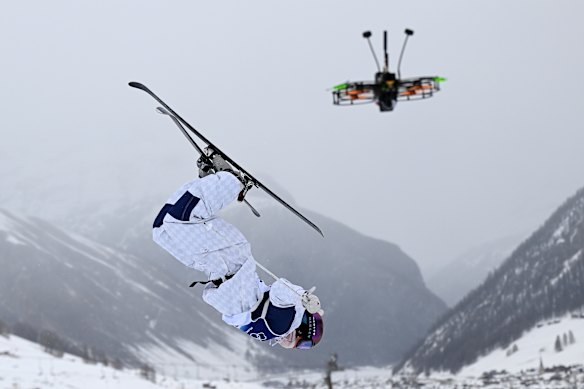
Makayla Gerken’s mogul run is watched by a drone.Credit: Getty Images
American snowboarder Bea Kim offered a less enthusiastic critique of the drones: “It depends who’s flying them. Sometimes they get too close to people, because the people flying them don’t realise how close they are. If they fly it down the middle, [they’re] in our heads.”
Australian snowboarder Mela Stalker said she did not notice the drone hovering in the air. “But at the top I could definitely hear the buzzing in the background. Sometimes it’s noticeable and sometimes it’s not. You’re so locked in that you kind of block it out.”
Loading
Swiss freestyle skier Giulia Tanno told The Washington Post that the drones caught her attention in practice and before descent, but not once she competed. “As soon as I drop, I don’t hear.”
The fastest drones are for the fastest sport, the luge, in which speeds exceed 130 km/hr.
Fast sports need the drones further away for safety, and they must be behind. “The slower the sport, the closer you can go,” said Exarchos.
“Luge we’re pretty far behind.”
At figure skating, the slower yet agile spider camera, floats above the skaters. The viewer at home doesn’t notice it. And nor do the skaters.
Australian figure skater Holly Harris did not notice the camera. “Not when I’m skating, but I think I notice it when I’m up in the stands.”
The athletes live in a world of their own in those seconds or minutes when a lifetime’s toil and preparation are on the line. But the gadgetry is transforming how we watch the Olympics.
The Winter Olympic Games is broadcast on the 9Network, 9Now and Stan Sport.
News, results and expert analysis from the weekend of sport sent every Monday. Sign up for our Sport newsletter.
[ad_2]

