








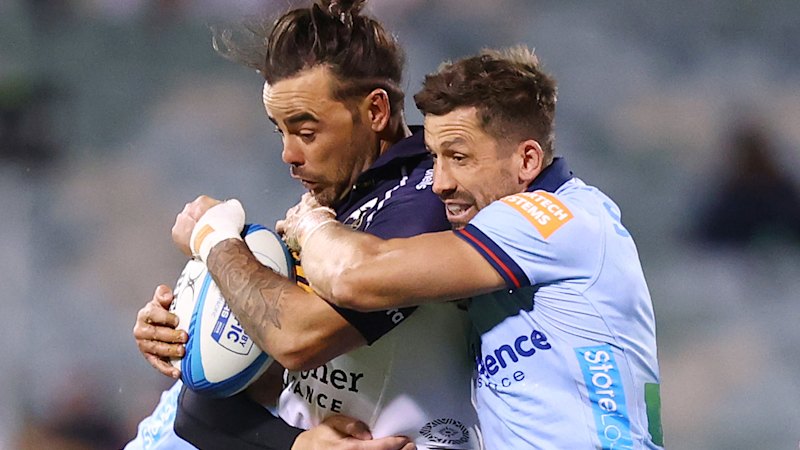


It’s a long way from Dublin to Canberra, via Belmore Oval, but the Waratahs’ defence provided a connection point on Friday when NSW produced a gritty upset win over the Brumbies, their first at GIO Stadium since 2018.
The result ended an eight-game losing streak for the Waratahs against the Brumbies in the nation’s capital, and while much crisper attack and Sid Harvey’s boot were important, the Tahs’ victory was built mostly on a resolute defensive effort.
Against a typically accurate Brumbies side that dominated possession and territory, the Waratahs made 254 tackles and, crucially, only missed 22, at a success rate of 91 per cent.
It was one of the Tahs’ highest tackle counts in a decade and eight players – including the entire tight five – made 16 tackles or more. Four players completed more than 20 tackles, including flanker Jamie Adamson, in just 48 minutes.
The Waratahs not only returned to the winner’s circle after three losses, but they also re-emerged as the side that built wins in the trials and early rounds on defence.
“It was a very pleasing effort from the boys – you don’t win in Canberra unless you work really hard and you’re physical for 80 minutes,” Waratahs defence coach Locky McCaffrey said. “We are slowly building an identity around an aggressive defence, and it was good to see them sustain it for 80 minutes. In previous games, we’ve only done it for 40 or 60.”
The base elements of the Waratahs’ win would have looked familiar at GIO Stadium, given NSW coach Dan McKellar coached the Brumbies using a similar playbook from 2018 to 2022.
McKellar sought to lay the same foundation after arriving at the Tahs in late 2024: namely a strong defence that creates pressure and then try-scoring opportunities via turnovers. And there were promising signs – the Waratahs finished with the best collision stats in the competition and the most forced turnovers.
But they did not have the fitness to maintain the intensity for 80 minutes, so a gruelling summer of conditioning – and the recruiting of industrious tight forwards like Matt Philip – followed.
Valuable off-season study trips were also undertaken by McKellar and McCaffrey. The pair spent a week at Belmore Oval with Cameron Ciraldo and the Bulldogs, and McCaffrey travelled to the UK for weeks at Leinster and Bath, the powerhouse clubs that won last year’s URC and English Premiership respectively.
“We wanted to go to teams that pride themselves on their defence and had an identity around it, and are a heavy line speed-based defence team,” McCaffrey said.
“The Bulldogs pride themselves on their defence as a No.1 thing in the building. So we were trying to go to like-minded teams in that sense, and successful teams. And there are a lot of similarities across them all, around recruitment and putting emphasis into a hard-working defensive system that is a real non-negotiable within the four walls of the building.”
McCaffrey said the time spent in Ireland with Leinster (and ex-Springboks) coach Jacques Nienaber, and Johann Van Graan at Bath, confirmed not only the importance of relentless defence, but having players with the right attitude.
“There was a really clear identity in both clubs around what’s important, and if you don’t want to work hard defensively, you’re not going to get picked,” he said.
“And that’s what we are about, too. Everyone has roles and responsibilities, but it is a non-negotiable if you want to pull on a Waratah jersey that you have to work hard and be physical around your defence.
“Players have to understand when you pull on that jersey every weekend, the way you defend and the work ethic around how you defend, that should make every Waratah fan proud.”
The Waratahs’ defensive system, says McCaffrey, is geared towards getting up quickly, denying rivals the gain line and forcing turnovers, allowing the skills of Max Jorgensen and the Tahs backs to strike against disorganised defence. They had seven forced turnovers against the Brumbies and did far better on the “bobble ball” after contestable kicks, too.
It’s an opportunistic style used by New Zealand teams in Super Rugby, and after getting badly exposed by the Hurricanes in a round four drubbing, the Tahs know they will have to be accurate when they meet the Chiefs in Hamilton on Saturday.
“You’ve got to attack them through your defence,” McCaffrey said. “Last year we beat the Chiefs at home and restricted them to, I think, their lowest points for the year.
“Obviously they’ve got quality everywhere, and if you give them time and space, they make you look pretty silly. So you’ve got to be really smart around your kick strategy. As we learned versus the Hurricanes, you can’t give them turnover ball opportunity.”


