








The long journey to the carousel
What happens between the bag drop and finding your bag on a carousel is a secret journey, one that’s being altered by technological advances and innovation.
“Today’s modern baggage systems give airports end-to-end control of every single bag,” said Ken Lowe, managing director of Beumer Group Australia, which is building Melbourne Airport’s baggage handling system. “We can track and trace luggage at every stage of the journey while inside the system,” Lowe added.
Increasing precision is raising passenger expectations.
So how do these ever-more-precise systems work?

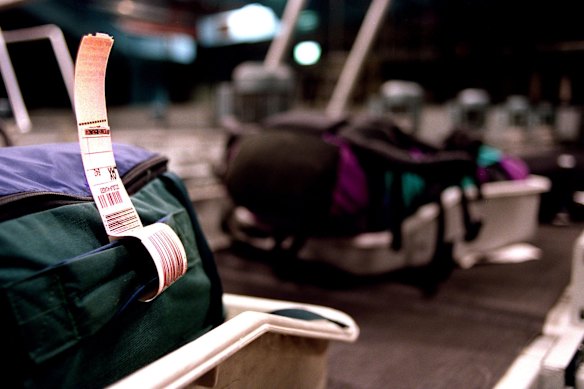
A bag with its all-important tag.
Let’s start with the bag tag taped around your luggage handle. It identifies the bag, customer and destination. The tag has a barcode containing real-time information on the bag’s itinerary (time and date, flights, destinations). The message with this information is read by the tag reader.
Your bag enters the main baggage handling system network of conveyors and lands on a tote, which has its own code. The bag tag and tote numbers are linked, which allows each bag and its progress to be monitored from a baggage system control room.
Your baggage is X-rayed and diverted for human review if something suspicious is found. The totes’ uniform size helps standardise the flow of baggage through the system.
If nothing is found, your bag is sorted and routed on a high-speed tote transport system, using a tilt tray sorter, to land at the correct pier, carousel or make-up unit (where they prepare for bags to be loaded onto the plane) for its scheduled flight. Software maps out the most efficient route through the system.
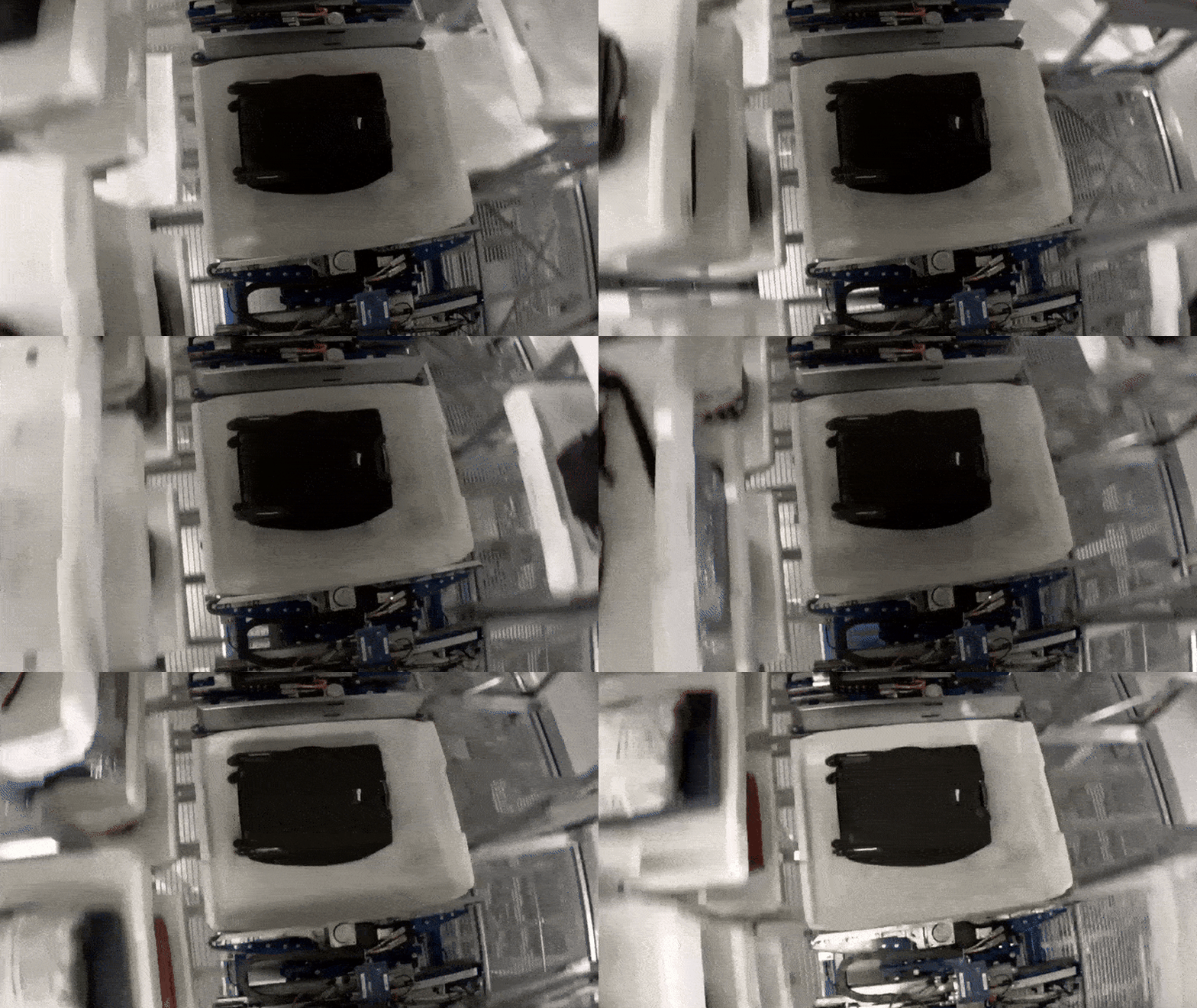
If your bag arrives hours in advance of its flight, it will be diverted into the Early Bag Storage area. The EBS is a large rack with a robotic picker that places totes for waiting and then picks them up when the flight is ready.
Melbourne Airport calls this a Dynamic Bag Storage area. It is also used to smooth out the flow of bags during peaks and troughs of activity, ensuring a steadier and easier-to-manage delivery of bags to ground handlers.
Your bag then goes to the load/make-up area, where ground handlers collect and load it onto specialised carts or Unit Load Devices (ULDs) that will be transferred directly to the aircraft.
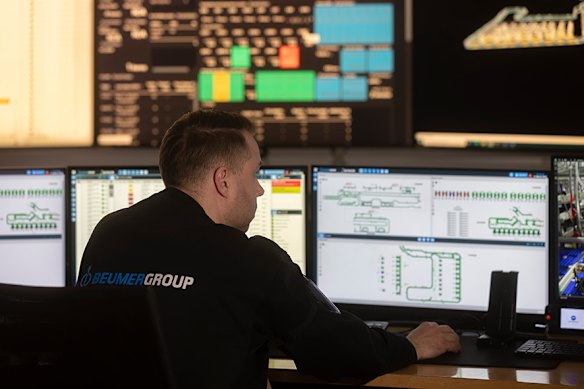
A baggage handling system by Germany-based Beumer Group, which is building Melbourne Airport’s new system.Credit: Beumer Group
The full ULDs are driven out to the aircraft for final loading into the cargo hold. Your bag is rescanned again to ensure the right bag is being loaded.
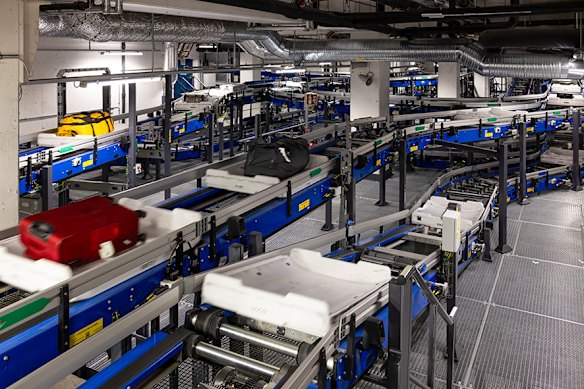
A system of totes carries the bags.Credit: Hartmann Schmidt
The full information on your bags will then be sent to the destination airport, where another reconciliation will be done at arrival and unloading. Another scan will be done to confirm that the bags have reached the destination.
Lowe said a good baggage handling system is “not just about speeding up operations for the airport, it’s about making sure each passenger’s bag is accounted for, matched correctly, and handled perfectly from start to finish”.
UAE-based special airport systems consultant Mehdi Lakhal Chaieb said good systems require back-up options in case there is a mechanical or tech breakdown.
“We should always make sure that we have a certain redundancy for mechanical parts,” Chaieb said. “That means in case of physical failures there should always be an alternative bypass or route.”
The hold baggage screening systems (found in Early Bag Storage) require enough human operators and computing power to function well if the screening has to be done remotely, Chaieb said.
With these advances, technology is lifting the lid, slightly, on the mystery of missing bags.
SITA’s “WorldTracer” system tracks missing bags across different airport baggage handling systems, airlines and airports.
‘Where is my bag?’
“For anyone who loses a bag, it’s updated in WorldTracer, and then WorldTracer helps track the bag through the entire ecosystem,” Patel said. That runs across all airports and airlines.
Yet, some factors can’t be controlled. Patel said that if an airport’s baggage handling system “is really old, it takes a lot of time for the baggage to be processed, and there’s still a lot of manual work to be done”.


SITA Asia Pacific president Sumesh Patel, pictured at the Australian Airports Association national conference in the Gold Coast on December 3, 2025.Credit: Chris Zappone
In part for this reason, more bags get lost in Europe than in any other region. “The biggest challenge is the transit,” Patel said, and many European airlines, airports and IT systems are “quite fragmented”.
“So they don’t talk to each other and a lot of manual work is required, and that’s where you see a lot of bag loss,” said Patel.
According to the 2025 SITA baggage IT insights report, a whopping 33.4 million bags were mishandled (delayed, damaged, lost or stolen) in 2024. Even so, the mishandling rate is dropping.
It fell to 6.3 bags per 1000 passengers last year, down from 6.9 in 2023, the company said.
It’s part of a longer-term trend. Better systems have whittled down the number of mishandled bags, which in 2007 stood at 18.9 missing bags per 1000.
Distance of the flight seems to be a factor in luggage difficulties. Your bags have better odds of arriving at their destination if you’re flying domestically.
International flights had a mishandling rate of 11.2 bags per 1000 passengers in 2024 while domestic flights stood at just 1.9 bags, according to SITA.
International travel is more complex, has longer layovers, more handovers of luggage and tighter transfer times. But these days, domestic flyers tend to travel with fewer bags.
“On short-haul and low-cost routes, more passengers are travelling light, favouring carry-on luggage and easing the load on hold baggage operations,” the SITA report said.
Mobile phones and personal technology help, too. During COVID, many passengers started using Apple AirTags to track bags. Passengers these days can share Air Tag location information with the airline ground handler, Patel said.
The embrace of airline apps – United, Qantas and Virgin all have them – is reducing the hassle associated with delayed bags. Passengers can now start the process of recovering their bag via their phone. They can also get updates on the location of their luggage, which gives a better sense of control.
Self-checking future
And if the system knows a bag is missing, why wait for the passenger to report it? In the brave new world of baggage systems, lost luggage can even be automatically rebooked to a flight with “no manual intervention required” – if you’re flying on German airline Lufthansa.
“The system will automatically look at the data, it will track the bag and will see what is the next available flight,” said Patel. Then “it will ‘automatically re-flight’ those bags, and give you a notification to say ‘Hey, your bag is here now’.”
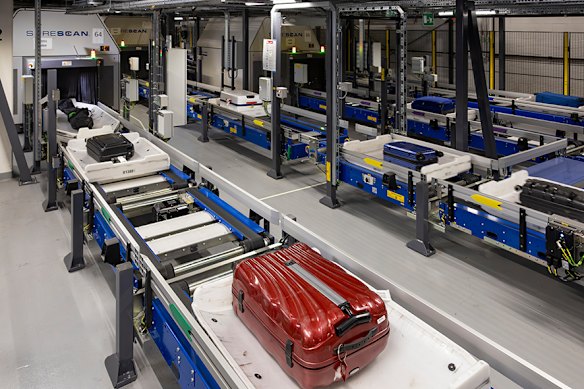
A baggage handling system by Germany-based Beumer Group, which is building Melbourne Airport’s new system.
Currently, the system is used for nearly 75 per cent of bags lost on Lufthansa, Patel said. Other airlines are trialling the capability.
If bags’ status can be tracked via phones and rebooked automatically, the next step is moving the drop-off point outside the airport.
Changi Airport, with Singapore Airlines and Marina Bay Sands hotel, are trialling a mobile passenger processing trolley which allows hotel guests to check in bags before they leave the hotel for the airport. Such a service is available at a Helsinki hotel and train station for Finnair.
Passenger convenience could potentially have an industry effect too: reducing the amount of terminal floor space dedicated to bag drops. It pushes “away a lot of what you do at the airport, off the airport”, Patel said.
With projections for airline capacity expected to soar, this is no small consideration.
Six airports in Asia plan to increase capacity to over 100 million passengers a year by the mid-2030s, Cirium aviation analytics data shows.
If you can check your luggage before going to the airport, your bag can journey directly from your hotel room to your next destination.
The Business Briefing newsletter delivers major stories, exclusive coverage and expert opinion. Sign up to get it every weekday morning.


