


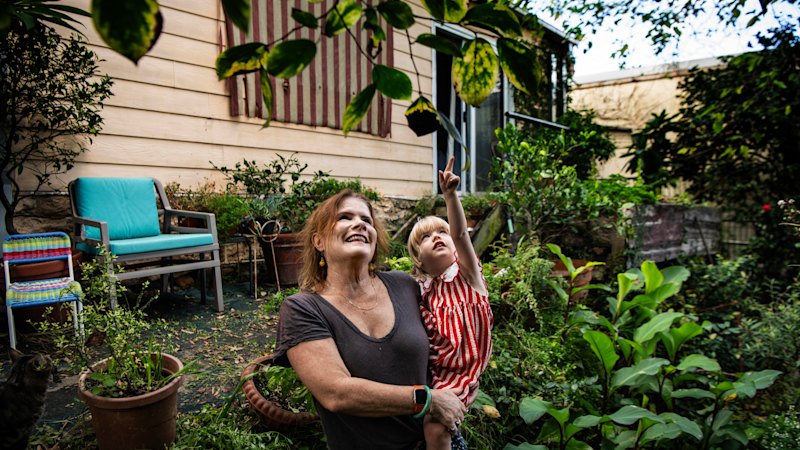

Sarah Connors is in her 60s and at the top of her professional game as a lawyer and team leader at a government agency. Like many mothers of her era, after her (five) children grew up, she could focus on her career.
But when her eldest daughter needed help balancing childcare and her own professional life, Connors decided to cut back her hours at the NSW Health Care Complaints Commission to take her two-year-old granddaughter one day a week.
“I try to just have a quiet routine in our days,” she says. “We go to a playground, then Cece [short for Celia] likes to come to my house, and we just potter around and go in the garden and run away from the cat.”
Connors enjoys time with Cece very much, but acknowledges that she and other midlife women cutting back on their paid work to support adult kids with free childcare are making a sacrifice.
“It does wear away at the pay packet a bit – quite noticeably,” Connors said.
She is part of what academics and a national white paper by the insurer Australian Seniors identify as a wave of midlife mothers reducing their own work to do childcare so their adult daughters can work.
Some advocates and researchers say they should be paid.
Australian Institute of Family Studies data has found that about two-thirds of grandparents with a grandchild under 10 provide care; 40 per cent with grandchildren under 13 do it at least weekly.
New data from a national survey by Australian Seniors and by soon-to-be-published Australian academic research both show it is mostly grandmothers feeling the strain, and caring is costing women who might otherwise be working.
Nearly seven in 10 (69 per cent) of the 4205 grandparents in a representative sample surveyed for the Australian Seniors Grandparents Report 2025 believe the government does not provide enough support for grandparents doing regular childcare.
Most – 70 per cent – believe grandparents should receive financial compensation.
What grandparents say about supporting their adult children
- Half of grandparents aged 50 and over provide childcare; 59 per cent do two or more days a week.
- Grandmothers report more strain, emotional and physical impacts of childcare.
- Just over half of grandparents provide financial support to grandchildren or adult children.
- Despite the cost, 69 per cent of those do not feel reluctant or resentful about giving financial help.
- Cost-of-living pressures have raised expectations; more than two in five grandparents say they are “generally expected to do more”.
- Nearly seven in 10 feel the government does not provide enough support for grandparents who do regular childcare, and most (70 per cent) believe grandparents who provide regular childcare should receive financial compensation.
- Source, Australian Seniors Grandparents Report 2025, compiled by MYMAVINS research consultancy via a representative survey of 4205 grandparents
“The most helpful forms of government assistance are subsidies or payments for childcare (57 per cent), tax relief and deductions (42 per cent) and discounted or free healthcare (40 per cent),” respondents said. One-third of grandparents over 50 juggled caregiving with paid work.
Of the more than half of grandparents (52 per cent) who provide hands-on care for their grandchildren, three-fifths (59 per cent) typically provide care two or more days per week.
Associate Professor Myra Hamilton, Australian Research Council fellow in the Discipline of Work and Organisational Studies at the University of Sydney, has examined the twin pressures on women to keep working longer and also provide childcare for grandchildren – mostly supporting working daughters.
“We found regular childcare had quite substantial impacts on grandparents’ labour market participation,” Hamilton said.
“Seventy per cent changed their hours or work shifts, half of grandparents reduced their working hours, and one in five changed their jobs to accommodate regular childcare of grandchildren.”
This had a negative financial impact due to “substantial” costs paid by grandparents for equipment, activities and food for grandchildren and from forgoing income and superannuation payments.
Hamilton’s new research with Melbourne University professor of sociology and social policy Lyn Craig has revealed a “generational squeeze” as mothers’ increased workforce participation ups pressure on their own mothers.
Their soon-to-be published paper reveals grandmothers do most physical care and are forced to make “difficult decisions” about trading work for childcare.
About half of grandparents in previous research have said they would like some compensation, and the new data based on interviews with grandparents will show they do not feel their caring work is acknowledged by government policies.
“We had grandparents saying ‘we feel very recognised by families, but we don’t feel our contribution is recognised by governments, and it would be helpful if it was’,” Hamilton said.
At present, grandparents can be paid for additional childcare only if they are the grandchild’s primary carer, meet childcare subsidy criteria and do more than 65 per cent of the child’s overall care.
Even if parents’ childcare subsidies were allowed to be paid to grandparents, women forgoing hours in their jobs to do so would still receive less income, Hamilton said.
“This wouldn’t do anything about a system driving unequal outcomes in who carries most of the responsibility for childcare; essentially, childcare gets pushed around between different groups of women,” she said.
The new research found mothers believe that fathers’ work is less flexible. They typically ask their mother for care help first, then their father, while disrupting their male partner’s work is a last resort, in part because of perceptions that fathers do not have social licence to use parental provisions.
Craig said Australia’s relatively low amount of paid parental leave (26 weeks) is one reason for pressure on grandparents, as are family tax provisions making it uneconomic to use commercial childcare more than three days a week.
‘Now families have got to have two full-time workers to be able to manage. I think our generation is paying the price a bit.’
Working grandmother and child carer Karen Purkis-Lester
“The main driver [of more grandparent care being required] seems to be that young women’s workforce participation is necessary for families to house themselves now and meet other aspects of the cost of living,” Craig said.
Often grandparents cover the extra two days’ care in a mother’s full-time workweek. “It seems to us that grandmothers are doing this whether they are [also] working,” Craig said.
None of the grandparents in her study with Hamilton were being paid for their time. Craig said it could be helpful to remunerate those who want it, but this would not provide a social solution for Australia’s lack of affordable and accessible care.
“We have an inadequate length of parental leave [26 weeks], and this needs to rise,” Craig said.
In countries where parents had longer paid leave and where men more commonly used their entitlements and there is universal childcare, grandparents are freer to do occasional care, which research shows is beneficial.
Working grandmother Karen Purkis-Lester, 61, said she does not resent adjusting her work hours to care for her son’s five-year-old twins, and girls aged nine and 10 after school several days a week.
“It’s tiring, but I enjoy it,” says Purkis-Lester, who works five days as week in aged care, finishing early enough for pickups.
“You are putting your life on hold, but they [economic factors] have made it so hard for this generation.”
When Purkis-Lester’s two sons were little, one full-time working parent and one working part-time was enough to support a family.
“Now they’ve [families] got to have two full-time workers to be able to manage,” she said. “I think our generation is paying the price a bit.”
 Wendy Tuohy is a senior writer focusing on social issues and those impacting women and girls.Connect via X or email.