



Graham Arnold believes in omens.
When he was assistant coach to Guus Hiddink, the Socceroos were trying to qualify for their first World Cup since Germany 1974. They did it, and Australia’s long drought ended at … Germany 2006.
So when Iraq were sent to Mexico for their World Cup qualifying play-off against Bolivia, Arnold took it as a message from the universe. Mexico, after all, was where the Lions of Mesopotamia made their one and only appearance on football’s grandest stage in 1986.
Not for the first time, Arnold’s superstition was vindicated. Forty years later, his magic touch has delivered a historic 2-1 win that has changed the mood of a nation.
“I’ve got to give so much thanks to the players,” Arnold said. “The work ethic they showed, the real Iraqi mentality of fighting and putting their body on the line. That’s why we won the game.
“I’m so happy that we’ve made 46 million people happy – especially with what’s going on in the Middle East at the moment, I’m just so happy for them.”
Public servants in Iraq were told they could turn up to work a little later than usual on Wednesday morning – just so they and the rest of the country’s 46 million football obsessives could watch the game in Monterrey that would decide the last remaining spot at the upcoming World Cup, one of the most anticipated in their history. They were not disappointed.
Now they have a World Cup to look forward to for the first time in 40 years – a journey that will begin against Erling Haaland’s Norway on June 16, and continue against France and Senegal, their other adversaries in Group I.
That was exactly what Arnold set out to do when he accepted the role as Iraq’s head coach in May, eight years after they first tried to secure his services.
Job done: now Arnold has a piece of history for himself, becoming the first Australian coach to work at two men’s World Cups, and the first to go there with another nation.
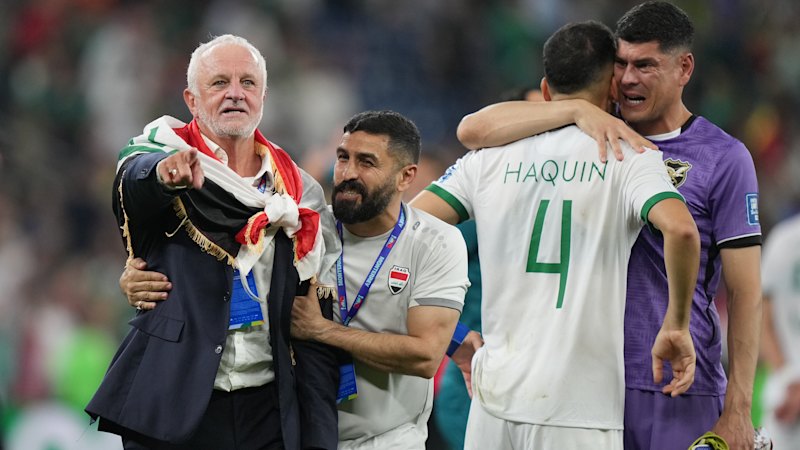
Players lifted Arnold onto their shoulders in celebration, with the former Socceroos boss proudly waving the Iraqi flag in front of their ecstatic supporters.
Just getting to the Estadio BBVA was an achievement in itself. The war in Iran shut down the airspace in Iraq, leaving Arnold – who was stranded in Dubai for 10 days as bombs landed near his hotel – fretting about how his players would get there.
He initially petitioned FIFA to postpone their play-off until just before the World Cup, and while that didn’t happen, his public pressure brought the world governing body into action, and they helped facilitate their safe passage from Iraq to Jordan (after a 20-hour bus trip), and then to Monterrey via Lisbon on a chartered flight.
The interrupted lead-in played havoc with their preparation, but Iraq’s players dug deep, spurred on by Arnold’s urging that they do it for their country but, above even that, themselves and their families.
Fittingly, it was hard-fought. Iraq began with ferocity, with their midfield chief Amir Al-Ammari hitting the woodwork in the ninth minute, his shot pushed onto the crossbar and out by the Bolivian goalkeeper.
But from the resultant corner, delivered impeccably by Al-Ammari, striker Ali Al-Hamadi headed the ball in from close range to give them a 1-0 advantage.
Bolivia responded seven minutes before half-time when Moises Paniagua collected a teammate’s long-range attempt, and then shot himself from just outside the six-yard box, putting the ball past Iraqi custodian Ahmed Basil Fadhil.
Arnold, however, swung the match back Iraq’s way with a double substitution on the other side of the break, partly forced by an injury to Youssef Amyn.
Moments after he entered the fray, his replacement, Marko Farji, found space on the right and crossed the ball in for his captain, Aymen Hussein, to sweep it into the net.
After enduring a late Bolivian siege, the blissful sound of the full-time whistle – at the end of the 899th and final game of cup qualifying – triggered an outpouring of emotion from Iraqi fans at the venue, in Iraq, and among their sprawling diaspora all over the world.
To them, Arnold is now a hero, the man who achieved what so many coaches before him could not.
