


When construction began on the Viva oil refinery in 1951, its owners were motivated by the anxieties of the day.
Emerging from the second world war into the Cold War, the Shell group feared oil-producing countries would nationalise their industries, giving Communist and other unfriendly nations a chokehold on global prosperity.
The Australian government, meanwhile, wanted a strong manufacturing base – for jobs, defence, security. So, in a muddy paddock at Corio, a largely migrant workforce lay the foundations of Victoria’s industrial future.
Seventy-five years later, Australia is once again gripped by anxiety. The Strait of Hormuz is choked shut by war and, in the midst of a new oil shock, on Wednesday night, the Viva refinery suffered a mechanical failure and exploded into flames.
As Australian Workers Union branch secretary Ronnie Hayden, who was on the scene on Thursday morning, said, it was like Geelong’s very own “war zone”.
“The whole backyard was lit up red,” said Melanie, who lives a few streets away.
For a nation already dusting off the jerrycans amid a fuel supply crisis, the fire could not have come at a worse time.
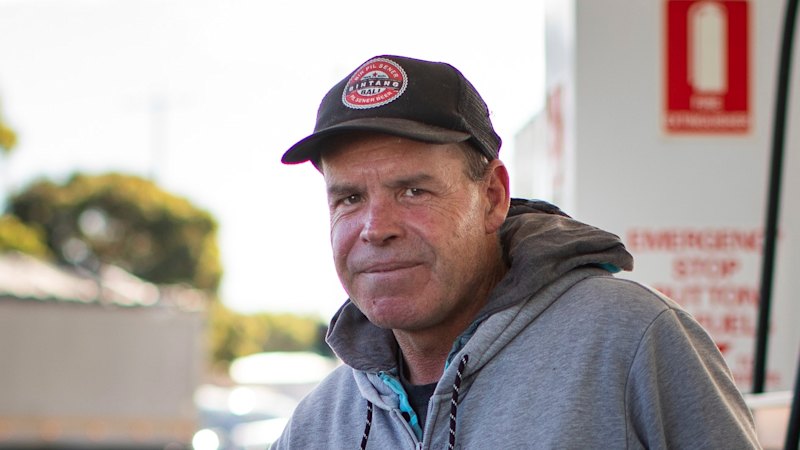
“I can’t really think about it,” said Geelong carpenter Alan Spierings of a possible further increase in petrol prices. “I might have to buy a horse and cart!”
“I’ll be eating a lot of two-minute noodles,” said another motorist, Katherine Crow.
Compounding disasters in Australia’s fuel supply chain have hit at the heart of a very modern worry identified in a major study by the National Security College at the ANU.
The study of 20,000 people found that a large majority of Australians fear the country has given away so much self-sufficiency that one blow at a vulnerable point will threaten their security. Report author Professor Rory Medcalf said people were expressing the fear that Australia’s supply system had “fragile arteries”.
Australians worry that an accident or an attack on a supply choke point would cause “cascading disruption to everyday life”. Medcalf said on Wednesday: “The Geelong fire exposes how acutely vulnerable Australia is to single points of failure in fuel, logistics and critical infrastructure.
“A largely market-based approach to these foundations of our national existence is no longer sufficient in a disordered world. And the public has known this for a while.”
The Viva refinery was built to shore up national self-sufficiency, but by 2015, when the Abbott government released its energy white paper, those anxieties and ambitions seemed hopelessly old-fashioned.
As the big refineries in Asia pumped out fuel more cheaply than Australia could manage, the government waved through the closure of most of Australia’s domestic capacity. Kwinana, Altona, Bulwer Island, Kurnell and Clyde refineries have all closed since 2013. Only Viva and Ampol Lytton in Brisbane remain.
This was not a problem, the 2015 white paper said, because, “The Australian government considers that supply reliability will be maintained because of the depth, liquidity and diversity of international crude and fuel markets.”
This is the neoliberal economic promise. If another country can make something cheaper than you, the only rational choice is to let them make it, then buy it from them on the open market. In return, Australia would sell the things it produced best. As long as trade was free and oceans navigable, everyone was a winner.
As for security against military threats, we lived under the US nuclear umbrella and the promise of the ANZUS treaty.
As a result, when it comes to fuel, “Australia carries the unenviable distinction of being one of the most import-dependent nations in the world for refined fuel products, while simultaneously holding some of the lowest strategic reserves of any developed economy,” according to Gero Farruggio, the head of Australian research at independent energy analyst Rystad.
“You can be heavily reliant on imports, or you can hold minimal reserves – but you cannot be both.”
Today, thanks to war in the Middle East, tariffs and threats to freedom of navigation, trade no longer seem so free, and Prime Minister Anthony Albanese has spent the past fortnight travelling the region to shore up Australia’s supply of fuel, using our gas exports as a bargaining chip.
His trip also serves to very publicly assure voters that he’s on the case, after his and Energy Minister Chris Bowen’s initial reassurances that Australia’s fuel supply was secure fell flat.
As Albanese was in Malaysia talking fuel, defence minister Richard Marles was at the National Press Club to announce “the biggest peacetime increase in defence spending in our nation’s history”. Both can be seen as reaction to the anxieties identified in Medcalf’s report.
“My organisation’s community consultations research showed that a year ago ordinary Australians were already warning of … the likelihood of multiple strategic shocks in the near future,” Medcalf told this masthead.
Well before Donald Trump’s Middle East war, “concern about energy security was widespread”.
Now, after the Viva fire, some predict Australia will need to step up to stage 3 of its fuel-saving plan. Fears of “cascading disruption” might soon be realised.
What Australians want in response, Medcalf’s research revealed, was “redundancy” – second, third, fourth options built in to the system. The fire at the Viva refinery – the first layer of back-up for imported product – will only make this desire more pressing.
People also wanted more information, Medcalf’s research found – to know where supply choke points were, to understand the cascading consequences of each one failing, then to see investment in the “diversifications and buffers that matter most in each place”.
More than half of Australians think the government shares too little or far too little information about security threats, leaving voters feeling “anxiety without agency”.
Those most concerned, the report found, were Australians aged 55 and older, regional and rural communities, lower socioeconomic groups, and the Australian-born – politically, those who are cleaving increasingly to One Nation.
Talk of boosting national security by building sovereign capability worries independent economist Saul Eslake.
“I don’t dispute that COVID and the spat with China, and now these developments, have raised questions about the extent to which the world has become ‘just in time’ rather than ‘just in case’,” Eslake said. He agreed that, at the very least, Australia should have stockpiled more fuel.
“However, I worry that’s being used as an excuse to justify the desire people have that Australia make things that we should not be making.
“I’m not to saying it’s never justified, but we should be very careful when people use arguments about security to ask for subsidies or tax breaks.”
This, he said, was very expensive and ultimately either taxpayers or customers paid.
ANU professor and historian Frank Bongiorno said from Federation until about the 1970s, what we now call sovereign capacity mattered in Australia – and it was “not widely known how much money they put into it”. After the 1970s, however, the “sway of the economists” began, with the assumption that “you could trade your way out of anything”.
“The broader set of policy directions that have been pursued for the past 50 years by both sides of politics are very different from the guiding assumptions of both sides of politics for the forgoing 70 years,” Bongiorno said.
When the Viva refinery was built, “the assumption was that Australia was living in a dangerous world and they weren’t fully trusting that the British Empire would be there for them. They weren’t fools,” he said.
Now, said Bongiorno, attitudes seemed to be changing back. Australia’s unquestioning reliance on trade security and a benign benefactor in the United States “seems to be coming to an end”. Unwinding the neoliberal compact, however, would be “hugely difficult and disruptive”. It would mean the government restoring critical manufacturing capacity. It would require rejigging the economy in unfamiliar ways.
To Eslake, at least, it’s a dangerous path.
“The argument that Australia needed to make things was widely used to justify the tariff walls we built after Federation and maintained until the 1970s,” he said.
“That attitude was a major reason Australia went from being one of the richest countries in the world to, by the time we realised how dumb that was, something like 26th richest.
“That’s the price we’ll pay.”
With Nick Toscano
 Michael Bachelard is a senior writer and former deputy editor and investigations editor of The Age. He has worked in Canberra, Melbourne and Jakarta, has written two books and won multiple awards for journalism, including the Gold Walkley.Connect via X or email.