







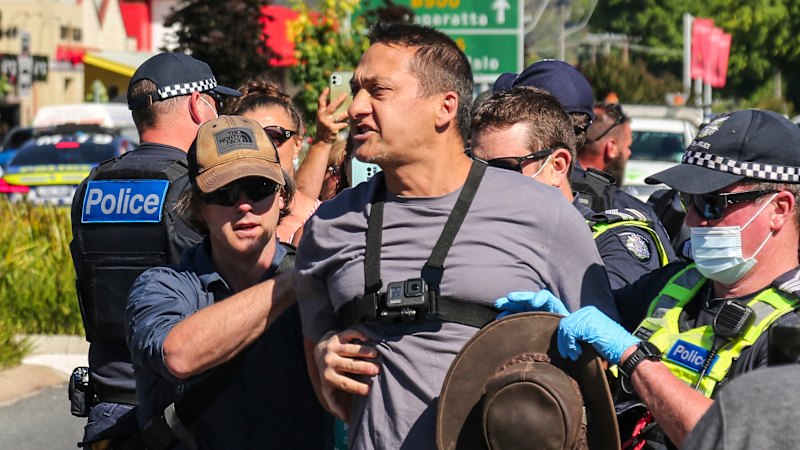
One of the first times Dezi Freeman ran from police, his friend Bruce Evans tried to negotiate on the phone between him and the local police.
“He’d gone through a tunnel on foot and popped up on the other side of the freeway, and they couldn’t catch him, so I offered to help de-escalate things,” recalls Evans, who was also facing charges at the time for breaching COVID restrictions.
They had been standing “back to back without masks”, part of a regular protest in the regional town of Benalla during pandemic lockdowns, and Evans was confident they had a solid legal case. “Instead, Dezi did a runner,” he says. “When he called me, he was hiding under a pile of leaves. I kept asking him, ‘Why did you run?’”
Years later, on August 26, 2025, when Freeman gunned down police serving a warrant on him and then disappeared into the wilderness of Porepunkah, Evans was no longer shocked. Freeman’s hatred of police and “the system” had boiled over by then, beyond his fights with them at protests and in court, Evans says.
The last text Freeman sent him – just days before the August shooting – declared that he no longer cared if he was caught driving without a licence. “They can shoot me,” Freeman had told Evans.
Like many of Freeman’s friends, Evans doesn’t believe “the official story” of the shooting and the extraordinary seven-month manhunt that followed, ending in a shootout and Dezi’s death last week at a remote property near Walwa – more than 100 kilometres from where he vanished into the Porepunkah forest.
“But I know he shot those police,” says Evans.

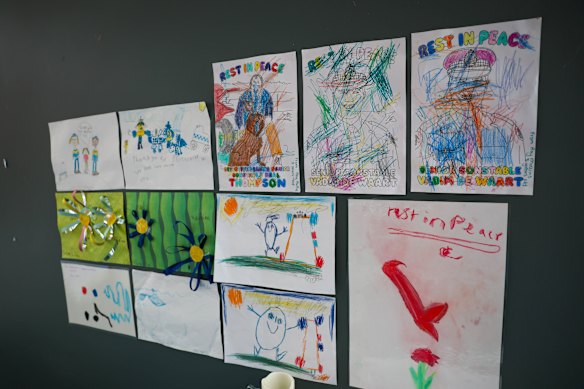
A memorial, papered with children’s drawings, has sprung up inside the nearby Wangaratta police station for the two officers Freeman shot dead: Detective Leading Senior Constable Neal Thompson and Senior Constable Vadim de Waart-Hottart.
They were among 10 officers who approached Freeman and his family that day in August at the renovated bus where they had been living off-grid to serve a search warrant on Freeman over child sexual offences. A third officer was seriously injured in the confrontation, and a female sergeant also narrowly escaped when the gun Freeman turned on her jammed and didn’t fire.
In the shadow of Mount Buffalo, where Freeman vanished with two stolen police guns, locals who were raided during the early manhunt say they are now wary police will come knocking again, as authorities search for those who might have offered him aid.
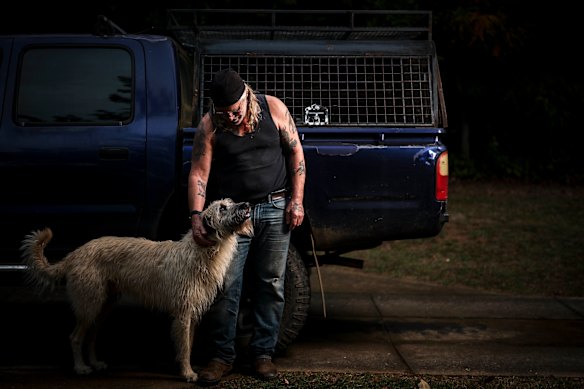
Until surprise intelligence from someone close to the fugitive arrived last month, police had come to believe that Freeman was dead. Surveillance was silent, and exhaustive searches of the bush had turned up nothing. Now detectives are certain he had help on the run – associates bringing him supplies or aiding his travel through treacherous terrain that had recently been hit by fires and snow.
Last weekend, two of Freeman’s associates were arrested in the area, though they have since been released without charge. As a flurry of holidaymakers descended on the tourist towns of Bright and Porepunkah, locals were quick to say they had spotted more undercover police in town as well. You can tell by their clothes, some told this masthead. Police dress too well to be your average tourist, and their haircuts are too smart. (An observation that quickly ruled this reporter out of suspicions.)

Still, those who knew Freeman, say it’s not surprising that the experienced bushman evaded police for so long. Former bikie and local blacksmith Stephen Mallett was part of the same “prepper” group as Freeman, who train to survive in the bush and are known to leave “feeder trails” – stashes of supplies – along prepared routes.
Here in the state’s alpine north-east, the scrub is thick and unforgiving, Mallett says – it’s almost impossible to stray from the path unless you know the land, or you end up “up to your neck in blackberries”.
Police sources say it’s just as difficult to run physical surveillance of properties bordered by forest.
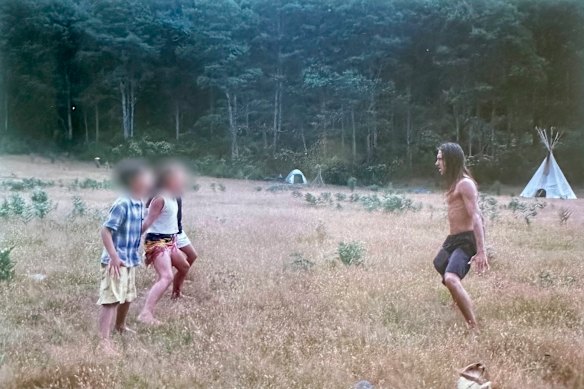
For bushmen like Freeman and Mallett, those wilds are full of hidden shelters and shortcuts – including waterfalls and abandoned huts – much of which went unsearched by the army of police who descended on Mount Buffalo during the manhunt, locals told this masthead.
“They went looking the wrong way,” says Mallett, who was raided by police early on at his home in Bright but cleared of involvement in helping Freeman evade authorities. “I always thought he’d go north, probably in a kayak, up the Murray river, and there they found him, up near the border. He ran rings around them.”
Jim Rech, a former friend of Freeman’s from the area, recalls years earlier Freeman pointing out key spots on Mount Buffalo – higher ground with “360-degree views” where Freeman suggested he had already hidden strategic stashes of supplies, should he ever need them.
“Dezi didn’t want to ever be caged. And he knew everything about that mountain,” says Rech, who was also raided repeatedly but found not to be helping Freeman. “He was prepared in his head. He was going to be gone where they’d never find him or go down fighting.
“His two favourite movies were Rambo and Dances with Wolves. But it’s been so hard on [his wife] Mali and his kids. I wish he’d thought more about that. I tried to warn him [he was] taking things too far.”

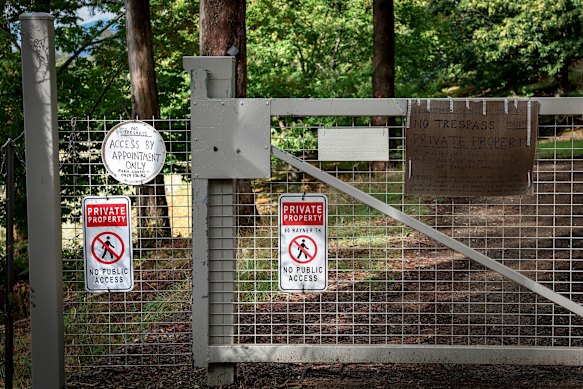
Many of those close to Freeman spoke of his recent stand-offs with child protection services, some of whom had surrounded the remote Porepunkah property where he was living before the August shooting, over concerns about homeschooling arrangements of his children.
Former friends cited his long-standing problem with female police officers, in particular, who he had thought “should be submissive”, as well as previous patterns of erratic behaviour that had forced him to move on from previous off-grid communities.
A risk assessment determined specialist officers weren’t needed that day in August to serve the warrant on Freeman – though such a trained squad would later handle the storming of his hideout near Walwa.
Even after the shooting – which followed the killing of two police officers and a neighbour by a family of conspiracy theorists in Wieambilla, Queensland, in 2022 – associates of Freeman insist the sovereign citizen movement isn’t dangerous.
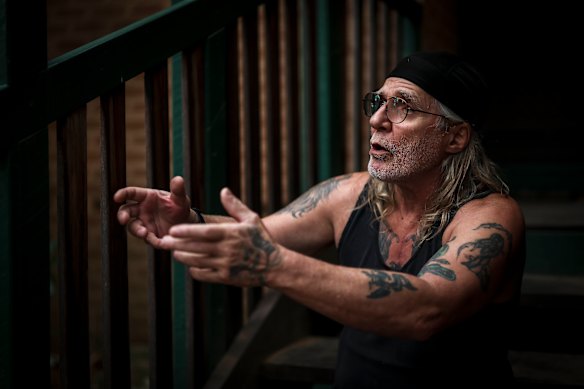
“It’s not like we’re running an organised militia up here,” says Mallett, though he admits some, including himself, are “prepping for the event of civil war”.
Mallet, Evans and Rech were among more than 100 people raided by police during the manhunt around Porepunkah, and say distrust in police there has never been higher.
“I snub my nose at all authorities, though, even sovereign citizens. I’m an outlaw biker,” says Mallett. But after a tactical squad descended on his house, Mallett says he nearly left town in shame.
“I thought they might shoot my dogs,” he says. “It shook me. And I didn’t want people scared to run into me in town. Instead, I became like a local hero, everyone wanted to say hi.”
Just don’t call Freeman a “sovereign citizen” here. Many locals baulk at the term, calling it an oxymoron. Some accuse the media of missing “the real story”, even as they decline to “divulge details”, at times citing unspecified “legal advice” or unproven conspiracy theories.
But then it can also be hard to tell when they are being serious.
Evans admits he’ll slip joke answers in even when speaking to police, always with a twinkle in his eye. A favourite gag when speaking to this masthead is pausing to “ask the guy hiding in my shed” for his opinion on Freeman. He gives his profession as a pole dancer with poorly attended shows.
But there is a genuine sadness about him when he considers how his friend’s war with police finally ended.
Freeman’s concerned family, the Filbys, had at last convinced him in to see a psychiatrist, after months of discussion, just days before the August shooting. Freeman never made it.
“God, it’s so sad,” Evans says.
But then he looks up, distracted. He could swear a local magistrate who Freeman once infamously tried to arrest just walked by our cafe.
Was that really him? Even Evans isn’t sure anymore.
Start the day with a summary of the day’s most important and interesting stories, analysis and insights. Sign up for our Morning Edition newsletter.


