








Opinion


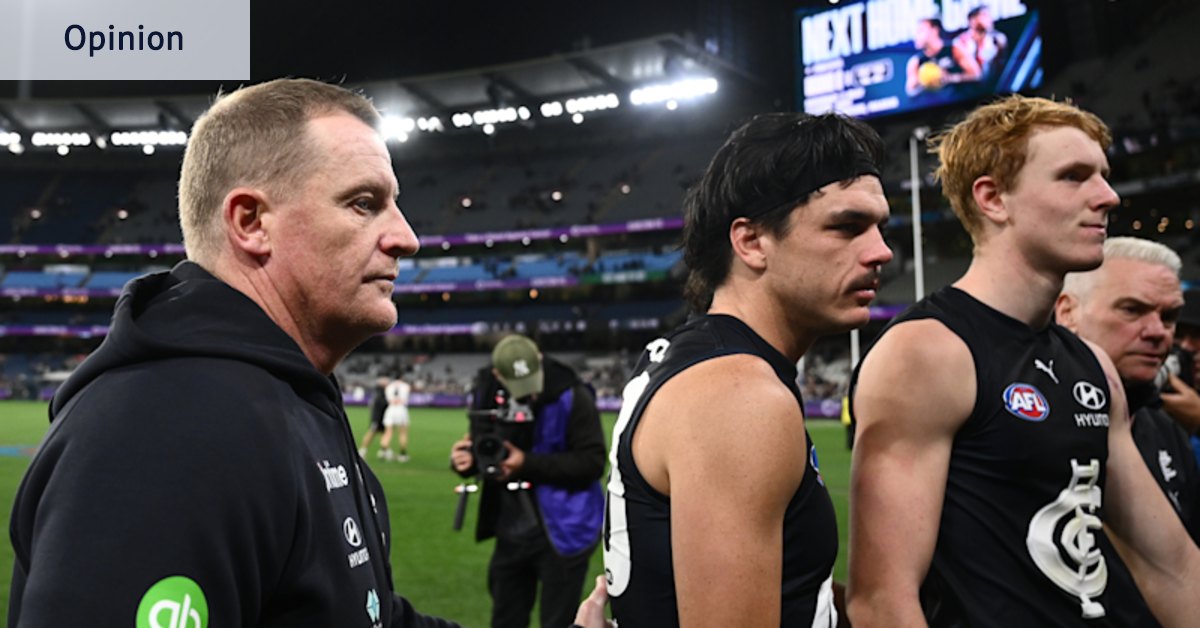
The question of why Carlton allowed Elijah Hollands to remain on the field for the majority of Thursday night’s close loss to Collingwood, when he was behaving erratically and could not perform to standard, will linger.
By Friday morning, the Blues had the mental health diagnosis that explained Hollands’ erratic movements, and rightly the club and the AFL made his welfare their paramount concern.
The Hollands episode is unusual, even though there have been numerous examples of AFL players who had severe anxiety during games.
Typically, those footballers either surmounted that ailment or they did not exhibit the kind of gestures that drew public attention to Hollands.
Hollands himself had experienced issues of this kind in the past during games, but had managed to overcome it and perform. This time, he could not.
The combination of his complete non-contribution in 60 per cent ground time and his erratic movements reflected poorly on Carlton, who, on the most basic reading of the facts, should have removed him from the field as soon as it was evident that he wasn’t capable of performing. And that was sooner than the final term.
The Hollands story is troubling for the Blues, far more so than the forsaking of another four premiership points after blowing a lead. It is incumbent on Carlton to explain, to the extent that they can, their decision-making that deemed him fine to stay on the ground. Without that explanation, it looks as if the club’s football systems failed Hollands, who was being filmed by fans in the middle of the MCG having a health episode in his very public workplace.
Hollands’ history of substance issues (he pleaded guilty to drug possession after being caught with cocaine in 2023) and the leave he took from the game last year for what he has called a “serious reset”, meant that fans immediately wondered if his episode was drug or alcohol-influenced. The Blues ruled that out and confirmed that it was mental health.
Hollands was aware during the game that he was having issues and communicated this to the club medicos. The club psychologist, who was not present, was dialled in to discussions, too.
Carlton, thus, followed standard procedures. The doctors are experts in Hollands’ health. Ditto the club psychologist.
None of us is privy to his medical/mental health information and background and it is not fair or wise to second-guess health professionals. This was not the Christian Petracca affair, when the player had a serious injury and was allowed back on the field for a short while.
But if the doctors assessed Hollands as fit to play during the game, and he had shared that something was amiss, this does not absolve the coaches, headed by Michael Voss, of responsibility for keeping him on.
Just as it is possible for a footballer to pass a concussion test, but soon prove to be unable to perform to his usual standard because of the blow, Hollands’ output and antics demonstrated that he was not capable on the night.
The problem, thus, was a football one. Hollands was given a pass to play by the experts who assess his health. The football experts – his coaches and possibly conditioning staff – could have made the that he was not capable sooner than the 20-minute mark of the final quarter, when he headed to the bench.
There is a mountain of information available to the coaches and support staff in the coaches’ box – such as GPS data measuring a player’s running and repeat efforts. The Blues should be asking why Voss and his lieutenants did not simply look at his output and recognise that he needed to be benched, for his sake and the team’s.
While there was no substance-use involved in the episode, it is still reasonable for Carlton and the AFL to ask whether medications or the non-use of them played any part in Hollands’ apparent disorientation.
The other factor that must be considered by the Blues and the AFL is the responsibility of the player. When precisely did Hollands realise that he was afflicted? Had he known something was awry before the game, he could have informed the club. Or was he not in the frame of mind to do so?
We do not know exactly what triggered the episode. What we know is that we haven’t heard the last of this strange story, in which there appears to be, at the least, a flawed football.
Keep up to date with the best AFL coverage in the country. Sign up for the Real Footy newsletter.


