









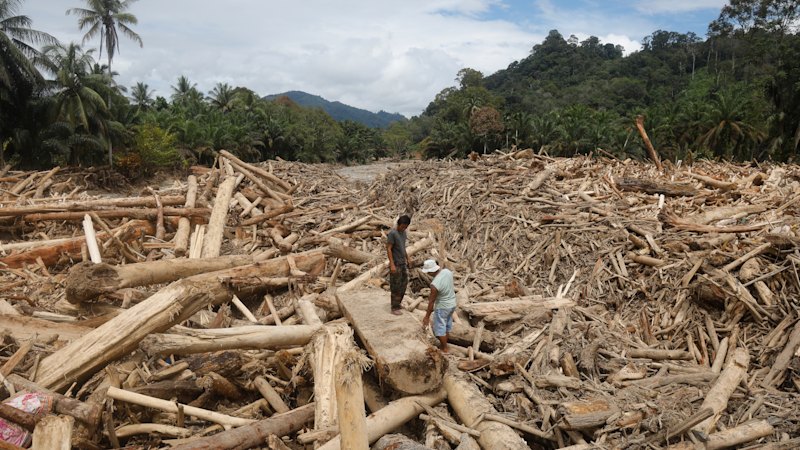
Despite the deaths and ongoing recovery mission, Prabowo has been reluctant to declare a national emergency. Doing so would unlock resources, remove bureaucracy and ease pressure on lower levels governments by centralising control at the national level.
Some regencies have written to their provincial governments warning that the disaster is beyond their budgets and logistical capacity.

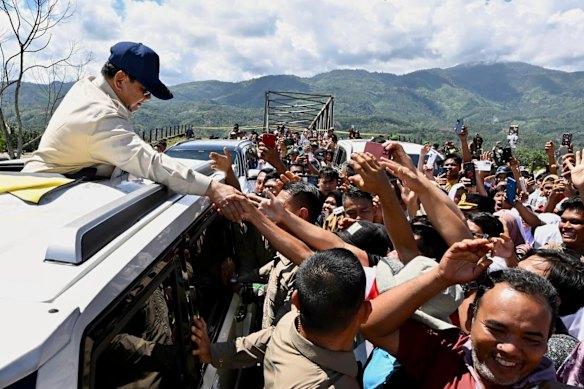
Indonesian President Prabowo Subianto greets flood survivors in Aceh on Monday.Credit: AP
“Considering the huge impact by the disaster and the regency’s limited ability in the form of logistics availability, equipment, human resources and budget, we are of the opinion that the Aceh provincial government needs to take over the emergency disaster response,” one regent wrote in a letter seen by this masthead.
Asked at a press conference on Wednesday why there was still no declaration of a national emergency, coordinating minister for human development and cultural affairs Pratikno, who goes by one name, said the president had ordered “all ministries and agencies” to “deploy all their resources at maximum”.
Prabowo told reporters this week he believed the “current measures” were “adequate”.
The last time disaster-prone Indonesia declared a national emergency was the COVID-19 pandemic. The time before that was the 2004 Boxing Day tsunami.
Green groups have pointed to large-scale deforestation as a factor behind the scale of destruction. Greenpeace Indonesia said the majority of river catchments on Sumatra were in critical conditions, citing forest-eating palm oil plantations, dryland agriculture and other land-hungry industries like hydropower as major causes.
The administration, however, has focused attention on illegal operations, announcing on Wednesday that it would get its forestry taskforce to investigate.
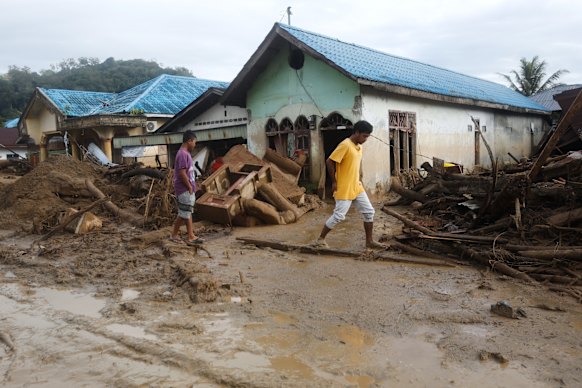
Survivors navigate the mud at a village affected by floods in Batang Toru.Credit: AP
On a tour of flood-hit regions of Sumatra this week, Prabowo called on local governments to play a bigger role in mitigating “extreme weather conditions that will arise from future climate change.”
This, too, may put pressure on regencies to find money where there is none.
“A special budget for future mitigation efforts will undoubtedly be a joint program between the central government and regional governments down to the district and city level,” said Muhammad MTA, the spokesman for Aceh’s provincial government.
“We do need budget support from the central government given the current regional fiscal situation.”
Prabowo has been vocal about the realities of climate change, even referencing it in his September speech to the United Nations General Assembly immediately after US President Donald Trump had called it a hoax.
But his budget priorities told a different story, according Dr Hilman Palaon from the Lowy Institute, an independent think tank.
Loading
“Climate change and disaster mitigation appear to be secondary concerns, overshadowed by other priorities,” he said.
“At the national level, the relevant ministries responsible for these issues have experienced budget cuts.
“Similarly, all local governments have seen reductions in their budget allocations, including those in disaster-prone areas that are most affected.”
The disaster in Sumatra is playing out as Sri Lanka comes to the terms with the flooding destruction wrought by Cyclone Ditwah. The death toll there so far is 465, while storms in southern Thailand late last month killed at least 185 people.
Get a note directly from our foreign correspondents on what’s making headlines around the world. Sign up for our weekly What in the World newsletter.


