









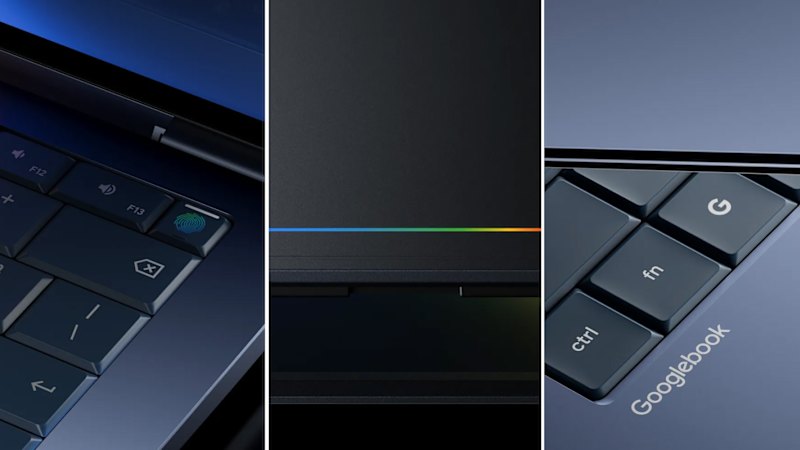


Google is hoping to compete with Apple’s MacBook and Microsoft’s Copilot+ PCs, introducing a new line of laptops built for Gemini AI and running on a hybrid of Android and ChromeOS.
These Googlebooks – which ironically may be tough to Google because they have a similar name to existing products Google Books and Google Play Books – will be manufactured by companies including Dell, Lenovo, HP, ASUS and Acer, and launch later this year. Google has not confirmed whether it will produce a model of its own, but all will run the same new operating system and feature a glowing rainbow bar on the lid.
Announced during this week’s Android Show, ahead of Google I/O next week, the laptops were positioned as Google’s “most advanced” and were shown to integrate deeply with Android phones. Users will be able to launch apps from their phone directly on the laptop as though they were installed locally, and will be able to browse files stored on their phone using the laptop’s interface.
Google also showed off a feature called Magic Pointer, with which users can shake the mouse cursor to activate Gemini, and then hover over any element on their screen to see suggestions or ask questions. Another new feature lets users describe a widget to Gemini and have it create something that lives on their home screen.
Google positioned these as innovations with endless potential, though examples shown stuck to tried and true AI demonstrations – outfit suggestions, flight tracking and restaurant bookings.
Google has given no indication of the devices’ likely price, or when and where they will roll out, but more details are expected later in spring.
Though details on the new laptops were light, we can surmise from previous leaks that Google’s new operating system maintains the strengths of ChromeOS, which powers the inexpensive web-based Chromebooks that have become popular in education, while being built on Android.
The machines will presumably be powered by modern mobile chips with significant neural processors, meaning local AI power for generating text and images without relying on the cloud.
That’s an important step up from Chromebooks, which rely on a web connection for just about everything. In the past two years, the market for mainstream laptops has shifted focus from thin and light ultrabooks to more capable and longer-lasting devices, which have also increasingly been marketed as AI workstations.
Windows PCs with powerful NPUs and a dedicated AI key have been released as Copilot+ PCs, while Apple has also increasingly integrated AI into its Macs, including the recent $900 MacBook Neo.

The gap in the market that Google hopes to address, then, is for an AI laptop that integrates closely with Android phones and Gemini. And while the Googlebooks will lack the rich ecosystem of apps found on Windows or MacOS, they may close the gap significantly with web apps and Google’s Play Store for Android apps.
Google has a chance to build AI “into the laptop in a different way that no one else has really hit on,” said the company’s president of Android, Sameer Samat, in an interview with Bloomberg. “There is an opportunity to bring more innovation back to laptops, especially at the higher end.”
Also at the Android Show, Google revealed a new agentic form of Gemini that will live in more powerful devices, which it dubbed Gemini Intelligence. The system will do things like filling out forms for you, refining transcriptions as you speak to send clearer voice-to-text messages, and grabbing insights from your calendar and previous messages to offer replies and suggestions.
Personal Intelligence, the Google feature that allows Gemini to draw from data in your various apps for context, has also launched in Australia after its US release earlier this year. It’s off by default, and requires users to have a paid Google subscription at the AI Plus tier ($12.50 per month) or higher.
Get news and reviews on technology, gadgets and gaming in our Technology newsletter every Friday. Sign up here.


