


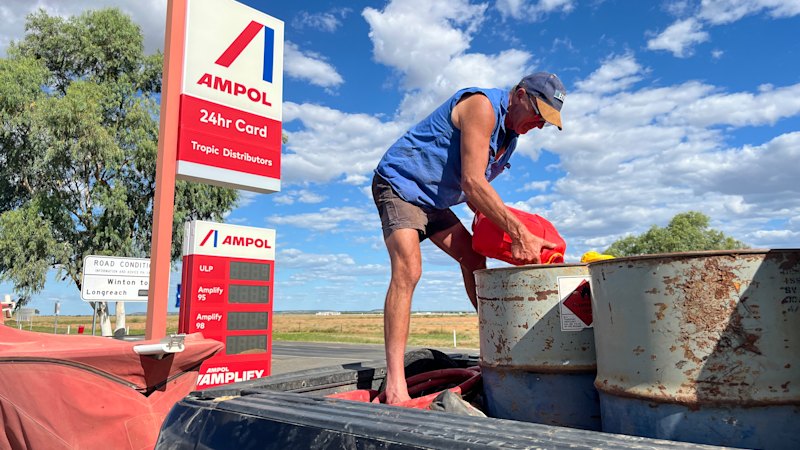






The federal government is poised to announce an emergency fuel plan to safeguard supplies to the most critical areas of our economy – starting with the bush and the trucking industry before including ambulances and garbage trucks if the crisis deepens.
The Saturday Telegraph understands the plan will be announced within days after the state government reported one in six servos running out of one type of fuel and 60 running dry completely.
Top priority will be to secure fuel for farmers, but a cut to fuel excise has been virtually ruled out because it would drive up demand.
Premier Chris Minns and other state and territory leaders want the federal government to lead the national response to the crisis. The state government has already begun planning its own emergency response, including potential rationing and prioritising fuel for ambulances and garbage trucks.
Angry farmers have lashed the Prime Minister for moving too slowly, and warned shortages of both fuel and fertiliser will drive up prices on supermarket shelves.
Prime Minister Anthony Albanese on Friday said Australia’s “fuel supply outlook remains secure” in the near term but the crisis needs “a national response” that does not repeat mistakes made in haste during the Covid pandemic.
“One of the lessons of the Covid pandemic is that we made a number of decisions as a nation that could have been made better if there was proper consideration,” he said.
Mr Albanese said Monday’s national cabinet meeting with state and territory leaders would ensure mistakes made during “Covid do not recur” and “that we have a truly national co-ordinated response”.
A high-level government source said that meant there would be no sweeping mandates, such as ordering people to work from home, and every state and territory would follow the same guidelines.
Over the weekend Mr Albanese and Energy Minister Chris Bowen will be war-gaming all options and their long- term implications.
It is understood the first priority will be to ensure fuel reaches farmers and truck drivers to secure the nation’s food supply.
It could then follow New Zealand’s four-phase national fuel plan, unveiled on Friday, where phase two encourages homes, businesses and the public sector to conserve fuel. Phase three prioritises fuel to emergency services and phase four brings in strict intervention.
The government is also looking at a national dashboard to provide daily updates on which petrol stations still have fuel.
The source said cutting fuel excise, as demanded by Opposition Leader Angus Taylor, was not a serious option because the high price was helping to restrict demand.
Mr Albanese said the Coalition’s demands would also make electricity more expensive.
“I don’t think there’s anyone out there today who has bought an electric vehicle who’s regretting the decision at this point in time,” he said.
But the comment brought an angry response from NSW Farmers President Xavier Martin, who said the next time the PM speaks it should be to “tell all Australians country fuel tanks have been filled”.
“The Prime Minister and (Energy Minister) Chris Bowen seem to have no idea what’s going on outside of the Canberra bubble, and their dismal failure to understand the fundamentals of Australia’s fuel and food supply and security has led us to this point,” Mr Martin said.
Furious Eugowra farmer Lachlan Noble said Mr Albanese needed “to get out of his city bubble” and understand why the lack of diesel and fertiliser meant he was planting only 75 per cent of his fields.
“Diesel fuel is our lifeblood,” he said. “An electric tractor is not going to work out here.
“My daughter has a 400km round trip just to play sport – an electric car is not going to cover those distances.”
The Telegraph understands the shortage of diesel in regional areas has been exacerbated by a resources giant stockpiling enormous reserves.
National Road Transport Association chief executive Warren Clark called for immediate action, including emergency financial support for trucking companies and a moratorium on heavy vehicle loan repayments.
“Businesses are going under now – not in weeks, not in months. Today. Drivers are having fuel cards declined,” he said.
“This is happening right now and, if we don’t see action, it will be too late.”
Griffith truckie Abner Leauma said he had to hunt for an open service station and then had to queue for 20 minutes to fill up on overpriced diesel.
“It’s affecting everyone because someone’s going to pay for the price going up,” he said.
NSW Farmers economist Sam Miller warned the shortage of diesel and fertiliser would push prices up beyond the jumps caused by the start of the Ukraine war that increased the cost of bread by a third.
Originally published as Fuel crisis deepens as PM prepares national plan to protect supply lines


