


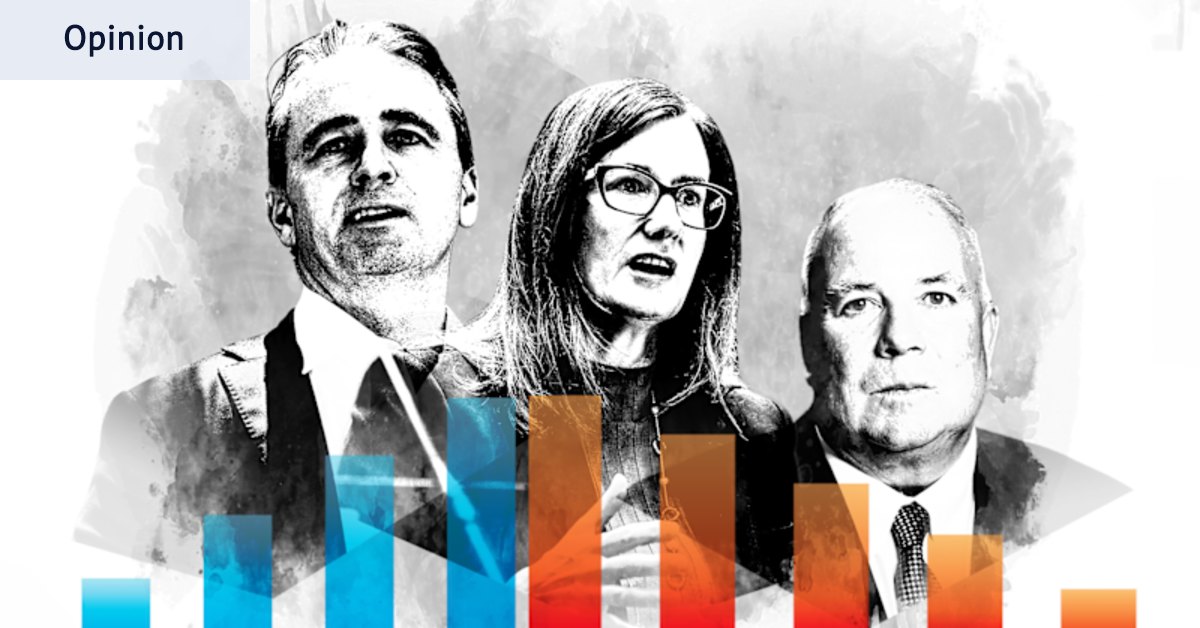
Hold on for the ride. Only halfway through week one of Australia’s earnings season, and already we have two chief executive beheadings and a third head crowned with a halo.
This is a story of the good, the bad and the very ugly. In order, I am referring to the Commonwealth Bank, biotechnology giant CSL, and Australia’s own corporate train wreck, the Australian Securities Exchange.
These are not any small Johnny-come-lately corporations at the risky end of the market. These three companies will feature heavily in most people’s superannuation portfolios, so their performance matters.
Only five years ago, CSL held the title of Australia’s largest company, based on market capitalisation, and one of the most successful in our history.
The Commonwealth Bank now boasts that leadership position, and the ASX runs our equities market, which is a nationally vital piece of infrastructure.
The fortunes of ASX and CSL have been plagued by some back luck and management mistakes for which their respective leaders paid with their jobs.
In stark contrast, CBA managed a robust result even in the face of intense banking competition. Its chief executive Matt Comyn has provided a masterclass in management.
On Tuesday night, CSL’s chief executive Paul McKenzie’s employment was abruptly cut – effective immediately.
Blue-chip companies of this size and pedigree rarely behave in such a chaotic way. Governance changes are carefully choreographed, telegraphed and stage-managed with permanent replacements lined up for smooth succession.
CSL’s change of the guard looked knee-jerk and desperate.
Despite the CSL board barrage of thanks to McKenzie, appreciation and lists of achievements which punctuated the announcement of his departure, by Wednesday morning the reasons for the shock change in leadership were abundantly clear, as was the urgency to inject new management blood.
CSL’s half year earnings were down 81 per cent and there was nowhere to hide from a conga line of angry and disappointed investors, who sent the share price into a 7 per cent downward tailspin.
Sure, the culprit was one-off impairments of $US1.1 billion ($1.55 billion), but they relate to ongoing problems in two of its major divisions. The first is Vifor, which makes products to deal with iron deficiency – its performance is being challenged by competition from generic products flooding the market.
The second is the vaccines business Seqirus, which is feeling the brunt of the Trump regime’s allergy to vaccines which has been driven by Health Secretary Robert F. Kennedy Jr.
And then China followed with a regulatory change which resulted in a decline in CSL’s vital albumin sales – which was responsible for exports of plasma to China falling precipitously.
Even without the writedowns from asset impairments, the result was down 7 per cent, giving voice to investors that had serious questions about CSL’s $US11.7 billion acquisition of Vifor in 2022.
CSL admits that the timing of that acquisition wasn’t great – which is code for it overpaying for the asset.
But it is the Australian Securities Exchange that deserves the “ugly” title in this three-horse line-up.
Its chief executive, Helen Lofthouse, is also headed for the exit door after only four years in the top job, with no replacement in sight and two days before it is due to release its results.
She represents the latest casualty in a decade of carnage at the company, which has struggled with a series of disasters in the replacement of its CHESS trading system.
Arguably it was the corporate regulator, the Australian Securities and Investments Commission’s (ASIC) recent report card that sealed her fate.
In December, it went so far as to question the company’s right to operate Australia’s national stock exchange, accusing it of prioritising short-term profit performance over the management of this vital infrastructure and branding its management as “insular and defensive” with significant deficiencies in culture, governance and technology.
ASIC additionally demanded that the ASX hold another $150 million in liquid assets to improve the robustness of its financial position.
The regulator highlighted the “bungled” and abandoned CHESS replacement project (which cost $250 million) and other outages as evidence of deeper issues.
Against that backdrop, the replacement of Lofthouse was already ordained.
The Business Briefing newsletter delivers major stories, exclusive coverage and expert opinion. Sign up to get it every weekday morning.
